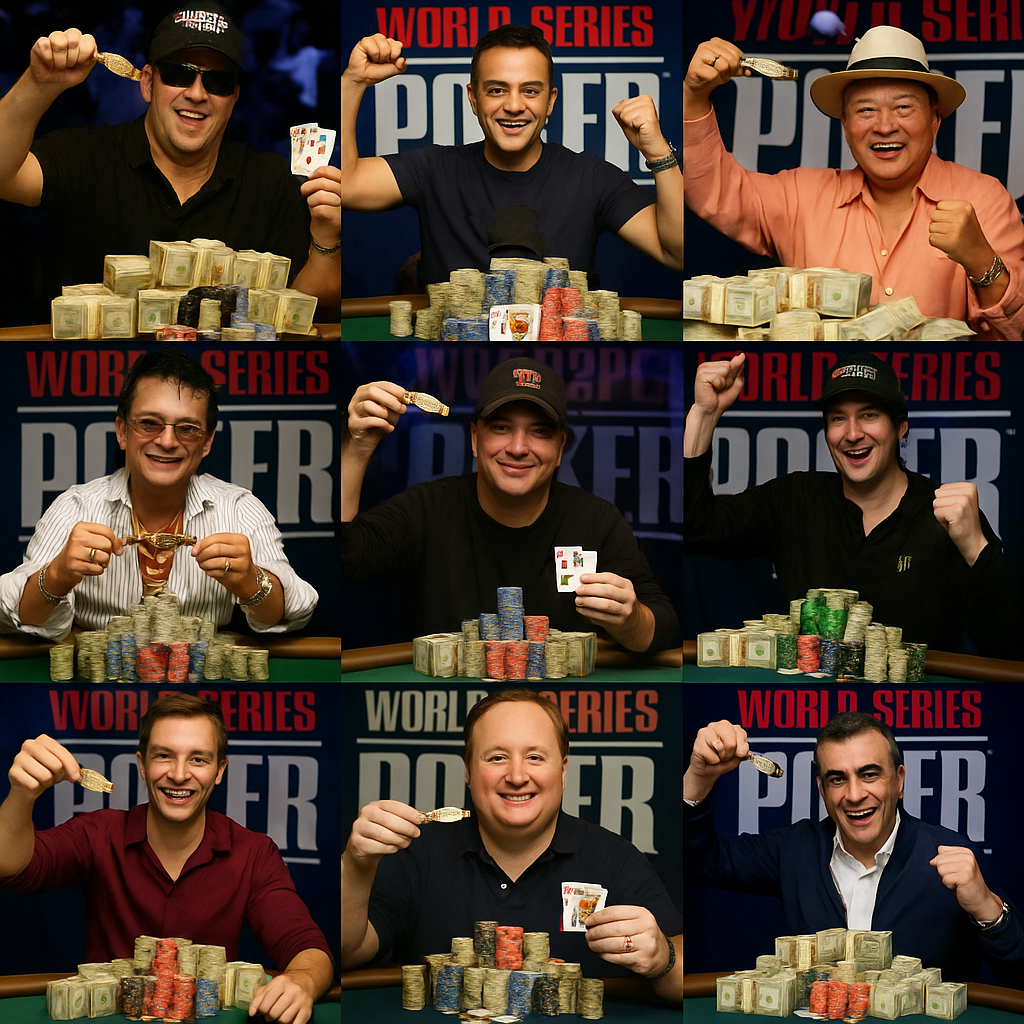
The Complete History of WSOP Texas Hold’em Main Events

The World Series of Poker Main Event stands as poker’s ultimate championship, transforming from a seven-player gathering in 1970 to a 10,112-player spectacle in 2024. This comprehensive examination reveals how iconic victories, memorable hands, and pivotal moments shaped not just tournament poker, but an entire global industry worth billions. From Benny Binion’s publicity stunt to today’s $94 million prize pools, the Main Event has created sports’ most democratic championship – where an $86 online qualifier can defeat seasoned professionals for millions.
Key Takeaways
- 1970: Benny Binion creates WSOP with 7 players; Johnny Moss wins by vote
- 1972: $10,000 buy-in freeze-out format established, unchanged for 52 years
- 2003: Chris Moneymaker’s $86 satellite victory triggers poker boom
- 2024: Record 10,112 entries generate $94,041,600 prize pool
- Total Impact: Over $1.3 billion awarded to 17,316 players throughout history
From Benny’s Gamble to Poker’s Greatest Stage
Benny Binion’s 1970 creation at Binion’s Horseshoe Casino began as little more than a publicity stunt. Seven players gathered for what was essentially a series of cash games, with Johnny Moss crowned champion by peer vote after everyone initially voted for themselves. The $10,000 buy-in freeze-out format, established in 1972, has remained unchanged for 52 years – though inflation means today’s entry fee represents roughly one-eighth the original’s purchasing power.
The tournament’s growth trajectory tells poker’s evolution story. From 6 players in 1971 paying $5,000 each, the field expanded modestly through the 1970s and 1980s, reaching 178 players when Phil Hellmuth defeated Johnny Chan in 1989. The introduction of satellite qualifiers and hole card cameras in 2002 set the stage for poker’s defining moment: Chris Moneymaker’s 2003 victory, which triggered field sizes to explode from 839 to 8,773 players by 2006.
The venue evolution mirrors this growth. After 35 years at Binion’s Horseshoe, the tournament moved to the Rio in 2005 to accommodate massive fields. The 2022 transition to Paris Las Vegas and the rebranded Horseshoe Las Vegas brought the event back to the Strip, where record-breaking fields of 10,043 (2023) and 10,112 (2024) have competed for prize pools exceeding $94 million.
Champions Who Defined Poker Greatness
Stu Ungar’s three Main Event victories (1980, 1981, 1997) remain unmatched in the freeze-out era, with his 1997 comeback representing perhaps poker’s greatest redemption story. Broke and physically damaged from years of drug addiction, Ungar received his entry fee from Billy Baxter moments before registration closed, then proceeded to win $1 million from a field of 312 players. His final hand – hitting a straight on the river with A♠4♣ against John Strzemp’s A♥8♥ – completed one of sport’s most improbable comebacks.
Johnny Chan’s back-to-back victories in 1987-1988 produced poker’s most famous hand, immortalized in the movie “Rounders.” Chan flopped the nut straight with J♣9♣ against Erik Seidel’s top pair, then masterfully trapped his opponent through the turn before collecting Seidel’s all-in on the river. Chan came within one hand of an unprecedented three-peat in 1989, losing to 24-year-old Phil Hellmuth, who became the youngest champion at the time.
Doyle Brunson’s consecutive championships in 1976-1977 created poker legend through sheer coincidence. Both victories came with 10-2 as his final hand – first 10♠2♠ making a full house against Jesse Alto, then 10♥2♥ repeating the feat against Gary “Bones” Berland. The hand became forever known as “The Doyle Brunson” in poker vernacular.
| Champion | Years Won | Total Earnings | Legacy |
|---|---|---|---|
| Johnny Moss | 1970, 1971, 1974 | $246,000 | First champion; 1970 by vote |
| Stu Ungar | 1980, 1981, 1997 | $1,745,000 | Only 3-time freeze-out champion |
The Moneymaker Revolution and Its Aftermath
Chris Moneymaker’s 2003 triumph fundamentally transformed poker from niche gambling activity to mainstream entertainment. The Tennessee accountant qualified through an $86 PokerStars satellite (often misreported as $39), then navigated through 839 players to win $2.5 million. His stone-cold bluff against Sam Farha – moving all-in with K♣7♦ on a board showing 9♣6♠2♠8♠3♥ while Farha held Q♠9♣ – became known as the “bluff of the century” after Farha folded his pair of nines following a 20-minute tank.
The “Moneymaker Effect” produced staggering growth: 2,576 players in 2004 (tripling the field), 5,619 in 2005, and 8,773 in 2006 when Jamie Gold won a record $12 million. PokerStars reported doubling their user base from 50,000 to 100,000 immediately following Moneymaker’s victory. The boom continued until Black Friday – April 15, 2011 – when the Department of Justice shut down PokerStars, Full Tilt Poker, and Ultimate Bet for U.S. players.
Despite fears of collapse, the 2011 Main Event still attracted 6,865 players, though long-term effects proved significant. American online participation plummeted, with the industry declining to 40% of its pre-Black Friday peak. Recovery came slowly until the COVID-19 pandemic forced innovation: a unique hybrid format with separate online brackets on GGPoker (international) and WSOP.com (domestic), culminating in Damian Salas defeating Joseph Hebert in a special heads-up finale for the title.
Hands That Changed Poker History
The 2008 clash between Motoyuki Mabuchi and Justin Phillips produced statistically the most improbable hand in WSOP history. On a board of A♥9♣Q♦10♦A♦, Mabuchi’s A♠A♣ gave him quad aces – only to lose to Phillips’ K♦J♦ royal flush. The roughly 1 in 2.7 billion probability of this confrontation epitomizes poker’s capacity for the extraordinary.
Scotty Nguyen’s 1998 victory featured poker’s most famous quote. With the board showing 8♣9♦9♥8♥8♠, Nguyen moved all-in holding J♦9♣ for the superior full house while telling Kevin McBride, “You call, it’s gonna be all over, baby!” The phrase became poker’s most recognizable catchphrase, embodying the game’s psychological warfare.
The 2018 heads-up battle between John Cynn and Tony Miles set duration records with 199 hands over 10 hours. The marathon ended when Cynn’s K♣J♣ flopped trips against Miles’ Q♣8♥, with Miles shoving the turn after making two pair. Miles initially accused Cynn of slow-rolling but later apologized after reviewing the hand.
| Year | Players | Hand | Significance |
|---|---|---|---|
| 1988 | Chan vs Seidel | J♣9♣ vs Q♣7♦ | “Rounders” immortalized hand |
| 1998 | Nguyen vs McBride | J♦9♣ vs Q♥10♦ | “All over, baby!” quote |
| 2003 | Moneymaker vs Farha | K♣7♦ vs Q♠9♣ | “Bluff of the century” |
| 2008 | Phillips vs Mabuchi | K♦J♦ vs A♠A♣ | Royal flush vs quad aces |
Records That Define Excellence
Joe Cada’s 2009 victory at 21 years, 357 days established the youth record unlikely to be broken given current age restrictions. At the opposite extreme, Johnny Moss won in 1974 at 66 years, 358 days, a mark that stood for nearly five decades. The age spectrum demonstrates poker’s unique competitive landscape where experience can match youthful aggression.
Barbara Enright’s fifth-place finish in 1995 remains the highest female Main Event finish, a distinction now spanning 30 years. She earned $114,180 while becoming the first woman to win an open WSOP event and eventually the first female Poker Hall of Fame inductee. The achievement’s longevity underscores both its significance and the challenge female players face in predominantly male fields.
Field size records chronicle poker’s growth: from 2006’s 8,773 players (a record that stood 17 years) to 2024’s 10,112 entries generating $94,041,600 in prize money. The largest first prize remains Daniel Weinman’s $12.1 million in 2023, surpassing Jamie Gold’s long-standing 2006 record by $100,000.
Heartbreak at Poker’s Biggest Stage
Sam Farha’s 2003 runner-up finish epitomizes championship heartbreak. The seasoned professional entered heads-up as the heavy favorite against amateur Moneymaker, having consumed “20 Red Bulls and 20 cups of coffee” to maintain focus. After folding to Moneymaker’s legendary bluff, Farha later reflected: “It was the worst bluff of the year, but it worked for one reason: I bluffed myself out.”
T.J. Cloutier’s career represents the ultimate “what if” narrative. Despite four Main Event final tables and two runner-up finishes (1985, 2000), he never captured the title. His 2000 loss proved especially cruel when Chris Ferguson’s A♠9♦ spiked a nine on the river to crack Cloutier’s A♠Q♦. Dewey Tomko similarly finished second twice (1982, 2001), including a devastating loss when Carlos Mortensen’s K♣Q♦ made a river straight against Tomko’s pocket aces.
The bubble boy phenomenon creates unique agony. Phil Ivey’s 10th-place finish in 2003 denied poker’s most talented player his only realistic Main Event final table shot. Recent bubble boys receive consolation through free entries to the following year’s tournament, acknowledging the cruel nature of finishing just outside life-changing money.
Statistical Milestones and Modern Evolution
Only four players have won consecutive Main Events: Johnny Moss (1970-71), Doyle Brunson (1976-77), Stu Ungar (1980-81), and Johnny Chan (1987-88). No player has achieved this feat since 1988, highlighting increased competition and field sizes. Moss and Ungar remain the only three-time champions, with Ungar’s achievements coming in the modern freeze-out format.
Phil Hellmuth’s 17 WSOP bracelets dwarf his Main Event competitors, though his 1989 victory remains his only Main Event title. His defeat of two-time defending champion Johnny Chan prevented poker’s only three-peat opportunity, forever altering championship history.
The November Nine era (2008-2016) created a unique dynamic where final tables were delayed four months for television production. This format produced memorable moments but ultimately proved unsustainable, with the tournament returning to its traditional July completion in 2017.
Modern innovations include the Big Blind Ante format introduced in 2019, speeding gameplay by eliminating individual ante collection. The $500 million purchase of WSOP by NSUS Group (GGPoker’s operator) in August 2024 signals potential global expansion, with GGPoker already sending over 1,000 qualifiers to the 2024 Main Event.
| Year | Entries | Prize Pool | First Prize |
|---|---|---|---|
| 1970 | 7 | N/A (vote) | N/A |
| 1972 | 8 | $80,000 | $80,000 |
| 1989 | 178 | $1,780,000 | $755,000 |
| 2003 | 839 | $7,987,500 | $2,500,000 |
| 2006 | 8,773 | $82,512,162 | $12,000,000 |
| 2024 | 10,112 | $94,041,600 | $10,000,000 |
Frequently Asked Questions
The WSOP Main Event’s evolution from Benny Binion’s seven-player gathering to today’s 10,000+ player championships mirrors poker’s transformation into a global phenomenon. Through iconic champions like Ungar’s three titles, revolutionary moments like Moneymaker’s amateur triumph, and devastating heartbreaks like Cloutier’s near-misses, the tournament has created sports’ most democratic championship – where an $86 online qualifier can defeat seasoned professionals for millions.
The verified statistics tell a remarkable story: over $1.3 billion awarded to 17,316 players, with prize pools growing from zero in 1970 to $94 million in 2024. Yet beyond numbers, the Main Event represents poker’s unique appeal – a test where psychology, mathematics, and fortune converge to crown a champion whose name joins Moss, Ungar, Brunson, Chan, and Moneymaker in poker immortality. As fields push toward 15,000 players and prize pools approach $100 million, the next chapter of WSOP history awaits its author at the felt.
Leave a Reply