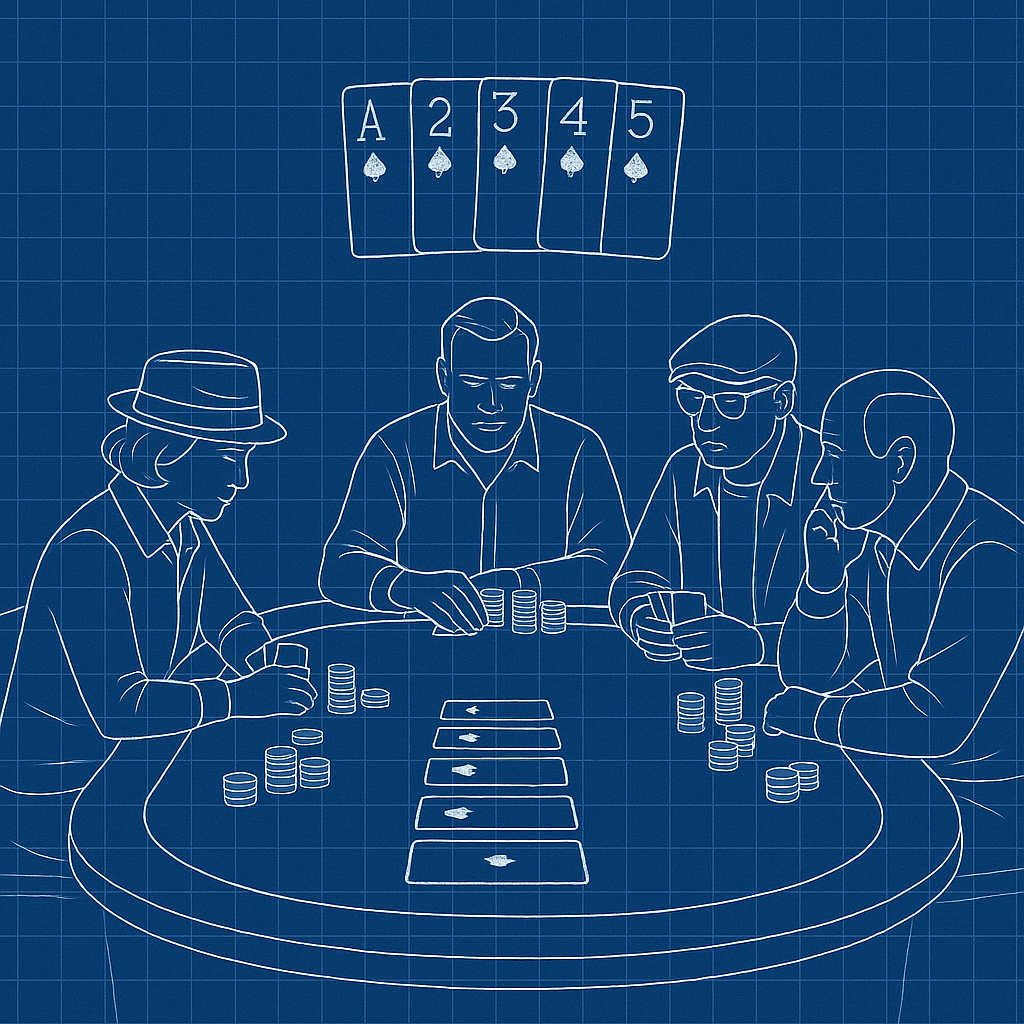
Razz Poker Strategy Evolution: From Early Days to Modern Championships

Razz poker strategy has transformed dramatically since the early 1900s. What began as simple lowball play evolved into today’s sophisticated game of mathematical precision and dead card mastery. This journey through Razz history reveals how legendary players shaped modern tactics.
Key Takeaways
- Early 1900s: Razz emerges as a lowball variant of Seven Card Stud
- 1971: Jimmy Casella wins first WSOP Razz bracelet for $10,000
- 1990s: Ted Forrest revolutionizes strategy with contrarian “Professor Backwards” approach
- 2004: T.J. Cloutier’s ESPN-televised win sparks online poker boom
- 2025: Modern Razz features sophisticated math, tracking tools, and mixed game integration
- Future: Continued growth through mixed games and online innovation
Historical Origins and WSOP Foundation
Razz poker has been played since the early 20th century. The game developed as a lowball variant of Seven Card Stud, gaining popularity in American card rooms through the 1900s. Military bases spread the game during both World Wars.
Competitive Razz found its home at Binion’s Horseshoe in Las Vegas. The game appeared during the inaugural 1970 World Series of Poker. Jimmy Casella won the first official WSOP Razz bracelet in 1971, taking home $10,000 (source).
Crandell Addington called Casella “might have been the best Razz player around at the time.” Casella won again in 1974. He became the first player to win the first two events of a single WSOP. Razz was absent from the 1972 schedule but has appeared every year since 1973.
California’s lowball culture shaped parallel strategic development. Gardena card rooms in the 1970s created their own approaches. California lowball used a joker while tournament Razz didn’t. These regional differences influenced modern starting hand strategies.
Strategic Pioneers Who Changed the Game
Ted Forrest stands as the greatest Razz player ever. His “Professor Backwards” style confused traditional players. A breakthrough 25-hour session at the Bicycle Casino in 1991 launched his career. He won over $20,000 against wealthy amateurs that day.
Forrest captured six WSOP bracelets. His Razz championships came in 1993 and 2014 (source). His philosophy? “Raise when others would call and vice-versa.” This contrarian thinking revolutionized the game.
Barry Greenstein brought mathematical rigor to Razz third street play. His mathematics and computer science background shaped analytical approaches. “Ace on the River” (2005) combined strategy with psychology. Three WSOP bracelets include the 2008 $1,500 Seven Card Razz (source).
Jennifer Harman broke barriers in high-stakes poker. She became the first woman with two open-event WSOP bracelets. Her published Razz tips emphasized dead card tracking and steal opportunities. She demonstrated that mathematical precision beats “feel” players (source).
From Basic to Sophisticated Strategies
Early Razz strategy was simple. Play premium three-card hands like A-2-3. Hope to complete strong lows. Players ignored opponents’ boards and dead cards.
Third street evolved dramatically. Basic “play any three cards 8 or lower” became obsolete. Point systems now account for dead cards, position, and betting action. The Gap Concept emerged—you need stronger hands to call than to raise.
Fourth street became the critical decision point. Completing to four good cards dramatically increases equity. Fifth street marks the “point of no return” with double betting. Counting visible outs changes equity calculations dramatically here.
Critical Strategic Evolution Points
- Third Street: From simple 8-or-better to complex point systems
- Fourth Street: Recognized as the most critical decision point
- Fifth Street: The “point of no return” with double betting
- Later Streets: Lock situation recognition and pot odds mastery
Mathematical and Theoretical Breakthroughs
David Sklansky transformed poker theory. “The Theory of Poker” and “Sklansky on Poker” established mathematical frameworks. His Fundamental Theorem applies perfectly to Razz decisions (source).
Modern math focuses on equity against ranges. Raw starting hand equity matters less than dead card implications. Drawing hands can have massive equity against made hands in multiway pots. Understanding board texture and upcard info became essential.
Mitchell Cogert’s “Play Razz Poker to Win” (2008) introduced breakthrough concepts. PokerStars chose it for worldwide player education. Point systems evaluate hands based on position, board texture, and action.
Unlike Hold’em, Razz lacks commercial solver development. The game remains primarily exploitative. Technical challenges and limited demand prevent GTO solutions. This creates opportunities for thinking players.
The 2004 Online Revolution
T.J. Cloutier’s 2004 WSOP Razz victory changed everything. ESPN televised the final table. Online sites scrambled to add Razz games. Full Tilt Poker reportedly became the first to offer online Razz.
Volume exploded online. Players saw 60-80 hands per hour versus 20-30 live. Years of experience compressed into months. Tracking software emerged for systematic analysis.
PokerTracker Stud (now discontinued) revolutionized dead card tracking. FPDB (Free Poker Database) provided free alternatives. HUD statistics helped profile opponents. ProPokerTools.com enabled post-session equity analysis.
Online specialists created educational content. Christopher George (Ceegee87) analyzed SCOOP tournaments at Run It Once. The platform’s MIXED Learning Path offers 84+ hours of instruction. Faster iteration cycles refined concepts rapidly.
Major Tournaments and Championships
The WSOP Razz Championship attracts elite competition. Two tiers serve different player pools. The $1,500 event provides broader access. The $10,000 Championship tests elite skills.
| Year | Event | Winner | Prize | Entries |
|---|---|---|---|---|
| 2025 | $10,000 Championship | Brian Rast | $306,644 | 134 |
| 2025 | $1,500 Razz | Allan Le | $126,363 | 472 |
| 2024 | $10,000 Championship | George Alexander | $282,449 | 123 |
| 2024 | $1,500 Razz | Scott Seiver | – | – |
Jeff Lisandro’s 2009 “Stud Triple Crown” remains legendary. He won all three stud bracelets (Seven-Card Stud, Stud Hi-Lo, and Razz) in one year. This feat earned him Player of the Year honors.
Multiple Player of the Year winners included Razz victories. Frank Kassela (2010), George Danzer (2014), and Scott Seiver (2024) all demonstrated mixed-game mastery. Field sizes grew from 195 in 2004 to 472 in 2025’s $1,500 event.
Modern Strategic Concepts
Contemporary Razz strategy goes far beyond basics. Board reading involves multiple levels. Track dead cards to calculate improvement odds. Recognize when draws strengthen or weaken. Construct ranges based on betting patterns and exposed cards.
Ante stealing evolved dramatically. Simple door card comparisons became obsolete. Modern stealing considers player types, entire table texture, and proper defense frequencies. Position changes each street based on board strength.
Bluffing exists despite exposed information. Representation bluffing leverages strong-looking boards. Semi-bluffs with draws create fold equity. Timing depends on opponent tendencies and board textures. Limited fold equity requires precise spot selection.
Modern players master multi-street bluff timing. They understand lock situations perfectly. River calling frequencies follow pot odds precisely. Every decision incorporates dead card implications.
Integration into Mixed Games
Razz thrives in mixed formats. As the “R” in H.O.R.S.E., it offers specialists huge edges. Many strong players struggle with lowball concepts. Fixed-limit structure across all games creates unique dynamics.
PokerStars innovated with 8-Game Mix. The format includes both limit and big-bet games (T-H-O-R-S-E-H-A). Six-max tables rotate games every six hands. Stakes vary based on liquidity and player pools.
The $50,000 Poker Players Championship features nine games. Razz mastery proves essential for success. Michael “The Grinder” Mizrachi won four times (2010, 2012, 2018, 2025). His Razz excellence contributed to each victory (source).
Strategic adjustments in mixed games include increased stealing against uncomfortable opponents. Value bet aggressively against recreational players. Focus intensely on dead cards while others lose concentration. Wait patiently for premium spots.
Master Modern Razz Strategy
Ready to improve your Razz game? Explore our comprehensive guides:
- 📚 Complete Rules & Rankings
- 🎯 Seventh Street Decisions
- 💡 Handling Bricked Hands
- 🏆 Comprehensive Razz FAQ
For online play, check our SwC Poker review for mixed game options.
Current State and Future Trajectory
Today’s Razz landscape reflects niche appeal with enduring popularity. PokerStars dominates online offerings. Stakes vary based on liquidity. Most action occurs within HORSE or 8-Game formats. Standalone Razz remains limited outside micro-stakes.
Training resources expanded significantly. Run It Once offers 84+ hours of mixed game content. George Danzer and other pros provide detailed instruction. Upswing Poker’s Mixed Game Mastery covers fundamentals through advanced concepts. YouTube creators introduce new players regularly.
The future looks promising for dedicated students. Online poker continues steady growth worldwide. Mobile gaming expands player pools. Razz maintains exploitative focus unlike solver-dominated games. This creates sustainable edges for thinking players.
Strategic development continues through human innovation. Professionals refine concepts through high-volume play. Multi-street equity calculations improve constantly. Stealing frequencies and betting patterns evolve. The game rewards those who study its unique challenges.
Frequently Asked Questions
Looking Forward: The Continuing Evolution
Razz poker strategy continues evolving through human innovation. From early 20th century origins to modern championships, the game rewards deep study. Mathematical precision meets psychological warfare at every street.
The game’s integration into mixed formats ensures survival. Specialists maintain edges through superior fundamentals. Strategic development accelerates through online play and analysis. Professionals refine concepts daily.
Understanding Razz history provides crucial context for modern play. Ted Forrest’s contrarian approaches still work. Barry Greenstein’s mathematical frameworks guide decisions. Jennifer Harman’s dead card emphasis remains vital. These pioneers created foundations for today’s sophisticated strategies.
Razz remains poker’s most intellectually rewarding stud game. The lack of solver solutions preserves strategic diversity. Every session offers learning opportunities. Master this variant and dominate mixed games forever.
About the Author
Mixed Game Masters Editorial
Published: August 12, 2025 | Categories: Strategy & History, Draw & Lowball
Mixed Game Masters is the premier resource for non-Hold’em poker strategy, tournament coverage, and mixed game education. Our editorial team consists of experienced players and poker historians dedicated to preserving and sharing the rich history of poker’s most challenging variants.
We provide comprehensive coverage of stud games, lowball variants, and mixed game formats, helping players of all levels improve their skills beyond traditional No-Limit Hold’em.
Leave a Reply