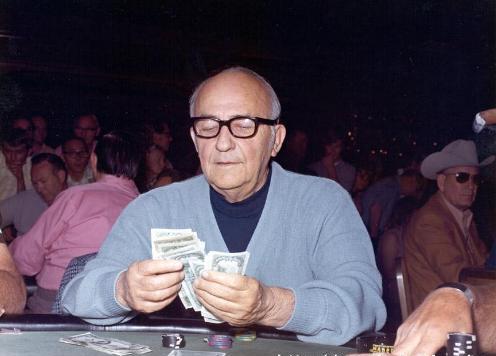
Johnny Moss History: First WSOP Champion’s Legacy

Johnny Moss stood as poker’s bridge between two worlds – from dangerous Texas road gambling to the bright lights of Las Vegas, from underground games to legitimate tournament play. Born May 14, 1907, in Marshall, Texas, the man who would become poker’s first world champion learned the game not in casinos but in the perilous backrooms of Dallas, where a pistol was as essential as a deck of cards.
From Tragedy to the Tables
Moss’s path to poker greatness began with childhood tragedy. His mother died from appendicitis complications when he was eight, and his father suffered a serious work injury months later. The young Moss sold newspapers to support his family, eventually moving to Dallas at age 15. Working for Western Union Telegraph Company, he discovered local pool halls where small wagers supplemented his income. There, at age 16, he met Benny Binion, a friendship that would shape poker history.
Moss’s real education came at the Otter’s Club in Dallas, where he earned $10-20 daily as a “cheat catcher” – watching for holdout machines, marked cards, and sleight of hand. For two years, he observed expert players, learning their strategies and tells. By 18, he quit his legitimate job to become a full-time “rounder” – a traveling gambler navigating the dangerous Texas circuit. He married Virgie Ann Mouser on May 1, 1926, though convincing her father to approve a union with a professional gambler proved challenging.
The Making of a Poker Legend
The Texas oil boom of the 1920s-1940s created games of staggering proportions. As Moss recalled in a 1971 Sports Illustrated interview: “If you played a week you could win a million dollars, win it in a night if it shaped up right.” The Metropolitan Hotel in Fort Worth hosted games with sums that, according to Moss, “nobody would believe” if revealed. These weren’t friendly games – Moss always carried a pistol and claimed to have found “about 15 holdout machines on naked men through the years” after ordering suspected cheaters to strip at gunpoint.
During World War II, Moss served in the U.S. Navy Seabees from 1943 to 1945. After the war, he returned to high-stakes gambling, eventually moving to Odessa during the 1950s oil boom. He bought land there specifically to qualify for local games – land ownership was required for participation. His reputation grew to legendary proportions. As contemporary Sid Wyman observed: “If you put 10 games together, like a decathlon, he’d be the best at eight and probably second in the other two.”
The Controversial Greek Marathon
The most famous – and disputed – story in Moss’s career involves his marathon match with Nick “The Greek” Dandolos. Traditional accounts claim that in 1949, Benny Binion arranged a five-month heads-up match at the Horseshoe Casino, played publicly to attract tourists. Moss allegedly won $2-4 million before Dandolos uttered the famous surrender: “Mr. Moss, I have to let you go.”
Modern historians have raised serious doubts. The Horseshoe didn’t open until December 1952, and Binion was fighting extradition without a gaming license in 1949. No contemporary newspaper accounts exist despite Dandolos’s fame. In 2017, Jack Binion clarified that Moss and Dandolos did play in 1949, but at the Flamingo in a private game. The confusion likely stemmed from Moss participating in multiple legendary games, with stories merging over time.
Birth of the World Series of Poker
The 1970 World Series of Poker began not as a tournament but as a gathering of seven elite players invited by Benny Binion to the Horseshoe. They played cash games in five-card stud, deuce-to-seven lowball, razz, seven-card stud, and Texas Hold’em for approximately ten days. When asked to vote for the champion, each player initially voted for themselves. On the second ballot – voting for the second-best player – Johnny Moss was elected the first WSOP champion. He received a silver cup but no cash prize.
The 1971 WSOP adopted the freeze-out tournament format with a $5,000 buy-in (the only time at this level). Six players competed for the $30,000 winner-take-all prize. Moss defeated Puggy Pearson heads-up, becoming the first back-to-back champion and earning his first actual prize money from the Main Event. He also won the Ace-to-Five Draw event that year.
In 1974, at age 66 years and 358 days, Moss won his third Main Event, defeating Crandell Addington for the $160,000 prize – the largest in WSOP history to that point. This record as the oldest Main Event winner still stands. After winning, he declared: “I’m not going to play in tournaments no more. Never. I’m too old.” He returned the next year.
| Year | Format | Prize | Age | Field Size |
|---|---|---|---|---|
| 1970 | Player Vote | Silver Cup | 63 | 7 players |
| 1971 | Freeze-out | $30,000 | 64 | 6 players |
| 1974 | Freeze-out | $160,000 | 66 | 16 players |
Nine Bracelets and Endless Stamina
Moss accumulated nine WSOP bracelets total, specializing in Seven Card Stud variants. His final bracelet came in 1988 when he won the $1,500 Ace-to-Five Draw at age 81 – still the record for oldest bracelet winner. He earned $834,422 in WSOP tournaments alone, with 27 cashes over 25 consecutive years of participation from 1970 to 1995. His total live tournament earnings reached $1,254,859.
Beyond the Main Events, Moss dominated the highest cash games in Las Vegas. The Dunes Casino hosted what was described as “the richest established permanent poker game in the world,” with regular $70,000 pots and some reaching $250,000. Players paid the casino $50 per hour, and armed guards escorted winners to the cage. One regular, Tommy Abdo, suffered a fatal heart attack at the table, his last words being “Somebody count my checks.”
Master of Psychological Warfare
Moss’s playing style combined mathematical precision with psychological mastery. He employed what he called the “double-up buy-in” strategy – observing a table, then purchasing twice the largest stack to intimidate opponents. As Puggy Pearson noted: “If somebody had $3,000 and another had $4,000, Johnny would buy in for $10,000.”
His approach was tight-aggressive before the term existed. “Hold’em is to stud what chess is to checkers,” Moss famously said, understanding the game’s complexity early. He specialized in reading tells, having trained as a cheat catcher in his youth. Players described his eyes as “hooded like an alligator’s,” capable of detecting “a faint pulse of apprehension in the veins of a man’s neck.”
Doyle Brunson, who considered Moss his mentor, placed him on poker’s “Mount Rushmore” alongside Puggy Pearson, Sailor Roberts, and Chip Reese. “I learned from Johnny Moss, who was the best poker player in the world at the time,” Brunson stated. He described a breakthrough moment when he correctly called Moss’s $4,000 bluff with just jack-high, reading that Moss had a busted straight draw.
Moss’s Famous Quotes
- “Hold’em is to stud what chess is to checkers”
- “A sucker don’t ever catch on. A smart man don’t ever sleep. He’s got to keep ducking the traps.”
- “I never touch our house money. I’d rather borrow from a bellhop than ask Virgie for a penny”
- “I was so good from the fairway I always got inside of them on my approach shot. I made millions on that golf bet”
Golf Hustles and Dangerous Propositions
Moss’s gambling extended far beyond poker. His signature golf proposition allowed opponents to start each hole on the green (at a position he chose) while he played from the back tees. “I was so good from the fairway I always got inside of them on my approach shot. I made millions on that golf bet,” he claimed. In one legendary match in Roswell, New Mexico, playing $10,000 per hole, his caddy (earning 10%) won enough to buy 18 rent houses.
The most dramatic golf story involved a mob-backed match where Moss was down $250,000. His backers planned to kill the businessman opponent rather than pay if Moss lost. Moss rallied on the final holes, and when his opponent said “You’re the luckiest man alive,” Moss replied: “No sir, you are” – the man never knew how close he came to death. Moss also claimed to have won “over $2 million at the bowling alley” through various proposition bets.
The Tragic Flaw: Gambling’s Dark Side
Despite his poker genius, Moss had a devastating weakness. He lost over $8 million on dice and sports betting throughout his lifetime. Once, he gave his wife $200,000 to buy a house, then lost everything overnight at craps and had to ask for the money back. After his legendary 1950s Las Vegas run where he won approximately $5 million at poker and $1.5 million at golf, he left town $500,000 in debt from craps, paying it back over five years at $100,000 annually.
This compartmentalization extended to his finances. “I never touch our house money. I’d rather borrow from a bellhop than ask Virgie for a penny,” he said. His wife managed their real estate investments while he treated gambling money as “just paper to gamble with.” Eventually, he quit dice, sports betting, and smoking: “My eyesight suddenly got better. My bankroll got better, too.”
Texas Road Gambling’s Last Gunslinger
The pre-Vegas era required extreme caution. Moss described a military-style raid in Beeville, Texas: “They shot tear gas into the room, and all these guys with shotguns and gas masks, like they’d come out of space, had us surrounded.” In some towns, he paid police chiefs four times their salary just to be left alone – $150 monthly when the chief made $37.50.
Once, noticing peepholes in a ceiling where confederates spied on players’ cards, Moss pulled his gun: “Now, fellas, do I have to go and shoot a bullet in the ceiling?” When they thought he was bluffing, he shot, wounding the spy. He discovered numerous holdout machines and marked cards throughout his career, developing what he called a “small regard for money” – treating it purely as a tool for gambling.
The Binion Connection
Moss’s childhood friendship with Benny Binion proved pivotal to poker history. Both had shot and killed people in Texas gambling disputes – Moss served time while Binion claimed self-defense. When Binion established himself in Las Vegas, he brought Moss to manage the Horseshoe’s poker room and participate in high-stakes games.
Their relationship went beyond business. Binion provided backing for major games and trusted Moss’s expertise in establishing the WSOP. The tournament wasn’t inspired by the disputed Nick the Greek match but by the 1969 Texas Gamblers Reunion in Reno. Binion told Doyle Brunson in 1970: “You know, Doyle, someday we may have a hundred people in this tournament.” The 2024 Main Event had over 10,000 entrants.
Charter Hall of Famer
In 1979, Moss became the first person inducted into the newly created Poker Hall of Fame, alongside Nick Dandolos and Wild Bill Hickok. The honor recognized not just his playing achievements but his role in legitimizing professional poker. Michael Konik wrote: “If you haven’t lost a game to Johnny Moss, you haven’t really played poker.”
Moss authored “How to Win at Poker” in 1950 and collaborated on the authorized biography “Champion of Champions” with Don Jenkins in 1981. His strategic philosophy emphasized discipline and observation: “A sucker don’t ever catch on. A smart man don’t ever sleep. He’s got to keep ducking the traps.”
Final Years: The Grand Old Man Endures
Moss never fully retired, playing his last tournament six months before his death. He participated in every WSOP from 1970 through 1995, missing the Main Event only in his final year due to failing health. Witnesses described a transformation when the frail octogenarian sat at a poker table – his eyes would sharpen, his posture straighten, and “The Grand Old Man of Poker” would emerge.
His last recorded cash came at the Queens Poker Classic on June 15, 1995, finishing 7th in a $2,500 No Limit Hold’em event for $6,563. On December 16, 1995, Johnny Moss died of a heart attack at Medical Center Hospital in Odessa, Texas, at age 88. He left no known children, and little is recorded about his widow Virgie after his death.
Measuring an Immeasurable Legacy
Johnny Moss bridged poker’s transformation from underground danger to legitimate competition. His three Main Event victories remain matched only by Stu Ungar. His nine bracelets stood as a record for years. The A-10 starting hand bears his name. But statistics cannot capture his true significance.
Moss represented poker’s soul – the danger, skill, and psychology that elevate it beyond mere gambling. He survived an era when losing meant more than money, when games ended in gunfire, when a tell could save your life. His transition to tournament play legitimized poker for a generation of players who would never face such dangers.
Modern poker, with its mathematical precision and computer analysis, owes its existence to pioneers like Moss who proved poker was a game of skill worth playing professionally. Every player who sits at a WSOP table, every viewer who watches poker on television, every amateur who dreams of poker glory connects to a tradition that Johnny Moss embodied and established. In the mythology of American gambling, he stands not just as the first champion but as poker’s founding father – the man who carried the game from the shadows into the light.
Key Takeaways: Johnny Moss’s Legacy
- 1907-1995: Lived 88 years, playing professionally for over 70
- 3 Main Events: Won WSOP championships in 1970, 1971, and 1974
- 9 Bracelets: Total WSOP victories between 1970-1988
- Age Records: Oldest Main Event winner (66) and bracelet winner (81)
- First Hall of Famer: Charter inductee in 1979
- $1.25 Million: Career tournament earnings
- Bridge to Modern Poker: Connected Texas road gambling to Las Vegas legitimacy
Master Mixed Games Like Johnny Moss
Ready to improve your game across multiple variants? Explore our comprehensive guides:
Frequently Asked Questions
About the Author
Mixed Game Masters Editorial
Published: October 21, 2025 | Categories: Tournaments & Events, Draw & Lowball
Mixed Game Masters is the premier resource for non-Hold’em poker strategy, tournament coverage, and mixed game education. Our editorial team consists of experienced players and poker historians dedicated to preserving and sharing the rich history of poker’s most challenging variants.
We provide comprehensive coverage of stud games, lowball variants, and mixed game formats, helping players of all levels improve their skills beyond traditional No-Limit Hold’em.
Leave a Reply