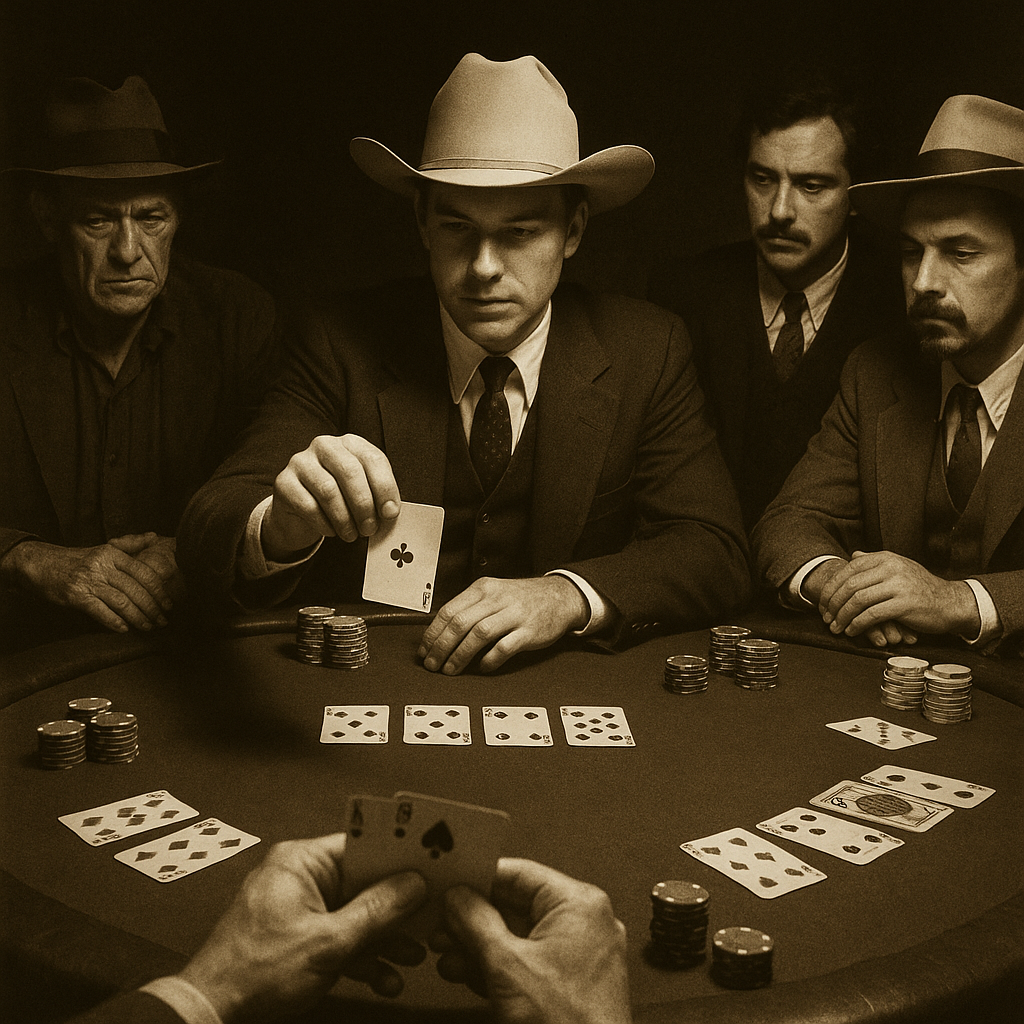
Legendary Stud Poker Events: A Look Back at Iconic Moments

Before Texas Hold’em conquered the poker world, Seven Card Stud reigned supreme for over a century as America’s game. From Bill Boyd’s unprecedented dominance in the 1970s to Nick Guagenti’s dramatic 2025 championship victory, stud poker has produced some of tournament poker’s most legendary moments and unforgettable champions. Today, while mainstream poker has moved on, Seven Card Stud endures as the ultimate test of poker mastery, where legends like Chip Reese earned immortality and modern specialists battle for six-figure prizes at the World Series of Poker.
The Golden Era: When Stud Ruled the WSOP
The World Series of Poker’s relationship with Seven Card Stud began at the very inception of tournament poker. Bill Boyd dominated early WSOP history by winning every single Five-Card Stud championship from 1971 to 1974, a feat unmatched in any other poker variant. His four consecutive victories established the first dynasty in WSOP history before the event was discontinued, leaving Boyd as the permanent record holder.
The Ladies Championship, introduced in 1977, chose Seven Card Stud as its exclusive format for the first 24 years. Jackie McDaniels captured the inaugural event for $5,580 from a field of 93 players, beginning a tradition that would continue through 2000. This commitment to stud poker reflected the game’s status as the sophisticated choice for serious players, requiring memory, patience, and card tracking through streets that Hold’em couldn’t match.
A persistent myth claims the 1989 WSOP Main Event was the last played in Seven Card Stud format, but the Main Event has actually been No Limit Texas Hold’em since 1972. Phil Hellmuth Jr.’s famous victory over Johnny Chan that year occurred in Hold’em, not stud. The confusion likely stems from the Ladies Event maintaining its Seven Card Stud format until 2001, marking the true end of stud’s prominence in marquee WSOP events.
The Immortal Stud Legends
Stu “The Kid” Ungar brought his photographic memory and genius-level IQ to stud poker, capturing the $5,000 Seven Card Stud championship in 1983 for $110,000. His ability to remember every folded card gave him an insurmountable edge in stud games, where exposed information rewards perfect recall. Though better known for his three Main Event victories, Ungar’s stud prowess was equally legendary among those who witnessed it firsthand.
Johnny Chan added a Seven Card Stud bracelet to his collection in 1994, defeating Mansour Matloubi for $135,600. This victory came between his back-to-back Main Event wins, demonstrating the versatility that helped him accumulate 10 total bracelets. Chan’s mastery of aggression and positional value in stud games made him equally dangerous in limit and no-limit formats.
Ted Forrest emerged as a stud specialist with remarkable consistency, winning Seven Card Stud bracelets in 1993 and 2004, plus a Razz championship in 2014. Forrest became one of only six players to win three WSOP bracelets in a single year during his 1993 campaign, with one of those victories coming in Seven Card Stud. His longevity across multiple decades proves stud excellence requires more than temporary hot streaks.
| Player | Stud Bracelets | Notable Victory | Prize |
|---|---|---|---|
| Chip Reese | 3 (including H.O.R.S.E.) | 2006 $50K H.O.R.S.E. | $1,716,000 |
| Bill Boyd | 4 | 1971-1974 Five-Card Stud | Dynasty |
| Ted Forrest | 3 | 1993 Triple Crown | Multiple |
| Johnny Chan | 1 | 1994 Seven Card Stud | $135,600 |
| Scotty Nguyen | 1 (plus H.O.R.S.E.) | 2008 $50K H.O.R.S.E. | $1,989,120 |
Chip Reese: The Greatest Who Ever Lived
Chip Reese stands alone as the consensus greatest Seven Card Stud player in poker history, earning this distinction from legends including Doyle Brunson, who called him “the best seven-card stud player he had ever played.” Reese’s dominance extended beyond tournament victories to decades of crushing the biggest cash games ever spread.
His crowning achievement came in 2006 when he won the inaugural $50,000 H.O.R.S.E. World Championship for $1,716,000, a tournament heavily weighted toward stud variants. The victory required excellence across H.O.R.S.E. rotation, but Reese’s stud superiority provided his biggest edge. The Poker Players Championship trophy now bears his name following his death in 2007 at age 56.
Reese’s philosophy on stud excellence centered on emotional control: “My edge is that I don’t steam. My D game isn’t much different than my A game.” This consistency, combined with his authorship of the Seven Card Stud chapter in Doyle Brunson’s “Super System,” cemented his legacy as both player and teacher of the game’s highest level.
The Chip Reese Memorial Trophy
Since 2008, winners of the $50,000 Poker Players Championship receive the Chip Reese Memorial Trophy, honoring the man Doyle Brunson called “certainly the best poker player that ever lived.” The trophy represents excellence across all poker variants, but especially the stud games Reese dominated for three decades.
Championship Moments That Defined History
The 2025 WSOP $10,000 Seven Card Stud Championship produced one of the most dramatic finals in recent memory. Nick Guagenti overcame a 2.5-to-1 chip deficit against Chino Rheem in a five-hour heads-up marathon. The crucial moment came when Guagenti flashed the 2♥ after making a better flush than Rheem’s, prompting Rheem to exclaim “F****** brutal” in frustration. The final hand saw Guagenti’s pocket sevens improve to kings-up on seventh street, claiming the $295,008 first prize.
Perhaps the rarest hand in WSOP stud history occurred at the 2025 championship when Gus Hansen and Dzmitry Urbanovich made identical flushes in different suits. Hansen held 10♥J♥9♥A♥3♥ while Urbanovich showed 10♣J♣9♣A♣3♣ for a chopped pot. Nick Schulman, a Poker Hall of Famer, declared “I’ve never seen that before”, highlighting the astronomical odds against such an occurrence.
The 2019 championship featured John “Johnny World” Hennigan defeating Daniel Negreanu in an epic heads-up battle lasting nearly four hours. Observers compared it to “a Muhammad Ali and George Foreman fight, minus the literal fighting part.” Hennigan overcame Negreanu’s commanding chip lead to win $245,451, demonstrating how stud’s limit structure creates marathon battles where seventh street bluff catching decides championships.
From Mainstream Dominance to Elite Specialty
Seven Card Stud ruled American poker rooms unchallenged until Chris Moneymaker’s 2003 WSOP Main Event victory triggered the poker boom. The Main Event exploded from 839 players in 2003 to 8,773 by 2006, a tenfold increase that coincided with stud’s rapid decline. Television coverage through ESPN’s hole-card cameras made Hold’em dramatically more appealing to viewers, while stud’s exposed cards paradoxically provided less dramatic tension for broadcasts.
Economic factors accelerated the transformation. Casinos discovered Hold’em games generated significantly more rake per hour due to faster play. Online poker sites focused almost exclusively on Hold’em variants, creating a generation of players who never learned stud. As one veteran observed, “The joke is if you want to find a 7 card stud game your best chance is a nursing home.”
Mixed-game formats like 8-Game and 10-Game became stud’s primary refuge, preserving the game for serious students while removing it from mainstream poker rooms. This evolution transformed stud from America’s game to poker’s most elite specialty.
Bobby’s Room: Where Millions Change Hands
Bobby’s Room at Bellagio, renamed “Legends Room” in 2020, remains the epicenter of high-stakes Seven Card Stud cash games, with limits ranging from $400/$800 to $8,000/$16,000 during peak WSOP periods. Players typically buy in for $200,000-$300,000, with the stud variants rotating through an 8-game mix that changes every 8-10 hands.
Jennifer Harman, the only female regular in these games, reported side action reaching $15,000-per-point Chinese poker, with one player dropping $1.8 million at $5,000-a-point. The room’s legendary status stems from decades of hosting poker’s biggest names, including Doyle Brunson, Phil Ivey, and the late Chip Reese, whose stud expertise dominated these games.
High-stakes stud sessions produce pots averaging $200,000-$300,000 when games reach their peak limits. These games preserve stud poker at its highest level, where lifetime edges are measured in millions and single sessions can swing seven figures. The transition from “Bobby’s Room” to “Legends Room” honored the game’s history while acknowledging its evolution.
Modern Championships Keep the Legacy Alive
The 2024 and 2025 WSOP demonstrated stud’s continued vitality among elite players. James Obst’s emotional 2024 victory for $260,658 marked his return to poker after pursuing professional tennis. “I never really wanted to leave entirely. A part of my soul, I think, lives here at the World Series,” he told reporters after defeating Paul Volpe in the $10,000 championship.
Current field sizes reveal a stable, dedicated community of stud enthusiasts. The $1,500 events maintain 377-406 player fields, generating prize pools approaching $800,000. Dan Heimiller’s 2025 victory in the $1,500 Seven Card Stud ended an 11-year bracelet drought for the veteran who has cashed at every WSOP since 1997, demonstrating the endurance required for stud success.
Seven Card Stud Hi-Lo consistently attracts larger fields than pure stud events, with the $1,500 tournaments drawing 566-611 players. The 2025 $10,000 Stud Hi-Lo Championship attracted 186 entrants competing for a $1,729,800 prize pool, with Qinghai Pan capturing his third career bracelet for $411,051.
Master Seven Card Stud Strategy
Ready to learn the game of legends? Explore our comprehensive guides:
The Poker Players Championship: Stud’s Ultimate Test
The Poker Players Championship evolved from the original $50,000 H.O.R.S.E. format (2006-2009) to its current 8-game mix, consistently featuring both Seven Card Stud and Seven Card Stud Hi-Lo among the rotation. Michael Mizrachi holds the record with four PPC victories (2010, 2012, 2018, 2025), while Brian Rast captured three titles (2011, 2016, 2023), both excelling in the stud rounds that often determine championship outcomes.
The tournament awards the Chip Reese Memorial Trophy, honoring the stud legend who won the inaugural event. Recent champions demonstrate that excellence across stud variants remains essential for poker’s highest honors. The $50,000 buy-in ensures only the world’s best mixed-game players compete, creating fields where Razz expertise matters as much as Hold’em skill.
Jeff Lisandro’s remarkable 2009 campaign saw him win three bracelets exclusively in stud variants – the $1,500 Seven Card Stud, $10,000 Seven Card Stud Hi-Lo Championship, and $2,500 Razz – earning Player of the Year honors. This achievement proved that stud mastery could still dominate even during Hold’em’s peak popularity.
Razz Championships: The Lowball Challenge
George Alexander’s 2024 $10,000 Razz Championship victory for $282,443 ended a 15-year quest after nine previous final table appearances. The 118-player field included Phil Ivey finishing 11th and Daniel Negreanu in 9th, demonstrating Razz’s appeal to poker’s biggest names. Alexander called the lowball stud variant one of his favorites with “a lot of room for creativity.”
The strategic depth of Razz third street discipline and the psychological warfare of multi-street bluff timing make it a favorite among mixed-game specialists. Scott Seiver dominated the 2024 $1,500 Razz event for $141,374, leading from start to finish as part of his successful Player of the Year campaign.
The Philosophy of Stud Poker Excellence
The complexity that makes stud “the hardest of all poker games” stems from its unique combination of exposed information, memory requirements, and multi-street decision-making. Players must track folded cards, calculate precise odds with partial information, and navigate seven betting streets while managing both concealed and exposed cards.
“There are no charts to follow, no substitute for experience” became stud’s defining characteristic. Books like “Seven-Card Stud for Advanced Players” by Sklansky, Malmuth, and Zee remain essential texts, with their 21st Century Edition adding over 100 pages to address modern playing styles.
Modern professionals describe stud as “not a young man’s game,” reflecting both its complexity and the patience required for success. The limit betting structure prevents aggressive all-in moves, forcing players to build pots methodically through superior sixth street pot control and value extraction.
Frequently Asked Questions
The Enduring Legacy of Seven Card Stud
Seven Card Stud’s transformation from poker’s dominant game to elite specialty represents one of gambling’s most dramatic evolutionary shifts. The game that once defined American poker now serves as the ultimate proving ground for mixed-game specialists and serious students of poker strategy.
While mainstream poker has moved decisively toward No Limit Hold’em, Seven Card Stud occupies an honored position as poker’s most challenging and prestigious variant. The recent success of players like Nick Guagenti, James Obst, and multi-time champions like Michael Mizrachi proves that stud mastery remains a pathway to poker immortality.
The game endures through WSOP championships attracting fields of exceptional quality, high-stakes cash games continuing at legendary venues, and the Poker Players Championship maintaining stud variants as essential components. As veteran players note with pride, finding a Seven Card Stud game may require visiting a nursing home, but winning one still requires the highest level of poker skill ever demanded by any variant.
Key Takeaways: Seven Card Stud’s Tournament Legacy
- 1971-1974: Bill Boyd wins every Five-Card Stud championship, creating WSOP’s first dynasty
- 1977-2000: Ladies Championship exclusively uses Seven Card Stud format
- 2003: Poker boom begins stud’s decline from mainstream dominance
- 2006: Chip Reese wins inaugural $50,000 H.O.R.S.E. Championship for $1,716,000
- 2020: Bobby’s Room renamed to Legends Room, maintaining high-stakes tradition
- 2025: Nick Guagenti defeats Chino Rheem in dramatic championship final
About the Author

Mixed Game Masters Editorial
Published: October 21, 2025 | Categories: Tournaments & Events, Draw & Lowball
Mixed Game Masters is the premier resource for non-Hold’em poker strategy, tournament coverage, and mixed game education. Our editorial team consists of experienced players and poker historians dedicated to preserving and sharing the rich history of poker’s most challenging variants.
We provide comprehensive coverage of stud games, lowball variants, and mixed game formats, helping players of all levels improve their skills beyond traditional No-Limit Hold’em.
Leave a Reply