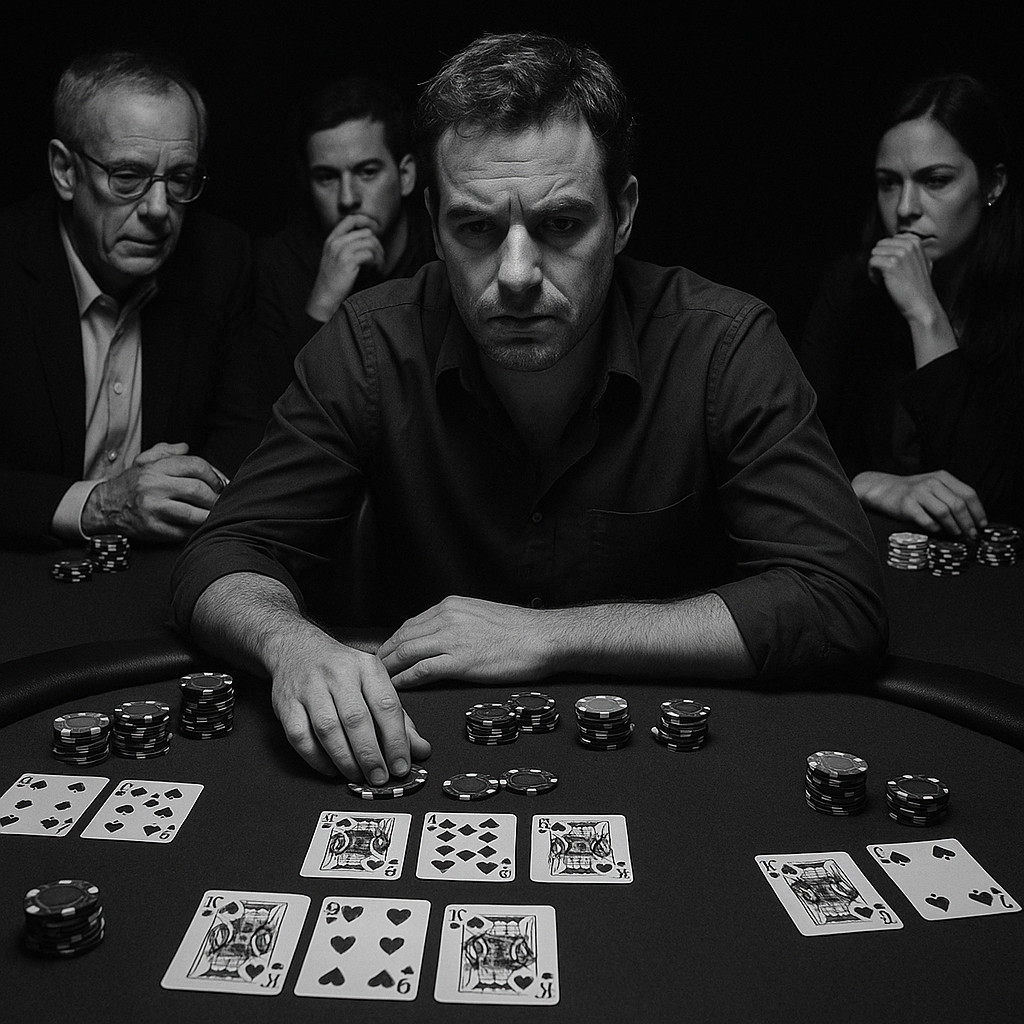
Omaha Poker: Hand Histories That Changed Strategy Forever

When Patrik Antonius scooped the $1,356,947 pot against Viktor “Isildur1” Blom on November 21, 2009, the poker world witnessed more than just the largest online pot in history—they saw the culmination of Pot-Limit Omaha’s evolution from mathematical theory to hyper-aggressive warfare. This hand, along with other pivotal moments from David Sklansky’s 1983 foundation to Michael Wang’s miraculous 2025 WSOP comeback, didn’t just create massive pots—they fundamentally transformed how we understand equity, aggression, and strategic depth in four-card poker.
The Mathematical Foundation and Early Championship Hands
David Sklansky’s victory in the first-ever WSOP Omaha tournament in 1983 established the mathematical foundation for modern PLO strategy. Winning Event #11: $1,000 Limit Omaha for $25,500, Sklansky applied his theoretical framework from “The Theory of Poker” to the four-card game, introducing concepts of pot odds, implied odds, and expected value calculations that hadn’t been systematically applied to Omaha before.
The strategic torch passed to a new generation when Phil Ivey defeated Amarillo Slim Preston heads-up in the 2000 WSOP $2,500 Pot-Limit Omaha event. At just 23 years old, Ivey’s $195,000 victory symbolized the transition from old-school gambling to modern aggressive play. This win launched Ivey’s unprecedented run of 11 WSOP bracelets, all in non-Hold’em events, proving that mastery of Omaha variants was essential for poker’s elite.
The death of “fit or fold” PLO came through specific hands that showed the power of coordinated starting hands and aggressive drawing play. Early players would only continue post-flop with made hands or nut draws, but breakthrough moments like wrap straight draws changed everything. A hand like Q♥J♠10♦7♣ on a 9♥8♠2♦ flop provides 13 outs to a straight, and modern players learned these massive draws often had more equity than made hands like sets.
The Online Revolution and the Largest Pot in Poker History
The $1.36 Million Pot
November 21, 2009 – Full Tilt Poker $500/$1,000 PLO
Patrik Antonius: A♥K♥K♠3♠
Viktor “Isildur1” Blom: 9♠8♥7♦6♦
Board: 4♠5♣2♥5♥9♣
Pot: $1,356,947
The hand developed with Blom raising to $3,000, Antonius 3-betting to $9,000, and escalating through a 5-bet to $81,000. The flop came 4♠5♣2♥, giving Antonius a straight. After Blom raised Antonius’s $91,000 bet to $435,000, Antonius re-potted to $870,000, and Blom called all-in for his remaining $163,000. Antonius scooped the historic pot as a 54.63% favorite.
Isildur1’s emergence revolutionized online PLO through hyper-aggressive play that nobody had seen before. The 19-year-old Swedish player built his bankroll from $2,000 to nearly $6 million in two months, crushing legends like Tom Dwan for $4-5 million across marathon sessions. His catastrophic $4.18 million loss to Brian Hastings in a single five-hour session on December 8, 2009, demonstrated PLO’s crushing variance. Hastings had studied over 30,000 hands of Isildur1’s play, showing how data analysis was becoming crucial for high-stakes success.
Two days after his record loss to Antonius, Blom extracted revenge with a $1,127,955 pot against Phil Ivey. Holding K♦K♣5♥4♦, Blom flopped a full house on J♠K♠J♦. After checking the flop, Ivey bet $41,000 on the 10♦ turn, Blom raised to $177,000, and Ivey called. The 5♦ river saw Ivey check-call Blom’s $408,000 bet with his remaining $359,977, only to muck when shown the flopped boat.
Tom Dwan’s Aggression Revolution and the Durrrr Challenge
Tom “durrrr” Dwan transformed PLO strategy by demonstrating that extreme aggression could overcome equity disadvantages. His famous $477,556 pot against Patrik Antonius during the Durrrr Challenge showcased this approach. Dwan held 7♥9♥8♥6♦ against Antonius’s Q♣Q♥K♦9♠ on a 6♠6♥Q♥ flop. Despite being behind, Dwan check-raised to $47,100 and shoved the turn for $173,000, ultimately losing when Antonius’s queens full held.
Dwan’s influence extended beyond individual hands to reshaping how players thought about ranges and aggression. Phil Galfond recounted a pivotal learning moment:
“I had a bluff-catcher on the river facing a triple barrel, and I said I wanted to call. Tom quickly said ‘Oh, I’d raise.’ He said, ‘Well, you’ve called twice, you obviously have a made hand on this board and he’ll realize that and just fold whatever overpair he has.’ That opened my mind to evaluating every option at all points.”
During High Stakes Poker Season 5, Dwan executed one of poker’s most audacious bluffs with Q♠10♥ against Barry Greenstein’s A♠A♣ and Peter Eastgate’s 2♥2♠ on a 2♦2♥7♦ board. Betting $104,200 as a 95% underdog and successfully forcing Eastgate to fold trip deuces showcased Dwan’s ability to apply pressure regardless of his holdings.
Phil Galfond’s Balanced Mastery and the Galfond Challenge
Phil Galfond bridged the gap between old-school feel-based play and modern GTO concepts through his online dominance as “OMGClayAiken” and his revolutionary Galfond Challenge matches. His comeback against VeniVidi1993 stands as one of poker’s greatest achievements—down nearly €900,000 at one point in their €100/€200 PLO match, Galfond fought back over 25,000 hands to win by just €1,671.58.
Galfond’s strategic innovations popularized key concepts that define modern PLO:
- “Fast-playing strong hands” for maximum value versus passive nut-peddling
- Selective bluffing on rivers where opponents least expected it
- Pioneering the use of blockers for both value betting and bluffing
- Understanding deep-stack dynamics where 200+ big blind stacks created unique strategic considerations
Through his 183-video “This Is PLO” course spanning 73 hours, Galfond taught players to think in ranges rather than specific hands, mix value bets and bluffs in mathematically sound ratios, and understand the importance of pot control and leverage.
| Opponent | Stakes | Hands Played | Result |
|---|---|---|---|
| VeniVidi1993 | €100/€200 PLO | 25,000 | +€1,671.58 |
| ActionFreak | €100/€200 PLO | 15,000 | +€114,765.66 |
| Chance Kornuth | $100/$200 PLO | 35,000 | +$726,500 |
| Bill Perkins | $100/$200 PLO | Completed | Winner |
| Brandon Adams | $100/$200 PLO | Completed | Winner |
Modern Breakthroughs with Blockers and Strategic Concepts
The evolution from “nut-peddling” to sophisticated blocker play transformed PLO strategy fundamentally. A hand like A♠10♥10♦J♦ on Q♦8♦2♣6♦3♠ demonstrates modern blocker usage—the A♠ blocks the nut flush while allowing effective bluffs even without holding the actual nuts. This concept, once intuitive to players like Dwan, became mathematically formalized through solver work.
Wrap draws revolutionized understanding of drawing hand power. The famous “Maine to Spain” 20-out wrap—hands like 10♥9♣6♦5♠ on 8♠7♣2♥—showed that certain draws had more equity than made hands. Players learned that:
- A double wraparound straight draw wins 68% of the time (0.48-1 odds)
- Top set only maintains 70% equity against a flush draw
- 13-out wraps often have more equity than sets on certain boards
- The “fit or fold” mentality was mathematically incorrect
The concept of nut advantage became central to modern strategy. Holding A♣A♠K♠Q♣ on K♣7♦2♥ provides both made hand strength and blocks opponent’s nut possibilities. Players learned to build pots when holding nut advantage even without the current nuts, understanding that pot-limit betting structures rewarded early aggression when equity distributions favored their range.
Historic Televised Moments Changing Public Perception
High Stakes Poker produced several historic Omaha moments that brought PLO strategy to mainstream audiences. The $743,800 pot between Patrik Antonius and Jamie Gold showcased the game’s variance when Antonius’s straight held against Gold’s set of kings, though they ran it three times with Antonius winning only once despite being a 77% favorite.
The famous $600,000 Poker After Dark pot between Antonius and Dwan exemplified the cooler potential in PLO. Antonius flopped a set of tens against Dwan’s pocket kings, only to see Dwan turn a higher set. Running it twice with Dwan scooping both times highlighted how even optimal play couldn’t avoid massive confrontations in PLO.
Recent high-stakes streams have continued this tradition. Alan Keating’s participation in $1.4 million pots on High Stakes Poker and the $1,978,000 pot won by Antonius on “No Gamble, No Future” in 2023 showed PLO’s enduring appeal for creating poker’s biggest moments. These modern streams, combined with detailed hand analysis available online, have accelerated strategic evolution as players can study elite decision-making in real-time.
The 2025 WSOP Revolution and Michael Wang’s Miracle
The Greatest Comeback in WSOP PLO History
2025 WSOP $10,000 PLO Championship
Michael Wang reduced to 65,000 chips (⅔ of a big blind)
Final hand: Q♠J♣J♦8♠ vs A♣K♠10♥5♠
Board: J♥10♠10♦A♠6♦
Prize: $1,394,579
Wang’s comeback referenced Jack Straus’s legendary 1982 Main Event “chip and a chair” story but in the modern PLO context where such comebacks are even more improbable given the game’s flatter equity distributions. Wang reflected:
“Honestly it felt like a freeroll at that point. I already thought I had busted… With two thirds of a big blind there were no expectations, no pressure.”
The 2025 WSOP showcased PLO’s explosive growth with the $100,000 High Roller attracting 121 entries for an $11.6 million prize pool, won by Shaun Deeb for $2,957,229. These record-breaking fields—874 entries in the $10,000 PLO Championship creating a $6.37 million prize pool—demonstrate PLO’s evolution from niche variant to mainstream poker format.
Statistical Evolution and the Solver Revolution
Modern PLO strategy rests on mathematical foundations that early players couldn’t access. With 270,725 starting hand combinations compared to Hold’em’s 1,326, PLO’s complexity deterred comprehensive analysis until recently. The development of cloud-based solvers like PLO Genius and simplified tools like PLO Matrix democratized access to GTO solutions.
Key Statistical Insights That Reshaped PLO
- PLO requires 100-150 buy-ins for professionals (vs 30-40 in Hold’em)
- Standard deviation: 144bb/100 hands (vs 80-100bb/100 in Hold’em)
- Variance stretches can last over one million hands
- Pre-2013 wisdom: always check turn after check-calling flop
- Solver solution: 11% betting frequency optimal for value-betting trips and semi-bluffing flush draws
- Modern players must understand minimum defense frequency, pot geometry, and equity realization
The solver revolution revealed counterintuitive strategic adjustments. These precise frequencies, impossible to determine through intuition alone, demonstrate how mathematical analysis has refined even basic strategic decisions. Players studying GTO vs exploitative strategy now understand concepts like minimum defense frequency, pot geometry, and equity realization to compete at high stakes.
Master Omaha Poker Strategy
Ready to improve your PLO game? Explore our comprehensive guides:
Frequently Asked Questions
The Evolution Continues
The transformation of Omaha poker from Sklansky’s mathematical framework to today’s solver-based strategies represents one of poker’s most dramatic evolutions. Through specific hands that cost or won millions—from Isildur1’s record-breaking pots to Wang’s miraculous comeback—players discovered that PLO rewarded aggression, required deeper bankrolls, and offered more strategic complexity than initially understood.
The contributions of pioneers like Dwan’s hyper-aggression, Galfond’s balanced approach, and Antonius’s European tight-aggressive style created a rich strategic tapestry that continues evolving with each breakthrough hand. As prize pools reach unprecedented heights and solver technology advances, these historic hands remain touchstones for understanding how poker’s most action-packed variant transformed from a sideshow to the main event.
For players looking to master modern PLO, understanding these pivotal moments provides context for today’s strategic landscape. From preflop fundamentals to variance management, the lessons learned from these historic hands continue to shape how we approach four-card poker strategy.
About the Author
Mixed Game Masters Editorial
Published: October 21, 2025 | Categories: Tournaments & Events, Draw & Lowball
Mixed Game Masters is the premier resource for non-Hold’em poker strategy, tournament coverage, and mixed game education. Our editorial team consists of experienced players and poker historians dedicated to preserving and sharing the rich history of poker’s most challenging variants.
We provide comprehensive coverage of stud games, lowball variants, and mixed game formats, helping players of all levels improve their skills beyond traditional No-Limit Hold’em.
Leave a Reply