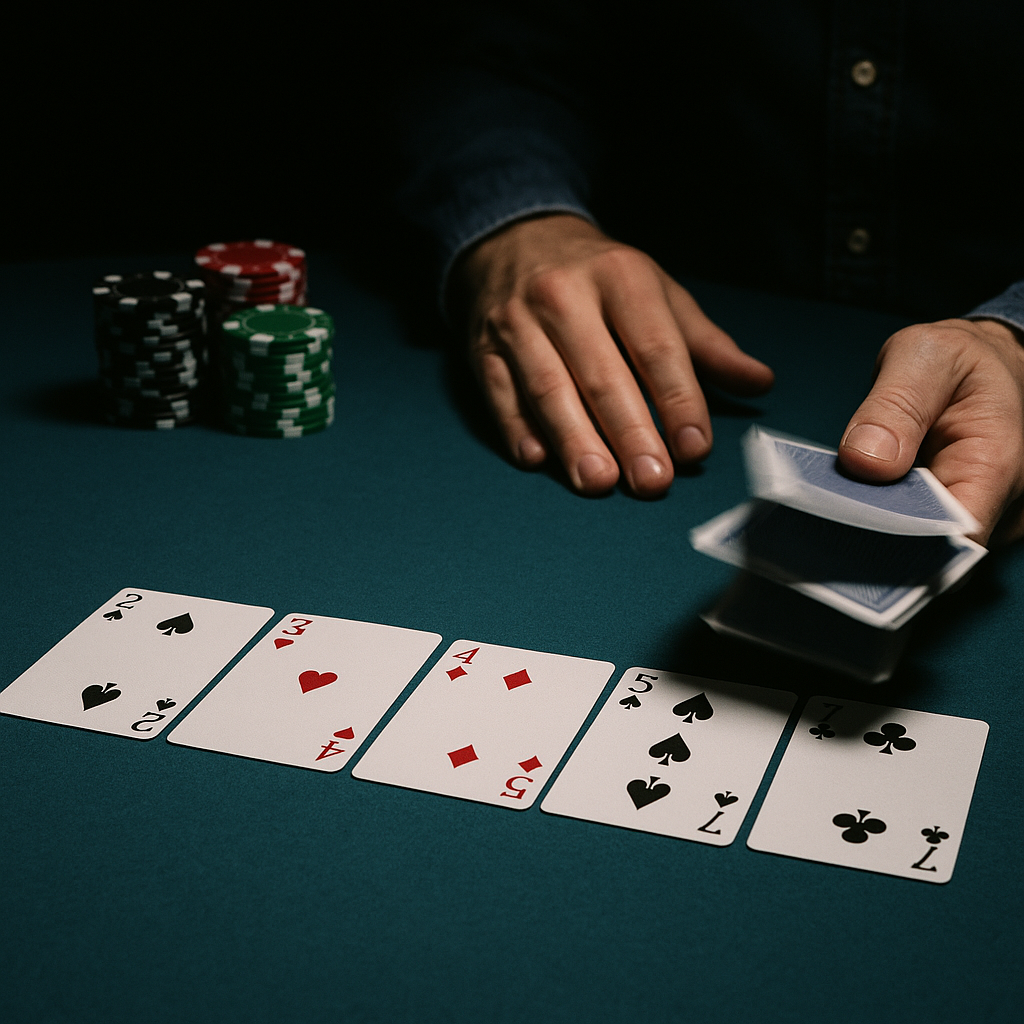
2-7 Triple Draw Classic Hands: Snowing and Bluff Inducement

In the high-stakes world of 2-7 Triple Draw poker, “snowing” represents one of the game’s most sophisticated bluffing techniques—standing pat with a busted hand while betting aggressively to represent strength, forcing opponents to fold before showdown. This comprehensive analysis explores the evolution of snowing strategy from classic tournament hands to modern high-level play, revealing the mathematical precision and psychological warfare that define expert 2-7 Triple Draw.
Understanding the Snow: Core Concepts and Mechanics
Snowing fundamentally differs from standard poker bluffing through its unique opportunity cost. When a player chooses to snow, they completely eliminate any possibility of improving their hand through drawing, unlike semi-bluffing where outs remain. This commitment makes snowing both higher risk and potentially higher reward than conventional bluffs.
The most common snowing pattern, known as the “Gentleman’s Snow,” involves taking a single card on the first draw, then standing pat on the second draw after missing, continuing to bet aggressively throughout. This approach typically targets late position openers who likely hold rough one-card draws. Players execute this strategy most effectively when holding hands with strong blocker effects—pairs of eights or nines, trips, or other holdings that reduce the likelihood of opponents having strong hands.
Successful snowing requires careful consideration of position, which mixed game expert Randy Ohel emphasizes is “more important in draw poker games, especially 2-7 Triple Draw, than it is in other forms of poker.” Late position provides critical information advantages, allowing players to see opponents’ drawing patterns before committing to a snow. The three-draw structure creates multiple decision points for initiating or continuing snowing attempts, with each draw providing additional information about opponent strength through their drawing patterns and betting behavior.
Classic Tournament Hands That Defined Snowing Strategy
Daniel Negreanu’s masterful bluff inducement hand from the 2013 WSOP $10,000 2-7 Triple Draw Championship demonstrates advanced strategic thinking in action. With David Baker and Michael “The Grinder” Mizrachi at the table, Negreanu executed a brilliant value bet with a pat 10-8-7-4-2 that appeared to be a bluff inducement play. After Mizrachi went all-in and Baker was drawing one, Negreanu’s bet created a situation where Baker couldn’t be sure if Negreanu was snowing, since the hand would be shown down regardless. This forced Baker to fold what might have been the better hand, showcasing how the threat of snowing influences decision-making even when not executed.
Phil Ivey’s remarkable comeback victory in the 2024 WSOP $10,000 Limit 2-7 Triple Draw Championship, ending his 10-year bracelet drought, highlighted how position and aggression can overcome chip disadvantages against tough specialists. Down to just one big bet with three players remaining, Ivey’s strategic patience and selective aggression demonstrated that even against world-class opponents like Danny Wong and Jason Mercier, superior snowing and positional play can turn seemingly hopeless situations into victories.
Nick Schulman’s dominance in high-stakes cash games and tournaments provides numerous examples of expert snowing execution. His 2025 WSOP victory featured an epic eight-hour heads-up battle with Darren Elias, where Schulman’s ability to balance legitimate pat hands with well-timed snows wore down his opponent’s resistance. Regularly playing $1,500/$3,000 limit online and crushing opponents for six-figure amounts, Schulman exemplifies how consistent snowing success requires perfect frequency balance and opponent exploitation.
The Mathematics Behind Optimal Snowing
Mathematical analysis reveals that optimal snowing frequency isn’t fixed but depends on multiple quantifiable factors. Expert players limit first-draw snowing to approximately 33% maximum frequency to maintain balance, though this varies significantly based on opponent tendencies and board texture. Against balanced opposition, the game theory optimal approach suggests snowing approximately 15-25% of eligible trash hands, depending on position.
Expected Value Calculation Example
In a typical scenario where an opponent holds 2-4-5-7 and is drawing:
- Win 5.25 big bets when opponent misses both draws (33% probability)
- Lose 2 big bets when opponent makes a hand on second draw (31% probability)
- Lose 3 big bets when opponent makes a hand on final draw (36% probability)
Result: +0.033 big bet expected value – illustrating why precise opponent reading is crucial
Position dramatically affects these calculations, with in-position snowing succeeding 35-40% more frequently than out-of-position attempts due to information advantages. Stack sizes in tournaments introduce ICM considerations that can reduce optimal snowing frequency by 20-30% near pay jumps, while large stacks can increase frequency by 40-60% to exploit shorter stacks’ survival concerns.
Detecting and Countering Snows
Identifying snowing attempts requires sophisticated pattern recognition and statistical analysis. Frequency spikes exceeding 30% above an opponent’s established baseline pat frequency often indicate snowing, particularly when combined with non-standard bet sizing (80-120% pot versus standard 60-100%) and unusual decision-time patterns compared to legitimate pat hands.
Counter-strategies involve careful bluff-catching frequencies and range construction. Against suspected snowing opponents, experts recommend calling down with jack-low or better approximately 45-55% of the time, adjusting based on specific opponent tendencies and recent history. The minimum defense requirement mandates calling with 33% of your range when facing pot-sized bets, though this must be adjusted for tournament ICM considerations.
Card removal effects play a crucial role in both executing and detecting snows. When an opponent likely holds blockers—particularly deuces—their pat frequency increases by approximately 60%, making snowing detection more reliable. Conversely, holding key blockers yourself increases snowing success rates and provides what Matt Glantz calls an “effective randomizer” to prevent overuse.
Evolution in the Modern Game
The past decade has witnessed significant evolution in snowing strategy, driven by increased strategic sophistication and the influence of online play. Modern high-stakes players have moved away from simple “stand pat and bet” approaches to sophisticated multi-street campaigns that consider opponent tendencies, card removal effects, and complex table image management.
Top professionals now carefully modulate their snowing frequency relative to table image. As documented in recent strategic analysis, successful players are “generally aggressive and snow more often than opponents,” but must tighten up after being caught multiple times. The key innovation lies in dynamic adjustment—reducing frequency by 25-30% for 15-20 hands after exposure, then gradually increasing again as image shifts.
Randy Ohel, WSOP bracelet winner and mixed game specialist, describes snowing as “the most artistic form of poker there is,” combining game theory with “an incredible amount of live tells.” This artistic element manifests in modern approaches through complex meta-game exploitation, where players deliberately cultivate specific images to enhance later snowing opportunities.
Strategic Considerations for Successful Snowing
Effective snowing requires understanding optimal situational selection. The best opportunities arise against opponents drawing two cards who check after failing to improve, in position against tight predictable players, when holding hands with strong blocker effects, and against opponents with histories of breaking made hands under pressure. Position remains the single most critical factor, with late position snowing attempts succeeding at nearly double the rate of early position attempts.
| Situation | Success Rate | Frequency |
|---|---|---|
| Late position vs. 2-card draw | 65-70% | 25-30% |
| Button vs. small blind | 60-65% | 20-25% |
| With deuce blocker | 55-60% | 15-20% |
| Early position | 30-35% | 5-10% |
Hand selection for snowing has become increasingly sophisticated. Beyond obvious candidates like pairs and trips, modern players recognize the value of hands with specific blocking properties. Holdings like 2-2-2-9-J or 5-5-6-6-8 provide excellent removal effects while appearing credible as pat hands. The key lies in selecting hands that both block opponent outs and maintain story consistency across multiple streets.
Multi-street planning distinguishes expert snowing from amateur attempts. Professional players plan entire snowing campaigns before committing, considering how their story will develop across all three draws. This includes anticipating opponent reactions, planning bet sizing for maximum fold equity, and maintaining consistent timing and physical behavior to avoid detection.
Common Mistakes and How to Avoid Them
Recreational players frequently commit critical snowing errors that expert players exploit. Over-snowing after initial success ranks as the most common mistake, with inexperienced players increasing frequency dramatically after successful attempts, leading to quick exposure and opponent adjustment. Optimal play requires maintaining disciplined frequency regardless of recent results.
Poor opponent selection devastates snowing profitability. Attempting to snow against calling stations or players who rarely fold ignores fundamental strategic principles. Expert players categorize opponents into distinct types—tight-passive, aggressive-capable, and recreational—adjusting snowing frequency accordingly. Against weak opponents who call frequently, snowing frequency should approach zero, while against capable but exploitable players, selective snowing can be highly profitable.
Insufficient blocker consideration reduces snowing effectiveness significantly. Attempting to snow without holding key blockers like deuces decreases credibility and increases the likelihood of running into strong hands. Modern strategic thinking emphasizes that effective snowing “harnesses the power of blockers,” with deuces being the strongest due to their low value and limited drawing ability.
Bluff Inducement Techniques Specific to 2-7 Triple Draw
Bluff inducement in 2-7 Triple Draw involves sophisticated reverse psychology, creating situations where opponents feel compelled to bluff into your strong holdings. Check-call trap scenarios with marginal made hands like jack-low or queen-low require opponents to bluff more than 30% of the time for profitability. Expert players manipulate bet sizing, using 40-60% pot bets instead of full pot bets to increase opponent bluff frequency by approximately 25%.
Breaking inducement represents an advanced technique where betting patterns suggest the need to improve, causing opponents to break strong hands unnecessarily. This strategy works particularly well against players who overvalue having the best draw, creating opportunities to win pots that would otherwise be lost at showdown.
Multi-way pot dynamics create unique inducement opportunities. When a third player is all-in, betting into the dry side pot can induce folds from second-best hands that would call if checking were the only option. This technique, exemplified by Negreanu’s 2013 WSOP hand, leverages the impossibility of snowing when hands must be shown down to create fold equity against better holdings.
The Role of Physical and Timing Tells
Live 2-7 Triple Draw offers unique tell opportunities that online play cannot replicate. Josh Hale’s analysis of high-stakes mixed games reveals critical patterns: “He goes for calling chips, but then he hesitates, fumbles with his chips for a little and goes into the tank. After a few seconds he opts to raise.” This hesitation pattern often indicates bluffing attempts, as players with legitimate hands typically act more decisively in limit formats.
Breathing patterns and posture changes provide additional information. Expert live players note that snowing attempts often involve subtle physiological changes as players commit to representing hands they don’t have. These tells become particularly reliable in long sessions where fatigue reduces players’ ability to maintain consistent physical behavior.
Timing tells translate between live and online play. Unusual decision-time patterns compared to previous legitimate pat hands often indicate snowing attempts. Quick pats after long draws or delayed pats after quick draws frequently signal deception, though sophisticated players deliberately vary their timing to avoid detection.
Modern Innovations and Future Evolution
Contemporary 2-7 Triple Draw strategy incorporates elements from other poker variants and game theory advances. The emergence of no-limit 2-7 Triple Draw online has influenced bluffing concepts in the limit game, with bet sizing theory and range construction principles transferring between formats. Mixed game dynamics create cross-variant image effects, where tight images in Hold’em or Omaha rounds enhance snowing effectiveness in 2-7 rounds.
Conditional snowing strategies represent the cutting edge of modern play, where the decision to snow depends on specific opponent reactions during the hand rather than predetermined plans. This adaptive approach requires real-time strategic thinking and superior hand-reading skills but offers maximum exploitation potential against thinking opponents.
Looking forward, snowing strategy will likely become even more sophisticated as players develop better understanding of game theory optimal frequencies and counter-strategies. The integration of solver principles, though limited by computational complexity, will continue influencing frequency decisions and range construction. However, the human elements—physical tells, session dynamics, and psychological warfare—ensure that snowing remains as much art as science in high-level 2-7 Triple Draw play.
Key Takeaways: Mastering Snowing and Bluff Inducement
- Position is paramount: Late position snowing succeeds at nearly double the rate of early position attempts
- Frequency discipline: Maintain 15-25% snowing frequency against balanced opponents
- Blocker awareness: Holding deuces increases snowing credibility by 60%
- Multi-street planning: Plan entire campaigns before committing to a snow
- Dynamic adjustment: Reduce frequency by 25-30% after being caught, then gradually increase
- Opponent selection: Never snow calling stations; exploit capable but predictable players
- Physical tells matter: Hesitation patterns and timing deviations reveal deception
Master Your 2-7 Triple Draw Game
Ready to elevate your snowing and bluff inducement skills? Explore our comprehensive guides:
About the Author

Mixed Game Masters Editorial
Published: April 16, 2026 | Categories: Tournaments & Events, Draw & Lowball
Mixed Game Masters is the premier resource for non-Hold’em poker strategy, tournament coverage, and mixed game education. Our editorial team consists of experienced players and poker historians dedicated to preserving and sharing the rich history of poker’s most challenging variants.
We provide comprehensive coverage of draw games, lowball variants, and mixed game formats, helping players of all levels improve their skills beyond traditional No-Limit Hold’em.
Leave a Reply