2-7 Triple Draw Snowing Strategies: Evolution in Lowball Play

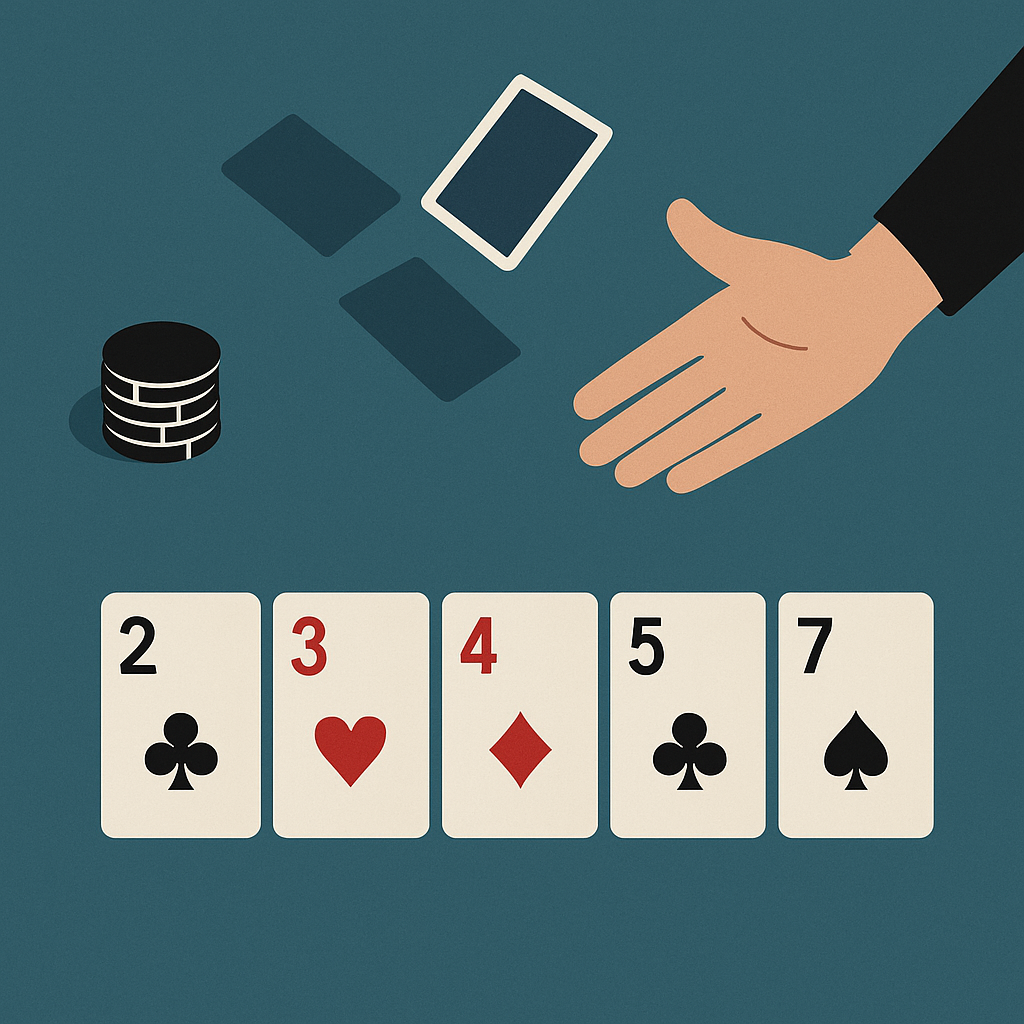
Snowing—standing pat with garbage to represent strength—represents the most sophisticated bluffing technique unique to 2-7 Triple Draw poker, evolving from a simple positional bluff into a complex strategic weapon requiring mathematical precision, psychological mastery, and perfect timing. Modern analysis reveals that optimal snowing frequencies range from 25-35% in position with appropriate holdings, while AI research values successful snows at approximately 78% of pot equity compared to 55% for drawing, making well-executed snows mathematically superior to continuing draws in many situations.
Evolution from Gentleman’s Game to Mathematical Warfare
2-7 Triple Draw gained mainstream recognition when the WSOP introduced it in 2004, but the strategic concept of snowing developed alongside high-stakes mixed games where elite players refined deception techniques away from public scrutiny. Daniel Negreanu’s foundational strategy section in Doyle Brunson’s “Super System 2” (2005) first documented snowing systematically, establishing the framework that modern players still reference.
The game’s inclusion as a regular WSOP event since 2007, culminating in the prestigious $10,000 Championship added in 2014, accelerated strategic evolution as top professionals competed for major titles. The fundamental mechanics of snowing exploit the limited information available in draw poker—opponents can only observe betting patterns and draw counts, not actual cards.
Unlike semi-bluffs in Hold’em that retain equity, snowing eliminates all chance of improvement, making it a pure bluff requiring maximum conviction. Standing pat naturally represents a strong made hand, creating immediate pressure on opponents still drawing cards. The technique works because pot odds in limit structure often reach 5:1 or 6:1 by later streets, meaning snows need only succeed 16-17% of the time to show profit—a remarkably low threshold that makes aggressive snowing mathematically sound.
AI Valuation of Snowing
Nikolai Yakovenko’s neural network analysis provides concrete valuation:
- Pat (snow) decisions: $311 value in a $400 pot
- Two-card draws: $222 value in same situation
- Mathematical advantage: 40% higher EV for snowing
This quantitative foundation transforms snowing from intuitive bluffing into calculated opportunity cost analysis.
Masters of Deception and Their Signature Moves
Phil Ivey exemplifies elite snowing execution, demonstrated in his legendary online hand against patpatpanda where he stood pat with Q♠7♥5♦3♠2♣ and moved all-in for $123,805, getting called by the second nuts—showcasing the psychological warfare possible at highest stakes. Ivey’s 2024 WSOP $10,000 Championship victory, requiring an unscheduled fourth day to complete, reinforced his dominance in draw games where deception matters most.
Nick Schulman, who won the 2-7 Single Draw Championship three times (2009, 2012, 2025), brings similar expertise to Triple Draw, finishing second in the 2025 $10,000 Championship after battling for over four hours three-handed. His aggressive style and psychological insights make him particularly dangerous when implementing sophisticated bluffing strategies.
Daniel Negreanu provided crucial strategic documentation through his 2013 WSOP hand analysis, where he held pat 10-low in a three-way pot with Michael Mizrachi all-in. Negreanu bet knowing David Baker “absolutely knows for certain I’m not snowing” due to the all-in player requiring showdown, demonstrating how situational factors affect snowing viability. His quote reveals the meta-game complexity: “My intention with the bet is to get David to fold hands like 98234 or 2347T that beat me, since he knows I’m not bluffing because I have to show my hand.”
| Player | Notable Achievement | Snowing Style | Career Earnings (2-7) |
|---|---|---|---|
| Phil Ivey | 2024 $10K Championship | Ultra-aggressive, all-in snows | $347,440+ |
| Nick Schulman | 3x Single Draw Champion | Balanced, position-based | $1,325,000+ |
| John Hennigan | 2016 $10K Championship | Mathematical, GTO-influenced | $320,103+ |
| Phil Galfond | High-stakes specialist | Exploitative, opponent-specific | Undisclosed |
Mathematical Precision Meets Game Theory Optimization
The mathematical framework for optimal snowing reveals position-dependent frequencies that vary dramatically based on opponent draw patterns. Against opponents drawing three cards, successful snow rates reach 60-80%, while those drawing one card create only 20-40% success rates. This differential guides frequency decisions, with GTO analysis suggesting 15-25% snowing frequency from early position increasing to 30-45% in late position against weak draws.
Blocker effects prove crucial for hand selection, with cards 5 through 9 providing maximum blocking value by reducing opponents’ wheel-making probability by 8-12% per duplicate holding. The hierarchy of optimal snowing candidates places full houses and trips with good removal (like 6-6-6-5-5 or 8-8-8-7-5) at the top, followed by trip deuces (2-2-2-K-J) with minimal improvement potential, then failed straight draws holding multiple blockers.
Randy Ohel’s analysis emphasizes that “any card nine or better is a snow blocker for sure,” while hands with multiple straight draws make optimal candidates because continuing carries significant risk of making straights. The expected value calculation becomes:
Expected Value Calculation
Draw EV = (Probability of making hand × Value if made) – (Probability of busting × Cost of busting)
Snow EV = (Fold frequency × Current pot size) – (Call frequency × Additional betting costs)
Counter-strategies require mathematical precision in defense frequencies. Given typical pot odds of 5:1 to 7:1 on the river, minimum defense frequencies demand calling with approximately 14-16% of hands. Against aggressive snowers, this translates to calling with any 10-low or better (35-40% of hands), while balanced opponents require calls with 9-low or better (25-30% of hands).
The Gentleman’s Snow and Other Sophisticated Variations
The “Gentleman’s Snow” represents the most common and believable snowing line—drawing one card initially, then standing pat on the second draw regardless of improvement. Matt Glantz explains the etymology: “probably the most frequent snow line taken… considered the most gentlemanly way to represent strength.” This technique targets late position raisers with rough one-card draws, converting hands like 4-6-7-8-X that catch bricks into aggressive pat bluffs.
Pre-draw snows involve standing pat immediately with complete garbage, optimal for hands with virtually no improvement potential like trip deuces (2-2-2-9-J). These hands provide excellent blockers while having minimal chance to improve legitimately. The exception involves premium trips like 2-2-2-4-7 or quad deuces with a wheel card (2-2-2-2-3) that retain legitimate improvement potential and shouldn’t be wasted on bluffs.
Developed snows emerge from drawing hands that encounter unfavorable developments—hitting two pair or trips when needing low cards, or recognizing blocked outs when multiple needed cards appear. The “D2/D1 Turn Snow” exploits specific dynamics where one player draws two cards and another draws one on the second draw, allowing the two-card draw player to raise with busted hands and stand pat.
Multi-street snows maintain bluffs across multiple betting rounds, requiring strong reads that opponents remain weak and drawing. This most dangerous variation demands careful opponent selection and maximum commitment, as it provides multiple opportunities for opponents to improve or recognize the bluff through betting pattern analysis.
Digital Revolution Transforms Strategic Landscape
The 2020-2025 period witnessed significant strategic evolution driven by increased online accessibility and sophisticated training content. PokerStars dominates online 2-7 Triple Draw, offering games from $0.10/$0.20 to $1,000/$2,000 stakes with weekly guaranteed tournaments including $5,000 events and championship series featuring $25,000-$75,000 guarantees. GGPoker emerged as secondary platform, though dedicated solver technology remains limited compared to Hold’em.
Online play enables sophisticated opponent tracking through standard software like PokerTracker 4, monitoring drawing patterns, betting frequencies, and showdown tendencies. However, the complex nature of multiple draws limits statistical depth compared to Hold’em. The faster online pace allows more snowing opportunities per session while HUD data identifies opponents’ calling tendencies, though multi-tabling reduces attention to draw patterns necessary for optimal execution.
Run It Once became the premier training platform, featuring multiple video series covering basic through advanced concepts, high-stakes session reviews at $400/$800, and specialized snowing content. The WSOP’s consistent growth shows increasing participation—Event #63’s $1,500 Limit 2-7 Triple Draw attracted record 635 entries in 2025, while Alexander Wilkinson’s Event #71 $10,000 Championship victory ($333,054) demonstrated the game’s continuing prestige.
Learn 2-7 Triple Draw Fundamentals
Master the basics before attempting advanced snowing techniques:
Psychological Warfare and Practical Execution
Successful snowing requires unwavering confidence and emotional control under maximum pressure. Doug Polk identifies the core obstacle: “The most common mistake I see from players when it comes to bluffing is letting fear keep them from pulling the trigger.” This fear manifests as reluctance to risk chips, embarrassment about failed bluffs, and anxiety about looking foolish at showdown.
Position provides crucial advantages with late position offering maximum information about opponents’ draws before committing to snows. Stack-to-pot ratios dramatically affect viability—deep cash game stacks enable multi-street campaigns while tournament ICM pressure reduces bluffing frequencies by 20-30% in high-pressure situations. The psychological profile of optimal targets includes aggressive but straightforward players who fold to consistent pressure, while calling stations and recreational players focused solely on their cards should never face snows.
Common execution errors include timing mistakes like checking after standing pat (destroying credibility), poor opponent selection (snowing calling stations), and ignoring blocker considerations. The classic failure pattern involves drawing one to rough hands, catching terrible cards, standing pat but then checking when opponents show weakness—proper execution demands betting when opponents check and continuing aggression if they draw again.
Building optimal table image requires balancing snowing frequency with legitimate holdings at roughly 1:2 ratio. Strategic showing of successful snows establishes capability while never revealing failed attempts. Image management varies by opponent type—increasing frequency against tight players, dramatically reducing against loose opponents, and using aggressive players’ tendencies against them through thin value betting.
Revolutionary Insights for the Modern Player
The integration of mathematical precision, psychological mastery, and strategic discipline creates optimal snowing execution. Key performance indicators include targeting 45-55% overall success rate while maintaining 80% accuracy in bluff-catching spots. The decision framework requires assessing draw quality and improvement odds, calculating blocker effects and likely holdings, determining pot odds and betting requirements, then executing mixed strategies based on position and opponent type.
Professional analysis reveals that “a good triple draw player is very aggressive and snows more often than his opponents”, but frequency must adjust to table dynamics and opponent tendencies. Never freeze up after being caught—premium hands receive more action when you’ve established a snowing image. The psychological element often trumps cards themselves, with confidence and image mattering more than specific holdings.
Key Takeaways: Mastering the Art of Snowing
- Optimal Frequencies: 25-35% in position, 15-25% out of position
- Success Rates: 60-80% against three-card draws, 20-40% against one-card draws
- Best Candidates: Trips with blockers, failed straight draws, hands with 5-9 blockers
- Mathematical Edge: Snows worth 78% of pot equity vs 55% for drawing
- Defense Strategy: Call with 14-16% of hands minimum given pot odds
- Common Variations: Gentleman’s snow, pre-draw snow, developed snow, multi-street snow
- Psychological Keys: Unwavering confidence, proper timing, opponent selection
Recent developments show movement toward GTO-based approaches in high-stakes games with continued refinement of position-dependent strategies. The lack of dedicated solver technology compared to Hold’em creates opportunities for thinking players to gain edges through superior understanding rather than computational analysis. Growing tournament presence and educational resources suggest continued evolution, though technological limitations may slow development compared to mainstream variants.
The mastery of snowing in 2-7 Triple Draw represents poker’s purest form of deception—no shared cards provide information, no runner-runner miracles save failed bluffs, only pure psychological warfare executed through mathematical precision. Elite practitioners combine technical excellence with mental fortitude, transforming garbage hands into profitable weapons through perfect timing, optimal frequency, and unwavering conviction. In this unique poker variant where standing pat with nothing becomes art form, the players who master snowing’s delicate balance between mathematics and psychology claim consistent edges in poker’s most deceptive game.
Frequently Asked Questions
The Future of Snowing Strategy
As 2-7 Triple Draw continues evolving from niche variant to mainstream mixed game staple, snowing strategies will undoubtedly become more sophisticated. The absence of dedicated solver technology creates unique opportunities for creative players to develop exploitative strategies based on observation and experience rather than computational analysis.
The game’s growing presence in 10-Game and other mixed formats ensures that mastering snowing remains essential for serious players. Whether competing in the online arenas or at live championship events, understanding when to transform garbage into gold through well-timed snows separates competent players from true masters.
For those seeking to elevate their game beyond basic hand rankings and trapping, snowing represents the final frontier—where psychology, mathematics, and pure nerve converge to create poker’s most sophisticated form of deception. In the immortal words of poker legend Doyle Brunson, “The key to No-Limit… is to put a man to a decision for all his chips.” In 2-7 Triple Draw, snowing accomplishes this through standing pat with nothing, proving that sometimes the best draw is no draw at all.
About the Author

Mixed Game Masters Editorial
Published: October 21, 2025 | Categories: Tournaments & Events, Draw & Lowball
Mixed Game Masters is the premier resource for non-Hold’em poker strategy, tournament coverage, and mixed game education. Our editorial team consists of experienced players and poker historians dedicated to preserving and sharing the rich history of poker’s most challenging variants.
We provide comprehensive coverage of draw games, lowball variants, and mixed game formats, helping players of all levels improve their skills beyond traditional No-Limit Hold’em.
Leave a Reply