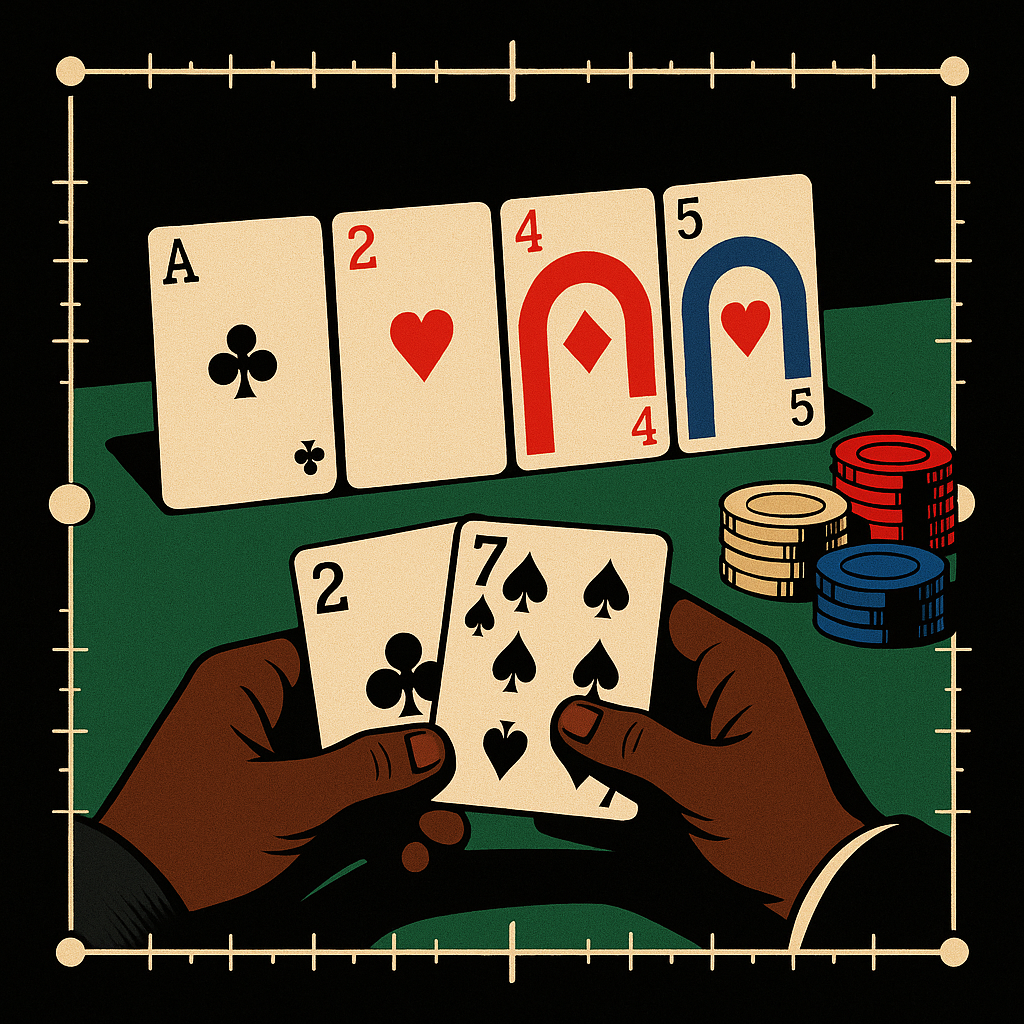
Badacey Historical Tech: Dual Lowball Draw Aids

Badacey poker emerged from the shadows of Las Vegas high-stakes games around 2007, representing one of poker’s most intriguing evolutionary branches—a split-pot variant that combines Badugi with Ace-to-Five lowball, yet its exact origins remain mysteriously unknown even to the game’s most devoted practitioners. The game splits each pot between the best four-card Badugi hand and the best five-card A-5 lowball hand, creating a complex strategic landscape that has captivated mixed game specialists while remaining largely inaccessible to casual players due to an almost complete absence of technological support and training tools.
From Underground Innovation to WSOP Recognition
The creation of Badacey represents a pivotal moment in poker’s transition away from traditional HORSE rotations. Between 2005 and 2007, as HORSE games “stopped being cool” according to contemporary players, mixed game specialists began experimenting with split-pot combinations of draw games. Professional player Bryan Devonshire documented this transition in Card Player Magazine, noting that these “mysterious Asian games that spawned forth from badugi” first appeared in Vegas casinos around 2007, though “where they came from is unknown to this guy or the internet.” The games emerged organically from the mixed game community’s desire to create more action and challenge experienced players beyond traditional formats.
The game’s transition from underground curiosity to mainstream recognition accelerated with its 2014 inclusion in the inaugural WSOP $1,500 Dealer’s Choice Six-Handed event. This tournament featured 16 game variants including Badacey (sometimes spelled “Badacy”), establishing it as part of poker’s official competitive landscape. Since 2016, WSOP Dealer’s Choice events have consistently featured the same 20 poker variants, with Badacey maintaining its position alongside more established games. The $10,000 Dealer’s Choice Championship, added in 2015, further cemented Badacey’s status in high-stakes mixed game rotations.
Tournament participation has grown steadily, with the 2014 inaugural $1,500 Dealer’s Choice event drawing 419 entries and awarding $147,092 to winner Robert Mizrachi. By 2025, the same event attracted 597 entries with a $150,246 first prize to Benny Glaser, demonstrating the game’s expanding player base. The $10,000 championship events typically draw 100-150 players with first prizes ranging from $300,000 to $350,000, attracting the world’s elite mixed game specialists.
The Specialists Who Mastered Split-Pot Complexity
Badacey’s strategic complexity has produced a distinct cadre of specialists who dominate mixed game tournaments. Benny Glaser stands as perhaps the game’s most successful practitioner, with eight WSOP bracelets all earned in mixed game events. His 2025 performance was historic—winning three bracelets in a single series including the $1,500 Dealer’s Choice event, joining an elite group of only eight players to achieve this feat. Glaser’s dominance extends online with 15 WCOOP titles and 11 SCOOP titles, though notably these achievements come from other mixed games since Badacey isn’t available on PokerStars.
Mike Gorodinsky, the 2015 WSOP Player of the Year, has captured five WSOP bracelets across mixed game variants from 2013 to 2025, including a dramatic comeback from a 7-to-1 chip deficit to win the 2025 $10,000 Eight Game Mixed Championship. George Danzer‘s remarkable 2014 campaign saw him win three WSOP bracelets and the Player of the Year award, establishing himself as one of mixed gaming’s elite with over $4 million in live earnings. Adam Friedman’s three victories in the $10,000 Dealer’s Choice Championship (2018, 2019, 2021) and Chad Eveslage’s unprecedented sweep of both Dealer’s Choice events in 2023 further demonstrate the specialized skill set required for Badacey mastery.
The Technological Void That Shapes Modern Play
Perhaps the most striking aspect of Badacey’s development is the near-complete absence of technological support—a void that fundamentally shapes how the game is learned and played. Unlike Hold’em or Omaha, which benefit from sophisticated solvers, tracking software, and training apps, Badacey exists in what amounts to a technological dark age. SwC Poker (SWCPoker.club) remains the sole online platform offering regular Badacey games, providing both cash games and tournaments to a small but dedicated player base.
The Software Desert
What doesn’t exist for Badacey:
- No GTO solvers or equilibrium calculators
- No support in PokerTracker 4 or Holdem Manager 3
- No equity calculators or hand range tools
- No training apps or drill software
- No availability on PokerStars, GGPoker, or other major sites
PokerStars, the world’s largest online poker site, explicitly refuses to add Badacey, with Pokerfuse reporting in 2024 that “the likes of Baducey and Badacey are not available on the platform, and it is not likely the operator will go through the trouble of adding them to please a very small potential player pool.” This absence extends to software tools—PokerTracker 4 and Holdem Manager 3 offer no Badacey support, nor do any mainstream poker calculators or equity tools. ProPokerTools, once a potential resource, remains offline with its creator uncertain about returning.
The solver revolution that transformed Hold’em and Omaha has completely bypassed Badacey. No GTO solvers exist for the game, and according to CardsChat, while “solvers exist for Omaha/8, various Stud games, triple draw” and other mixed games, “these are privately held and tough to access. The people who own mixed-game solvers aren’t interested in sharing them.” This technological gap means players must rely on experience, intuition, and limited educational resources rather than computational analysis.
Strategic Evolution Through Scarce Resources
Despite technological limitations, Badacey strategy has evolved through dedicated study and documentation by a small group of specialists. Ken Lo’s “A Poker Player’s Guide to Mixed Games” (2014), a comprehensive 696-page tome covering twelve variants, provides the foundational text for Badacey study. Dylan Linde’s “Mastering Mixed Games” (2019) refined this knowledge, offering what many consider the current gold standard for mixed game instruction across 304 efficiently structured pages including quizzes and hand examples.
The strategic framework that has emerged emphasizes extreme selectivity in starting hands, with positional opening ranges varying from 10.3% in early position to 40.4% on the button. Premium holdings like A♣ 3♥ 5♦ offer scoop potential—the ability to win both halves of the pot—which drives optimal strategy. Mathematical analysis reveals that with 16 key improvement cards available, drawing two cards provides approximately a 57% improvement rate, making precise draw decisions crucial for long-term success.
| Position | Opening Range | Key Holdings | Strategy Focus |
|---|---|---|---|
| Early Position | 10.3% | A-2-3-x, A-2-4-x | Scoop potential only |
| Middle Position | 18.5% | A-2-5-x, A-3-4-x | Strong both ways |
| Cut-off | 27.2% | A-x-x-x smooth | Position leverage |
| Button | 40.4% | Any 3-card 7 | Steal and realize |
CountingOuts.com, maintained by former MetLife actuary turned mixed games specialist Kevin Haney, provides the internet’s most comprehensive Badacey strategy content. Yet even this resource acknowledges the game’s informational poverty: “No published material exists on this game nor is there very much in the way of online resources.” Players seeking video instruction face similar limitations—Run It Once’s 8,500+ training videos include minimal Badacey content, while Upswing Poker’s $999 “Mixed Game Mastery” course covers related games but omits Badacey entirely.
Draw Mechanics Innovation Without Technological Aid
The triple-draw structure of Badacey, with its three drawing rounds and four betting streets, creates complex decision trees that in other poker variants would be analyzed through simulation and solver work. Instead, Badacey players must manually calculate drawing probabilities and rely on pattern recognition developed through thousands of hands. The game’s unique split between Badugi (requiring four different suits and ranks) and A-5 lowball (where straights and flushes don’t count against you) means optimal drawing decisions often conflict—keeping 2♥ 4♥ 6♥ might strengthen your low while weakening your Badugi potential.
Technology has helped players understand drawing decisions primarily through basic probability calculations shared in forums and strategy articles rather than through dedicated software. The absence of simulation tools means concepts like “keeping valuable low cards even if they don’t contribute to Badugi” emerged through trial and error in live games rather than computational analysis. The strategic principle that “7♥ decisions are contextual—discard multiway, consider keeping heads-up” represents wisdom earned through experience rather than solver output.
Community Development in Analog Spaces
Badacey’s community has developed primarily through live poker rooms and home games rather than online platforms. The game appears regularly in high-stakes mixed games at Las Vegas venues like Aria and Bellagio’s Legends Room (formerly Bobby’s Room), where it’s “almost always included in any mixed rotation that includes draw variants.” Home game adoption has been facilitated by “Abby’s Mixed Game Cards,” a popular reference system that helps players navigate the rules of various poker variants including Badacey.
Online community discussion remains limited to scattered threads on TwoPlusTwo forums and PokerChipForum, where players share hands and debate strategy without the benefit of database analysis or simulation results. The game’s 6-handed maximum due to deck limitations creates intimate playing environments that foster the oral tradition of strategy sharing—a marked contrast to the data-driven approach dominating mainstream poker variants.
Private high-stakes games and mixed game specialists have become the primary vessels for preserving and advancing Badacey knowledge. Coaches like Jeff Madsen ($7M+ in tournament earnings) and Jake Abdalla offer private instruction, while players must often travel to major poker destinations to find regular Badacey action. This geographic concentration has created pockets of expertise while limiting broader adoption.
The Paradox of Complexity Without Computational Support
Badacey represents a unique paradox in modern poker—a game whose strategic complexity rivals or exceeds many solver-supported variants, yet exists almost entirely without computational analysis. Players must simultaneously optimize for two different winning conditions while navigating multi-street drawing decisions, position-based ranging, and split-pot dynamics, all without access to GTO solutions or equity calculators. This has created what amounts to a pure game-theory experiment conducted through live play rather than simulation.
The absence of solvers has preserved Badacey as one of poker’s last frontiers for purely exploitative play. Without GTO baselines, players must develop reads, identify patterns, and adjust strategies based on observation rather than deviation from computed equilibrium. This creates massive skill edges for experienced players while presenting nearly insurmountable barriers for newcomers accustomed to solver-assisted learning in other variants.
Professional players have noted this dynamic creates unusual market inefficiencies. The game appears in the highest-stakes mixed games—$400/$800 limit and above—yet lacks the basic analytical infrastructure available for $0.01/$0.02 online Hold’em. This inversion of technological support relative to stakes represents a fascinating anomaly in poker’s ecosystem.
Master Badacey and Mixed Games
Ready to explore the world of draw games and mixed variants? Start your journey:
Frequently Asked Questions
Looking Forward: The Future of Analog Excellence
Badacey’s evolution from mysterious origin to WSOP staple illustrates both poker’s capacity for innovation and the limits of technological disruption in niche variants. Born from the creative ferment of mid-2000s mixed game culture, Badacey has achieved institutional recognition through WSOP inclusion and cultivation by elite specialists like Benny Glaser and Mike Gorodinsky. Yet it remains fundamentally unchanged by the technological revolution that transformed mainstream poker, existing in a curious twilight zone where $300,000 first-place prizes are won using strategies developed through intuition and experience rather than computational analysis.
The game’s future likely depends on whether the technological void that defines it represents a barrier or a feature. The absence of solvers preserves Badacey as a haven for poker purists who value reads over ranges and experience over equilibrium. Yet this same absence limits growth, making the game inaccessible to a generation of players accustomed to app-assisted learning and solver-verified strategies. As mixed games experience renewed interest and online poker platforms seek differentiation, Badacey stands at a crossroads—poised for either technological modernization that could democratize access or continued existence as poker’s most complex analog game, where mastery comes not from software but from the accumulated wisdom of thousands of split pots won and lost.
Key Takeaways: Badacey’s Unique Position in Modern Poker
- 2007: Badacey emerges from Vegas high-stakes games, origins unknown
- 2014: WSOP Dealer’s Choice event includes Badacey, achieving mainstream recognition
- Technology Gap: No solvers, tracking software, or training tools exist
- Single Platform: SwC Poker remains the only online site offering Badacey
- Elite Specialists: Benny Glaser, Mike Gorodinsky lead limited field of experts
- Educational Resources: Two books and one website provide primary instruction
- Strategic Complexity: Split-pot dynamics create unique challenges without computational support
About the Author
Mixed Game Masters Editorial
Published: August 29, 2025 | Categories: Tournaments & Events, Draw & Lowball
Mixed Game Masters is the premier resource for non-Hold’em poker strategy, tournament coverage, and mixed game education. Our editorial team consists of experienced players and poker historians dedicated to preserving and sharing the rich history of poker’s most challenging variants.
We provide comprehensive coverage of draw games, lowball variants, and mixed game formats, helping players of all levels improve their skills beyond traditional No-Limit Hold’em.
Leave a Reply