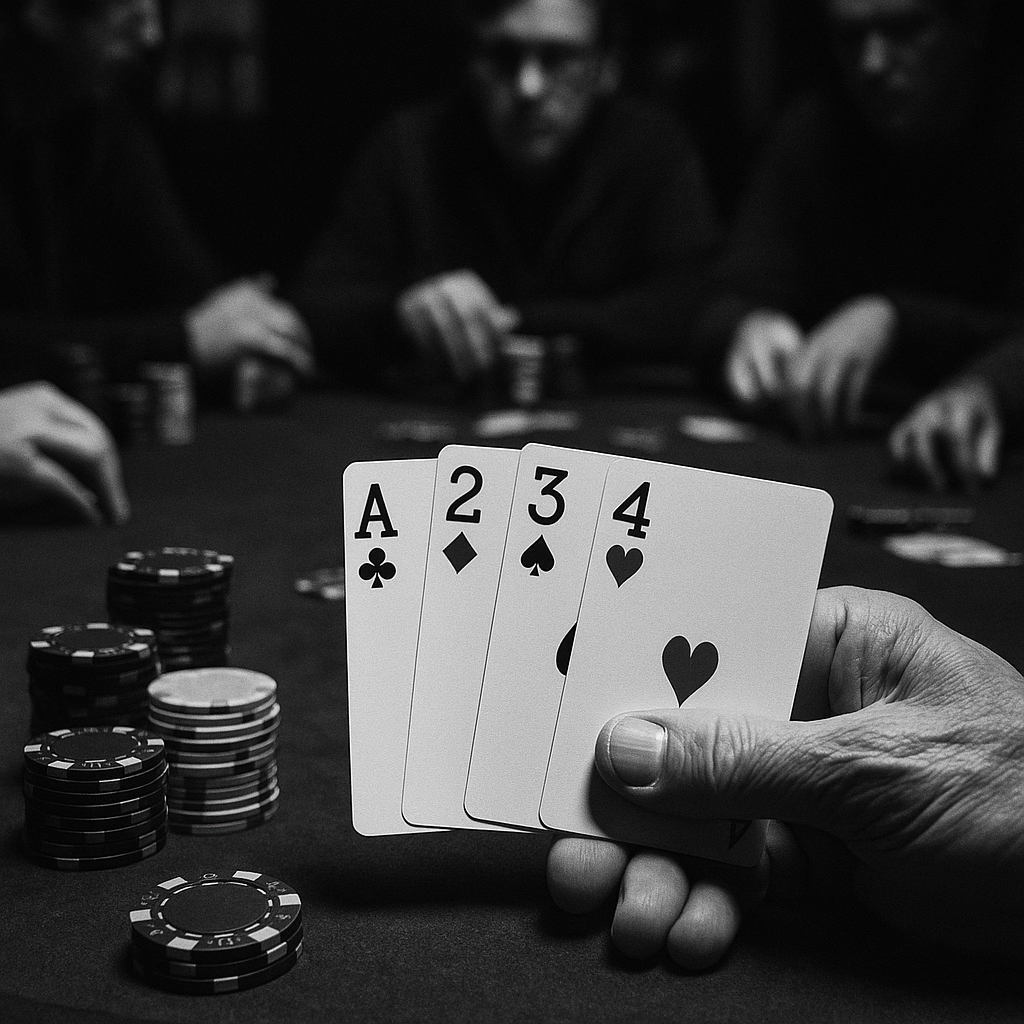
Badugi Brilliance: Classic Hands and What We Can Learn

When Phil Hellmuth chose Badugi for what would become the final hand of the 2021 WSOP Dealer’s Choice Championship, he unknowingly created one of poker’s most historically significant moments. Adam Friedman’s 9♥6♣5♦2♠ not only denied Hellmuth his 17th bracelet but secured an unprecedented third consecutive victory in the same WSOP event. This hand epitomizes Badugi’s journey from Korean card rooms to poker’s biggest stages, where mathematical precision meets psychological warfare in the pursuit of four-card perfection.
From Seoul to Vegas: Badugi’s Global Journey
Badugi’s transformation from an obscure Korean variant to a WSOP championship event represents one of poker’s most unlikely success stories. The game first appeared in American card rooms in the 1980s, brought by Korean immigrants who called it “padooki” or “badougi.” By the early 2000s, high-stakes mixed game players had discovered its strategic depth, incorporating it into the biggest cash games at the Bellagio.
The watershed moment came in 2023 when the WSOP introduced Event #20, the first standalone $1,500 Badugi championship. Michael Rodrigues of Portugal made history by defeating 515 opponents to claim $144,678, declaring emotionally: “I’m the best Badugi player in the world!” This wasn’t mere bravado – Rodrigues had studied optimal discard strategies for years, preparing for this moment.
The event’s growth has been remarkable. After a slight dip to 478 entries in 2024, the 2025 field surged to 534 players, generating a $708,885 prize pool – the largest in Badugi history. This 11.7% year-over-year growth suggests the variant has found its competitive niche alongside established games.
Championship Hands That Changed History
The Hand That Denied History
2021 WSOP $10,000 Dealer’s Choice Championship Final
Phil Hellmuth: [concealed inferior Badugi]
Adam Friedman: 9♥6♣5♦2♠
Result: Friedman wins his third consecutive Dealer’s Choice title
The significance of this hand extends beyond denying Hellmuth his 17th bracelet. Both players stood pat through all three draws, creating maximum tension. Friedman’s nine-high Badugi represented solid strength – better than approximately 85% of all possible Badugis. The psychological element of Hellmuth specifically choosing Badugi for this crucial moment, only to be outplayed, adds layers to the narrative.
Television coverage of high-stakes mixed games has captured strategic brilliance, particularly in PokerGO’s “Dolly’s Game” featuring $400-$800 limits. A pivotal analyzed hand saw Shaun Deeb check-raise Kane Kalas, who held 10♦6♠5♣3♥ – a smooth ten Badugi near the top of his range. Kalas faced the classic dilemma: his 90% winning odds staying pat exceeded his 10% chance of improving, illustrating the mathematical precision required at elite levels.
| Year | Winner | Country | Prize | Field Size | Winning Hand |
|---|---|---|---|---|---|
| 2023 | Michael Rodrigues | Portugal | $144,678 | 515 | 9♣4♥3♦2♠ |
| 2024 | David Prociak | USA | $129,676 | 478 | Not recorded |
| 2025 | Aloisio Dourado | Brazil | $138,114 | 534 | 6♣5♦4♥2♠ |
The Perfect Storm: Dourado’s Championship Moment
The 2025 championship’s decisive hand showcased textbook execution when Aloisio Dourado’s 6♣5♦4♥2♠ defeated Dominick Sarle’s J♣8♦6♠A♥ heads-up. Dourado entered with a 3:1 chip lead and closed efficiently, demonstrating how premium Badugis below eight-high dominate in championship moments. His six-high Badugi ranked in the top 2% of all possible holdings – a hand worth playing for stacks in any situation.
The Mathematical Framework of Excellence
Understanding Badugi’s probability structure separates casual players from champions. Being dealt a pat Badugi occurs just 6.3% of the time – similar to pocket pairs in Hold’em. However, the distribution heavily favors weak holdings:
Pat Badugi Distribution
- King-high: 220 combinations (30.8%)
- Queen-high: 165 combinations (23.1%)
- Jack-high: 120 combinations (16.8%)
- Ten-high: 80 combinations (11.2%)
- Nine-high: 50 combinations (7.0%)
- Eight-high or better: 80 combinations (11.2%)
Total: 715 possible pat Badugis from 270,725 four-card combinations
This distribution explains why three-card aggression often dominates dealt pat hands. A premium three-card hand like A-2-3 rainbow completes to eight-high or better 50% of the time, while the median dealt pat Badugi ranks at Q7 – a marginal holding in most situations.
Drawing probabilities drive optimal decision-making. The formula for completing a Badugi from a three-card hand over three draws: 1 – (38/48) × (37/47) × (36/46) = 51%. This means drawing is slightly favored over three attempts, fundamentally shaping aggressive strategies with strong draws.
Strategic Evolution: From ABC to GTO
Early Badugi strategy followed simple principles: draw to the nuts, stand pat with any Badugi, and avoid complex bluffs. Modern understanding has revolutionized every aspect of play, particularly the concept of “snowing” – standing pat with incomplete hands to represent strength.
Barry Greenstein’s seminal work “The Badugi Chapter” established the mathematical framework still used today. His analysis revealed that over 80% of pat Badugis are ten-high or worse, fundamentally changing opening standards. Greenstein’s principle that “position matters more than cards” transformed strategic thinking.
Modern position-based frequencies reflect this evolution:
- Early Position: Jack-high Badugis or better, smooth seven-high three-card hands
- Middle Position: All Badugis, eight-high three-card hands, premium two-card draws
- Button: All Badugis, nine-high tris, select two-card holdings (A-2, A-3, 2-3)
- Blinds Defense: Frequency-based, defending 60-75% versus button opens
The revolution in multi-way dynamics has been particularly striking. With two players drawing from three-card hands, there’s a 75% chance at least one completes a Badugi. This mathematics drives the counterintuitive strategy of breaking weak pat hands in family pots – a play that distinguishes experts from amateurs.
The Specialists Who Mastered Four Cards
Barry Greenstein stands as Badugi’s foremost authority, described universally as “the world’s foremost expert on lowball poker.” His analytical approach transformed understanding of hand values and drawing decisions. Despite his book being just 24 pages, it remains essential reading for serious players, containing hand rankings and examples from the highest stakes.
Nick Schulman, inducted into the Poker Hall of Fame in 2025, exemplifies modern mixed game mastery. While known primarily for his three WSOP bracelets in 2-7 Single Draw, his expertise transfers directly to Badugi. His seven total bracelets and over $24 million in tournament earnings demonstrate the value of mastering multiple variants.
The high-stakes ecosystem at Bellagio’s “Big Game” features regular $400-$800 Badugi action during WSOP, with participants including:
- Todd Brunson: Stated in 2009 that Badugi and triple-draw were his preferred games
- Shaun Deeb: Seven-time bracelet winner whose aggressive style translates perfectly to Badugi
- George Danzer: 2014 WSOP Player of the Year who streams educational content on Twitch
- Jean-Robert Bellande: Claims to have invented “Baduci,” the Badugi/2-7 split variant
Mixed Game Integration and Innovation
Badugi’s incorporation into mixed formats has driven widespread adoption. Badacey combines Badugi with A-5 lowball in a split-pot format where aces play low in both halves. Players receive five cards with three draws, making A-2-3-4 rainbow the ultimate hand for scooping both pots.
Badeucey increases difficulty by pairing Badugi with 2-7 lowball where aces play high. This fundamental change makes 2-3-4-5 rainbow optimal for Badugi while 7-5-4-3-2 wins the lowball half. The ace disadvantage completely alters hand selection strategies.
The 10-Game mix briefly served as the Poker Players Championship format from 2015-2016, including Badugi alongside Razz, various stud games, and big-bet variants. Player resistance to the expanded format led to its reversion, but Badugi retained its place in 8-Game rotations.
Master Badugi Strategy
Ready to elevate your Badugi game? Explore our comprehensive guides:
The Future of Badugi Excellence
Online platforms, particularly PokerStars with stakes from $0.25/$0.50 to $200/$400, have created laboratories for strategic development. The ability to play thousands of hands monthly has accelerated learning curves, revealing nuances impossible to discover in live play. Yet the absence of comprehensive solver work presents opportunity – Badugi remains poker’s last unsolved frontier.
The 2025 WSOP’s record field included notable casualties – Phil Hellmuth, defending champions Rodrigues and Prociak, plus established pros like Ari Engel and Dan Smith – demonstrating the event now attracts elite competition. Final table compositions reveal international appeal, with winners representing Portugal, United States, and Brazil, suggesting global growth potential.
As mixed games gain popularity and players seek edges beyond saturated Hold’em markets, Badugi offers a frontier where mathematical understanding, psychological warfare, and creative adaptation converge. The game’s unique mechanics – where position pressures weak ranges and breaking made hands can be correct – create complexity that rewards deep study.
Frequently Asked Questions
Looking Forward: The Brilliance Continues
From Phil Hellmuth’s fateful decision to choose Badugi for his championship moment to Michael Rodrigues’s emotional coronation as the first standalone champion, the game has produced moments that transcend mere cards and chips. Each hand teaches lessons about patience, position, and the paradox of breaking made hands to achieve greater strength.
The mathematical elegance of Badugi – where 715 possible pat hands create a hierarchy as rigid as it is rare – appeals to purists who appreciate poker stripped to its essential elements. No community cards provide information, no board texture guides decisions. Players navigate solely through betting patterns, draw counts, and the fundamental mathematics that govern four-card combinations.
As the 2025 WSOP field surge demonstrates, Badugi’s brilliance continues attracting new disciples. Whether pursuing the perfect 4-3-2-A rainbow or executing a well-timed snow, players discover that mastery requires understanding not just what to do, but when breaking conventional wisdom leads to breakthrough moments. In Badugi, as in poker’s highest forms, brilliance emerges from the synthesis of mathematical precision and psychological intuition – a combination that ensures this Korean import’s permanent place in poker’s championship pantheon.
Key Takeaways: Lessons from Badugi Brilliance
- Pat Badugi Rarity: Only 6.3% of hands dealt pat, with 89% being ten-high or worse
- Position Paramount: Button can profitably open 40% of hands versus 10% in early position
- Multi-way Mathematics: 75% chance of completion with two players drawing from three-card hands
- Breaking Made Hands: Weak pat Badugis (Q/K-high) should often break in family pots
- Championship Growth: Field sizes increased from 515 (2023) to 534 (2025) players
- Strategic Evolution: Modern “snowing” frequencies range from 60-75% depending on opponents
About the Author
Mixed Game Masters Editorial
Published: October 21, 2025 | Categories: Tournaments & Events, Draw & Lowball
Mixed Game Masters is the premier resource for non-Hold’em poker strategy, tournament coverage, and mixed game education. Our editorial team consists of experienced players and poker historians dedicated to preserving and sharing the rich history of poker’s most challenging variants.
We provide comprehensive coverage of stud games, lowball variants, and mixed game formats, helping players of all levels improve their skills beyond traditional No-Limit Hold’em.
Leave a Reply