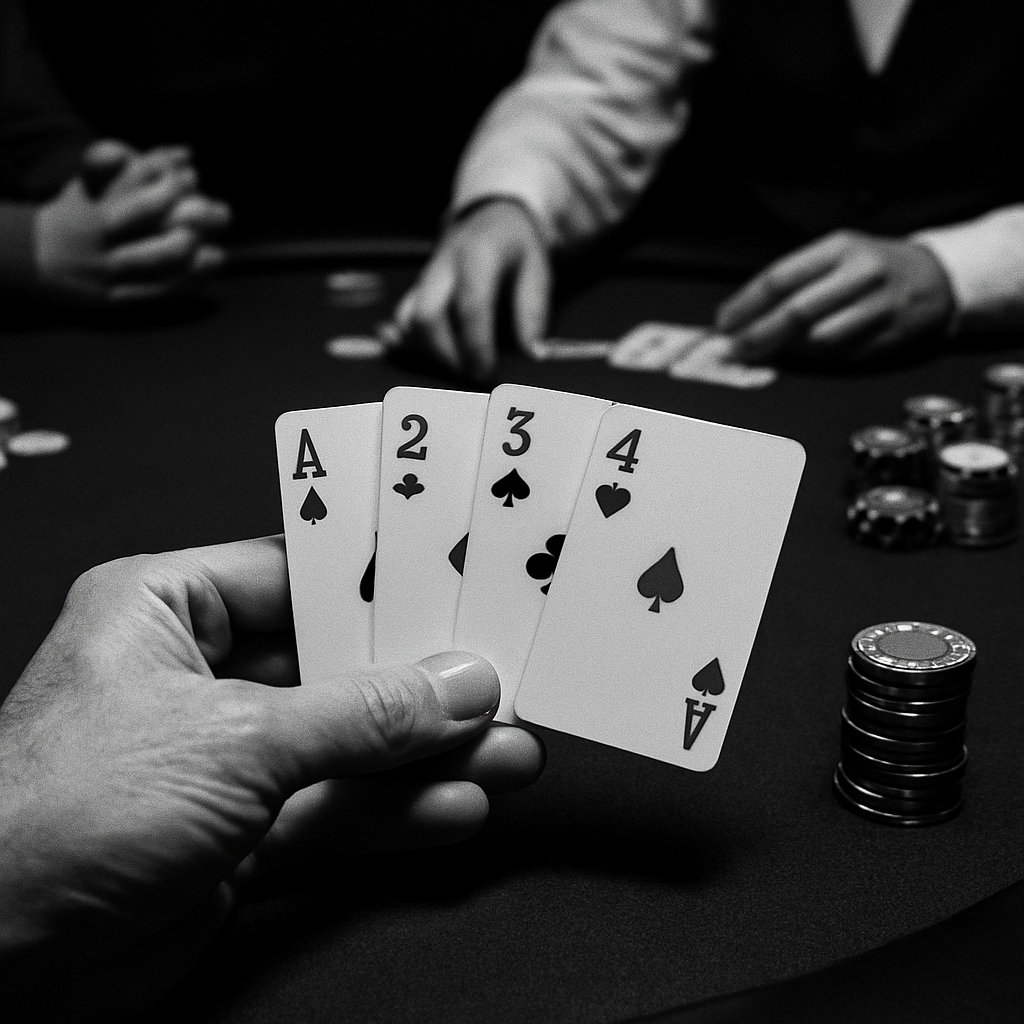
Badugi Classic Rainbow Hands: Four-Suit Draw Decisions

When you hold four cards of different suits in Badugi, you possess poker’s most paradoxical treasure—a hand that’s simultaneously unbeatable against incomplete combinations yet vulnerable within its own elite category. These rainbow hands, occurring only 6.3% of the time, define the strategic complexity that makes Badugi one of poker’s most sophisticated draw games. Understanding when to stand pat, when to break, and how to extract maximum value from these precious holdings separates recreational players from professionals who’ve mastered the art of four-suit warfare.
Understanding Rainbow Hands in Badugi
A rainbow hand in Badugi represents the game’s ultimate achievement—four cards of different suits with no paired ranks. The term “rainbow” perfectly captures the diverse nature of these holdings, where hearts, diamonds, clubs, and spades combine to create what players call a “Badugi” or “pat hand.” This fundamental structure establishes an absolute hierarchy where any four-card rainbow hand automatically defeats any three-card, two-card, or one-card hand, regardless of the individual card ranks involved.
The strategic importance of rainbow hands extends far beyond their raw strength. When you’re dealt a complete Badugi, you hold guaranteed superiority over approximately 94% of all possible starting hands. This massive equity advantage creates unique dynamics where even the weakest possible rainbow hand—King-Queen-Jack-Ten unsuited—maintains positive expectation against opponents who must draw to complete their hands.
Professional players recognize that rainbow hands provide both immediate value and future leverage. The scarcity of these holdings means opponents must often assume you’re drawing when you stand pat, creating opportunities for both value extraction and sophisticated bluffing plays. Understanding how to navigate these dynamics while protecting your equity forms the cornerstone of winning Badugi strategy.
The Mathematics Behind Four-Suit Combinations
The probability framework underlying rainbow hands reveals why these holdings command such respect. From a standard 52-card deck, exactly 715 unique four-card rainbow combinations exist, representing just 6.3% of all possible starting hands. This scarcity becomes even more pronounced when considering premium holdings—only 10% of all dealt Badugis rank 8-high or better, while the median dealt Badugi sits at Queen-7 high.
Critical Probability Benchmarks
- Probability of being dealt any Badugi: 6.3%
- Success rate per draw with 3 different suits: 20.8%
- Cumulative success over 3 draws: 51%
- Opponent completes against your pat hand: 21% per draw
- Multiple opponents (3+) complete: 88% combined
The distribution of rainbow hands follows an exponential curve based on high card values. While only one possible 4-high Badugi exists (A-2-3-4 rainbow), there are 220 possible King-high combinations. This mathematical reality means that 30.8% of all dealt Badugis are King-high, creating frequent confrontations between marginal rainbow hands where precise hand reading and position become decisive factors.
Hand Rankings and Starting Values
The hierarchy of rainbow hands in Badugi follows strict rankings based on the highest card, with subsequent cards serving as tiebreakers. Understanding these rankings and their relative frequencies proves essential for both hand selection and post-draw decision-making.
| Category | High Card Range | Frequency | Strategic Classification |
|---|---|---|---|
| Premium | 4-high to 7-high | <0.5% | Always maximum aggression |
| Strong | 8-high to 9-high | 1.35% | Aggressive multiway |
| Playable | 10-high to Jack-high | 2.8% | Position-dependent |
| Marginal | Queen-high | 1.4% | Heads-up preferred |
| Weak | King-high | 1.95% | Proceed with caution |
Within each category, the specific card combinations create substantial equity differences. A hand like K-4-3-2 rainbow performs significantly better than K-Q-J-T rainbow due to superior blocker effects and break potential. Professional players adjust their aggression levels based on these nuances rather than treating all hands within a category equally.
Critical Draw Decisions
The decision to stand pat versus drawing with rainbow hands represents Badugi’s most crucial strategic inflection point. Professional consensus establishes clear guidelines that prevent costly errors while maximizing expected value.
Never break these rainbow hands:
- Any 8-high or better Badugi (regardless of action)
- Any 9-high Badugi in heads-up play
- Any 10-high or better Badugi with position
- Any Jack-high Badugi against multiple card draws
The mathematics supporting these guidelines prove compelling. When you hold a Jack-high Badugi against an opponent drawing one card, you maintain approximately 79% equity. Even against two opponents each drawing one card, your equity remains positive at roughly 42%. Breaking the hand sacrifices this guaranteed advantage for speculative improvement with limited outs.
The rare exceptions for breaking rainbow hands occur only with the absolute weakest combinations facing extreme multiway pressure. If holding K-Q-J-T rainbow against three or more opponents who’ve shown strength through multiple raises and single-card draws, breaking becomes marginally profitable—but only with maximum draws remaining. After the first draw, the mathematics shift decisively toward standing pat regardless of hand strength.
Positional Strategy for Rainbow Hands
Position fundamentally alters rainbow hand strategy through information asymmetry and action control. From the button, any rainbow hand merits raising, as acting last provides optimal draw decisions, betting control, and bluffing opportunities. Early position demands stricter standards—typically 10-high or better—since acting first eliminates information advantages and increases reverse implied odds.
Late position enables the powerful “snow” play—standing pat without a Badugi to represent strength. When early position opponents draw multiple cards, button players can stand pat with garbage and bet aggressively, generating substantial fold equity. This positional weapon becomes particularly effective when holding four cards of the same suit, as you block opponents’ outs in that suit while maintaining credible pat representation.
The positional advantage compounds through streets as each draw provides additional information. Consider this scenario: from the button, you observe two opponents draw two cards, then one card, then one card again. This pattern signals weakness, making even King-high Badugis profitable for value betting. The same hand from early position faces an information vacuum, unable to determine whether opponents improved or are desperately chasing.
Professional Tactics and Tournament Play
Elite players like George Danzer, the 2014 WSOP Player of the Year, emphasize aggressive value extraction with rainbow hands while incorporating sophisticated bluffing frequencies. Danzer advocates “patting bad hands and betting twice” when opponents show weakness, noting that fold equity justifies this play in carefully selected situations. This balanced approach prevents opponents from easily categorizing pat plays as guaranteed strength.
The 2025 WSOP Badugi Championship showcased optimal rainbow hand play when Aloisio Dourado captured the $138,114 first prize. His victory featured multiple instances of standing pat with marginal Badugis against aggressive opponents, demonstrating how tournament dynamics alter traditional cash game strategy. The final hand saw him defeat Dominick Sarle’s Jack-high Badugi with a six-high rainbow hand, illustrating how even moderate rainbow hands dominate late-stage play.
Professional Rainbow Hand Guidelines
- Raise immediately with any playable rainbow hand for protection
- Never slow-play premium Badugis—build pots early
- Incorporate 25% bluffing frequency when standing pat
- Adjust aggression based on specific card combinations, not just high card
- In tournaments, widen breaking ranges near bubble situations
High-stakes online specialists emphasize exploitative adjustments based on opponent profiles. Against tight players who rarely continue after showing weakness, professionals maximize fold equity through oversized bets. Conversely, against stations who call down with weak Badugis, the strategy shifts toward pure value betting without bluffs. This opponent-specific approach separates professional play from rigid systematic strategies.
Common Mistakes to Avoid
The most devastating error involves overvaluing weak rainbow hands in multiway pots. Players holding Queen or King-high Badugis often fail to recognize their transformation from favorites to underdogs when facing multiple drawing opponents. With three opponents drawing, even Queen-high Badugis become money-losers, yet recreational players continue betting aggressively rather than exercising pot control.
Breaking rainbow hands prematurely represents another critical leak. Players facing aggressive action sometimes break Jack-high or better Badugis after just one or two bets, sacrificing guaranteed advantage for speculative improvement. The mathematics clearly demonstrate that standing pat remains optimal for any Badugi 10-high or better in heads-up play.
Additional costly mistakes include:
- Slow-playing premium rainbow hands and allowing draws
- Failing to thin the field with marginal Badugis
- Not adjusting for tournament ICM considerations
- Ignoring position when making stand pat decisions
- Playing rough combinations identically to smooth ones
Advanced Concepts and GTO Considerations
Game Theory Optimal (GTO) strategy for rainbow hands emphasizes balanced ranges and consistent bet sizing to prevent exploitation. This approach prescribes standing pat with approximately 75% value hands and 25% bluffs when representing rainbow combinations. The value range includes all actual Badugis plus premium three-card hands, while the bluff range consists of four-suited holdings and weak three-card combinations with blockers.
Modern solver analysis reveals that optimal rainbow hand play requires mixed strategies in marginal situations. For instance, with Queen-high Badugis facing a single opponent’s raise after drawing one, GTO strategy involves standing pat 70% of the time and breaking 30% of the time. This mixed approach prevents opponents from exploiting predictable patterns while maintaining positive expected value.
The concept of “removal effects” gains importance with rainbow hands. When holding K♠ Q♥ J♦ T♣, you block numerous combinations that opponents need to outdraw you. This blocker effect influences both your equity calculations and opponents’ perceived ranges, creating situations where weak rainbow hands maintain higher equity than their absolute strength suggests.
Master Your Badugi Game
Ready to dominate with rainbow hands? Explore our comprehensive guides:
The Evolution of Rainbow Hand Strategy
The strategic approach to rainbow hands has evolved significantly since Badugi’s introduction to mainstream poker. Early strategies emphasized passive play with marginal Badugis, but modern theory advocates aggressive protection and value extraction. The addition of Badugi to mixed game rotations has accelerated this evolution as players must quickly adjust between variants.
Online poker’s influence cannot be understated in advancing rainbow hand theory. High-volume grinders have documented millions of hands, revealing optimal frequencies and exposing previously hidden patterns. The discovery that rough King-high Badugis perform 15-20% worse than smooth versions revolutionized hand selection and post-draw strategy.
Tournament play has introduced additional complexity through ICM considerations and varying stack depths. Near bubble situations, the value of guaranteed rainbow hands increases dramatically, making even King-high Badugis worthy of protection. Conversely, with overwhelming chip leads, professionals advocate wider breaking ranges to maximize tournament equity through aggressive accumulation.
Exploitative Adjustments for Maximum Profit
While GTO provides a solid foundation, exploitative adjustments generate the highest win rates in practical play. Against opponents who “never fold bad Badugis,” eliminate bluffing entirely and value bet relentlessly with any rainbow hand. These players call down with King-high Badugis even facing obvious strength, making thin value betting extraordinarily profitable.
Conversely, against tight players who fold to aggression, increase bluffing frequency to 40-50% when standing pat. These opponents often fold Queen-high or even Jack-high Badugis to continued aggression, making the snow play particularly effective. The key lies in identifying these tendencies quickly through careful observation of showdown frequencies and folding patterns.
Population tendencies also inform strategy adjustments. In lower stakes games, players dramatically underbluff when standing pat, making hero folds with marginal Badugis profitable. At higher stakes, where players understand balanced strategies, such exploitative folding becomes costly. Understanding your player pool’s tendencies enables profitable deviations from theoretically optimal play.
Frequently Asked Questions
Final Thoughts: Mastering the Rainbow
Rainbow hands in Badugi represent both the game’s ultimate goal and its greatest strategic challenge. While holding any four-card Badugi provides immediate advantage over drawing opponents, navigating the complex decisions these hands present separates winning players from the rest. The mathematics clearly favor aggressive protection and value extraction, yet situational factors demand constant adjustment.
Success with rainbow hands requires understanding their dual nature—simultaneously powerful against incomplete hands yet vulnerable within their own category. This paradox creates the strategic richness that makes Badugi endlessly fascinating. Whether you’re standing pat with the nuts or agonizing over a King-high Badugi facing multiway aggression, rainbow hands define the critical moments that determine long-term profitability.
As Badugi continues evolving through online innovation and inclusion in prestigious mixed game formats like the Dealer’s Choice rotation, rainbow hand strategy will undoubtedly advance further. The players who master these concepts today position themselves for success in tomorrow’s games, where sophisticated opponents demand both theoretical knowledge and practical adaptation. Remember: in Badugi, the rainbow truly does lead to the pot of gold—but only for those who understand how to protect and extract maximum value from these precious holdings.
Key Takeaways: Rainbow Hand Mastery
- Frequency: Rainbow hands occur only 6.3% of the time, making them precious commodities requiring protection
- Hierarchy: Any four-card Badugi beats any incomplete hand, regardless of card ranks
- Never Break: 8-high or better Badugis should never break under any circumstances
- Position Matters: Play any rainbow hand from the button, but require 10-high or better from early position
- Mathematics: Opponents drawing one card succeed only 21% per draw against your pat hand
- Professional Edge: Balance 75% value hands with 25% bluffs when standing pat
- Common Leak: Overvaluing weak rainbow hands in multiway pots destroys profit
- Advanced Play: Smooth distributions outperform rough combinations by 15-20% equity
About the Author

Mixed Game Masters Editorial
Published: October 21, 2025 | Categories: Tournaments & Events, Draw & Lowball
Mixed Game Masters is the premier resource for non-Hold’em poker strategy, tournament coverage, and mixed game education. Our editorial team consists of experienced players and poker historians dedicated to preserving and sharing the rich history of poker’s most challenging variants.
We provide comprehensive coverage of stud games, lowball variants, and mixed game formats, helping players of all levels improve their skills beyond traditional No-Limit Hold’em.
Leave a Reply