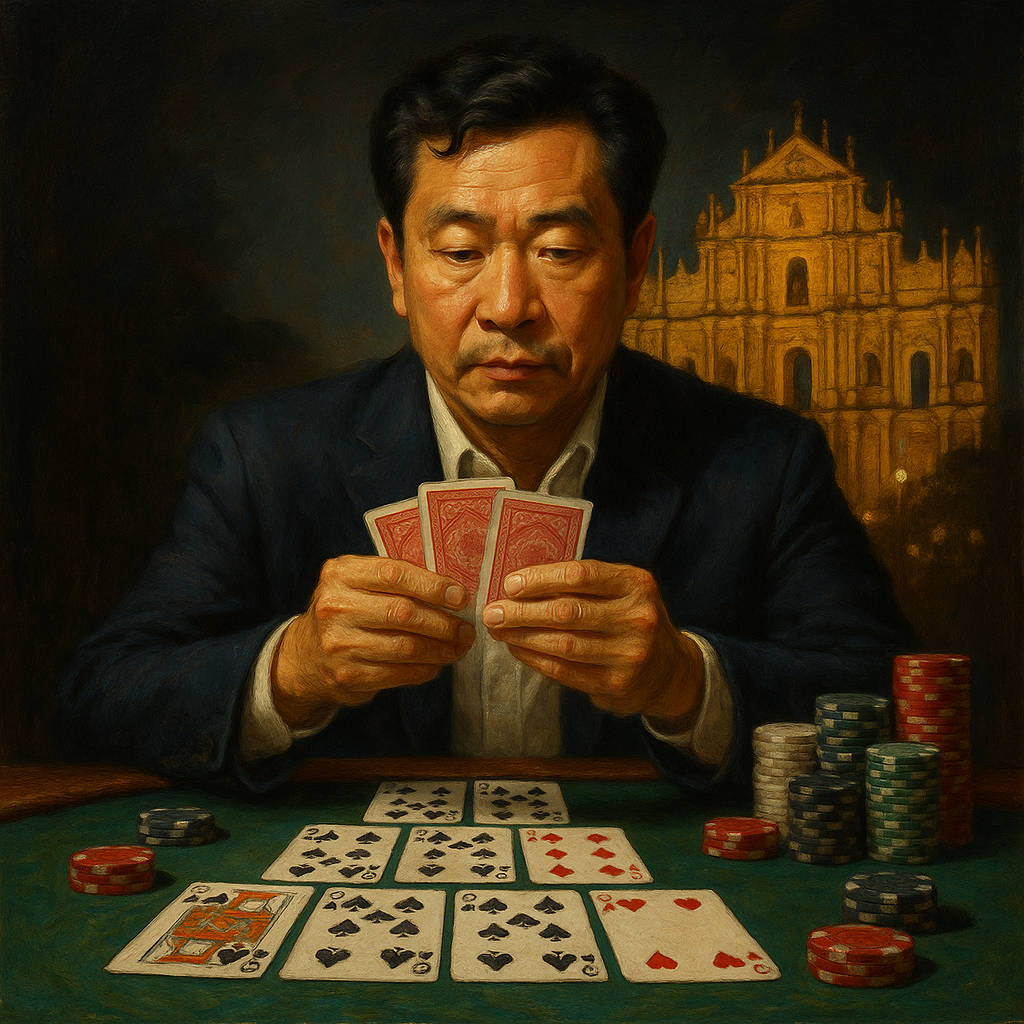
Chinese Poker: Macau’s Role in Its Global Explosion

In the neon-lit corridors of Macau’s towering casinos, where baccarat generates 84% of gaming revenue and high rollers bet millions on single hands, an ancient Chinese game underwent a transformation that would captivate the global poker community. From its roots in Song Dynasty tile games to the lightning-fast rounds of Open Face Chinese Poker spreading through European card rooms, Chinese Poker’s journey through Macau represents one of gambling’s most fascinating cultural exchanges.
From Ancient Tiles to Modern Cards
The story of Chinese Poker begins not with cards, but with dominoes. Pai Gow, meaning “make nine” in Chinese, emerged during the Song Dynasty (960-1279 AD) as a complex tile game that would influence gambling culture for nearly a millennium. Players arranged 32 dominoes into hands, following intricate ranking systems based on Chinese creation myths and military hierarchies.
This ancestral game established core concepts that would define Chinese Poker: multiple hands arranged from a single deal, specific ranking requirements between hands, and the strategic tension of optimizing limited resources. When Chinese immigrants brought these traditions to America in the 19th century, the seeds were planted for a revolutionary fusion of Eastern and Western gambling styles.
The transition from tiles to cards began in earnest during the 1980s. Sam Torosian’s creation of Pai Gow Poker in 1985 at California’s Bell Card Club demonstrated the commercial viability of adapting Chinese games for Western audiences. But it was in Macau, the only place in China where casino gambling is legal, that traditional Chinese Poker would find its perfect incubator.
Macau’s Transformation: East Meets West
When Portugal handed Macau back to China in 1999, few could have predicted the seismic shift about to occur. The end of Stanley Ho’s 40-year gambling monopoly in 2002 opened the floodgates to international casino operators, transforming a sleepy colonial outpost into the world’s largest gambling hub, surpassing Las Vegas in revenue by 2007.
This transformation created the perfect environment for Chinese Poker’s evolution. Unlike the baccarat tables that dominated Macau’s main floors, Chinese Poker found its home in VIP rooms and private games where East met West. High-rolling Chinese businessmen, accustomed to traditional tile games, encountered Western poker professionals seeking new challenges and bigger action.
Macau by the Numbers
- 1850: Gambling legalized under Portuguese rule
- 2002: Monopoly ends, international operators arrive
- 2007: Surpasses Las Vegas in gaming revenue
- 50+ casinos currently operating
- 5x Las Vegas revenue generated annually
- 84% of gaming revenue from baccarat alone
The cultural significance cannot be overstated. In Macau’s VIP rooms, where junket operators facilitated millions in credit and private jets ferried players from mainland China, Chinese Poker served as a common language between cultures. The game’s structure – requiring patience, mathematical precision, and psychological warfare – appealed equally to Asian gamblers steeped in strategic games like Mahjong and Western professionals trained in poker fundamentals.
The High-Stakes Revolution
The legendary “Macau Big Game” that emerged in the late 2000s became poker folklore. At venues like StarWorld Casino and the Poker King Club, stakes reached astronomical levels – HKD $30,000/$60,000 (USD $3,850/$7,700) – attracting elite players like Phil Ivey, Tom “durrrr” Dwan, and John Juanda.
These weren’t just poker games; they were cultural exchanges worth millions. Chinese businessmen, described by Poker King Club’s Winfred Yu as treating losses of “HK$5 million or HK$10 million as tuition fees,” sought to test themselves against the world’s best. The games operated on trust and reputation rather than formal contracts, with the understanding that both honor and future access depended on proper conduct.
| Year | Milestone | Impact |
|---|---|---|
| 2007 | First APPT Macau event | 352 players, largest Asian poker tournament |
| 2008 | Government publishes Texas Hold’em rules | Official recognition of poker |
| 2010-2012 | Peak of “Macau Big Game” | Highest stakes games in history |
| 2013 | Anti-corruption campaign begins | VIP gaming declines 40% |
| 2014 | First APT OFC side event | Open Face Chinese enters Asia |
The influence of these games extended far beyond Macau’s borders. Players who cut their teeth in Macau’s Chinese Poker games brought new strategies and variations back to their home countries. The requirement to set three hands optimally while considering opponents’ likely holdings created a strategic depth that attracted game theorists and mathematicians.
Open Face Chinese: The Finnish Connection
While traditional Chinese Poker percolated through Macau’s cash games, a revolution was brewing in Northern Europe. Open Face Chinese Poker (OFC), created in Finland during the mid-2000s, represented the game’s most significant evolution.
Russian professional Alex Kravchenko, credited with popularizing OFC among high-stakes players, described it as “spreading like a virus.” The variant’s genius lay in its progressive reveal – instead of receiving all 13 cards at once, players started with five cards face-up, then received one at a time. This transformed Chinese Poker from a game of optimization into one of risk management and incomplete information.
When OFC reached Macau around 2012, it found an eager audience. The Asia Pacific Poker Tour introduced OFC Pineapple as a side event in September 2014, with Jae Kyung Sim becoming the first winner of an OFC trophy in Asia. The variant’s appeal crossed cultural boundaries – Asian players appreciated the additional skill element, while Western pros enjoyed the reduced variance compared to traditional Chinese Poker.
The game’s spread through Macau’s poker ecosystem demonstrates how the city functioned as a global gambling laboratory. Innovations tested in Macau’s high-stakes games quickly disseminated worldwide through the international players who frequented its tables. Pineapple OFC, where players receive three cards and discard one, emerged from these sessions and became the dominant variant globally.
Tournament Poker Arrives in Paradise
The establishment of major tournament series in Macau legitimized poker’s presence in a market dominated by traditional Chinese games. The Asia Pacific Poker Tour’s inaugural Macau event in November 2007 marked a watershed moment – the first government-sanctioned real-money poker tournament in the territory.
With 352 entrants, it shattered Asian poker records and demonstrated untapped demand. The success prompted the Macau government to publish official rules for Texas Hold’em in January 2008, formally recognizing poker alongside traditional games. This regulatory framework enabled venues like the Grand Lisboa, Wynn Macau, and Venetian to establish permanent poker rooms.
The Asian Poker Tour (APT), founded in 2006, made Macau a cornerstone of its schedule. The 2012 APT Macau Main Event generated a prize pool of HKD 22,187,000 (approximately US$2,900,000), the largest in APT history. These tournaments didn’t just offer prize money; they provided a structured environment where Chinese Poker variants could be showcased to international audiences.
Macau’s Poker Infrastructure
Major Poker Rooms (2025):
- PokerStars Live Macau (City of Dreams)
- Wynn Macau Poker Room
- Venetian Macau Poker Room
- MGM Cotai Poker Room
Minimum Stakes: HKD $50/$100 (approximately $6/$13 USD)
Game Availability: Limited due to table cap regulations
Bridging Gambling Cultures
Macau’s unique position as the only legal gambling destination in China made it a crucial cultural bridge. The territory’s casinos became laboratories where Eastern gambling traditions merged with Western innovations. Chinese Poker exemplified this fusion – maintaining the multi-hand structure familiar to Pai Gow players while incorporating poker hand rankings understood globally.
The game’s adoption in Macau reflected deeper cultural preferences. Unlike the individualistic nature of Texas Hold’em, Chinese Poker’s simultaneous reveal created a communal experience. Players often gathered to discuss optimal hand settings, sharing strategies in a way that aligned with Chinese cultural values of collective learning.
Professional player Ryan Beauregard, who spent six years building Wynn Macau’s poker operations, observed that “the culture is accustomed to using what we would consider ‘oversized’ chips for gaming.” This comfort with high stakes, combined with the Chinese gambling philosophy that emphasizes fate and fortune, created an environment where Chinese Poker could flourish without the conservative bankroll management typical of Western poker.
The influence extended beyond the tables. Macau’s casinos adapted their operations to accommodate Chinese Poker’s unique requirements. Dedicated dealers learned complex scoring systems, floor staff became proficient in settling disputes over hand rankings, and poker room managers scheduled specific Chinese Poker games during peak hours to meet demand.
The Digital Age and Beyond
The Chinese government’s 2013 anti-corruption campaign fundamentally altered Macau’s gambling landscape. VIP gaming revenue plummeted 40% by 2015, and many of the ultra-high-stakes games that defined the “Macau Big Game” era disappeared. The COVID-19 pandemic delivered another blow, with travel restrictions severing the international connections that made Macau a global poker hub.
Yet Chinese Poker’s legacy endures. The variants refined in Macau’s casinos now thrive online, with apps and platforms offering 2-7 Pineapple OFC and Progressive Pineapple to players worldwide. The strategic concepts developed in Macau’s high-stakes games – Fantasyland requirements, optimal hand-setting algorithms, and risk-reward calculations – form the foundation of modern Chinese Poker theory.
Recent developments suggest a potential renaissance. Natural8’s sponsorship of APT events brings online qualifiers to Macau, while the 2025 APT Taipei’s TWD 70 million guarantee demonstrates continued regional enthusiasm. As President Xi Jinping urges Macau to diversify beyond casino gaming, poker – including Chinese variants – may benefit from efforts to attract a broader tourist demographic.
Master Chinese Poker Variants
Ready to explore the world of Chinese Poker? Start your journey with our comprehensive guides:
The Enduring Legacy
Macau’s role in Chinese Poker’s global explosion transcends simple geography. The territory provided the perfect conditions – legal framework, international accessibility, cultural diversity, and unlimited stakes – for an ancient game to evolve into a modern phenomenon. From the Song Dynasty’s tile games to today’s digital tournaments, Chinese Poker’s journey through Macau represents gambling’s capacity for cultural synthesis.
The game’s evolution continues. New variants emerge regularly, each building on foundations laid in Macau’s casinos. Double Board concepts influence Chinese Poker variations, while Dealer’s Choice games increasingly include OFC options. The strategic depth that captivated players in Macau’s VIP rooms now challenges a new generation through online platforms and home games worldwide.
As Macau navigates its post-pandemic recovery and seeks to balance gaming with broader entertainment offerings, Chinese Poker stands as a testament to the territory’s unique contribution to global gambling culture. Neither fully Eastern nor Western, but something entirely new, the game embodies Macau’s position as the world’s most important gambling crossroads.
Frequently Asked Questions
Key Takeaways: Macau’s Chinese Poker Revolution
- Ancient Origins: Chinese Poker evolved from Pai Gow, a Song Dynasty tile game dating to 960-1279 AD
- 2002 Transformation: End of Stanley Ho’s monopoly brought international operators and poker to Macau
- 2007 Milestone: First APPT event legitimized tournament poker in Asia’s gambling capital
- High-Stakes Legacy: The “Macau Big Game” featured the highest stakes in poker history
- OFC Revolution: Open Face Chinese spread from Finland through Macau to global popularity
- Cultural Bridge: Macau uniquely positioned to merge Eastern and Western gambling traditions
- Modern Evolution: Despite challenges, Chinese Poker variants continue thriving online and in mixed games
About the Author
Mixed Game Masters Editorial
Published: April 22, 2026 | Categories: Strategy & History, Chinese Poker
Mixed Game Masters is the premier resource for non-Hold’em poker strategy, tournament coverage, and mixed game education. Our editorial team combines decades of experience in Chinese Poker variants, draw games, and international poker markets.
We specialize in comprehensive coverage of games beyond traditional No-Limit Hold’em, helping players master the full spectrum of poker variants from classic Chinese Poker to cutting-edge Open Face variations.
Leave a Reply