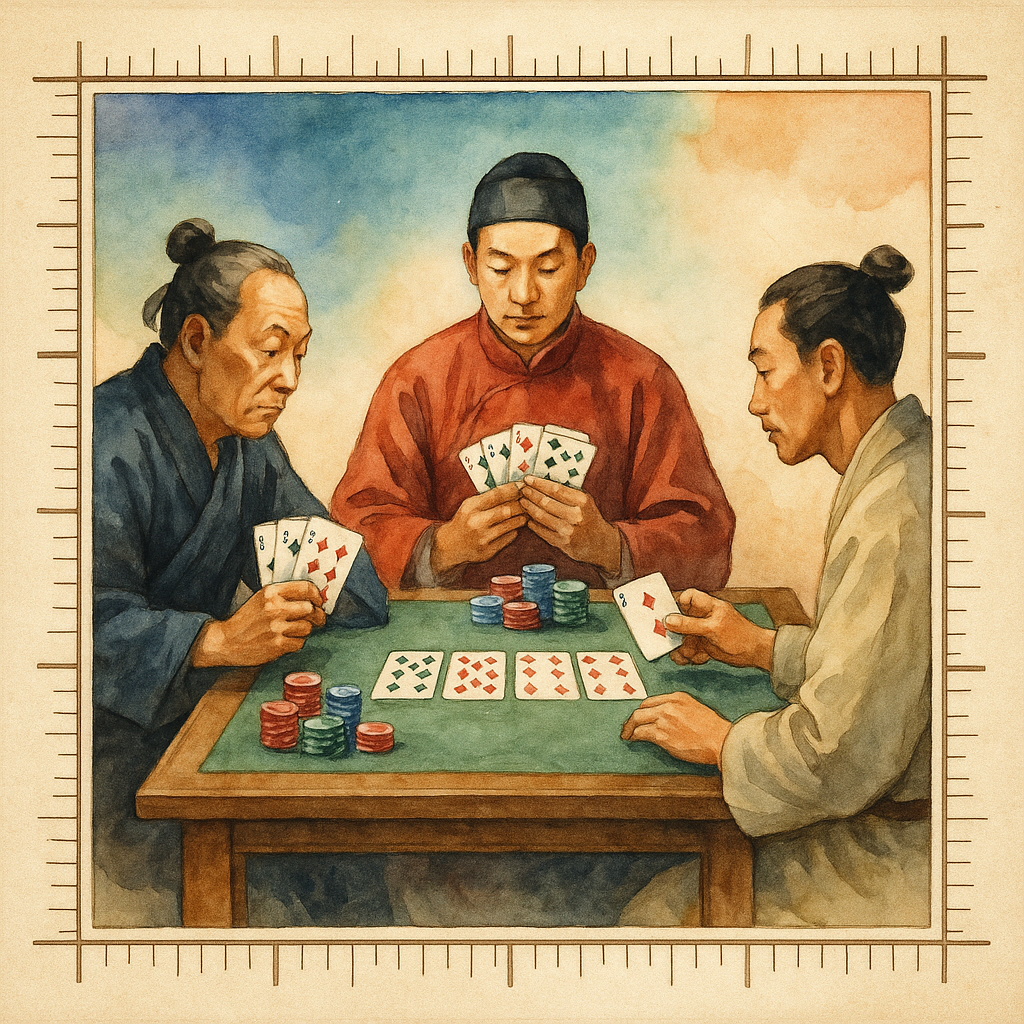
Famous Side Bets in Chinese Poker History

When an unnamed high roller lost $1.8 million in a single Chinese Poker session at Bobby’s Room, it marked just another chapter in the game’s legendary side betting history. From the WSOP championship era of 1995-1996 to the Open Face Chinese revolution that began in 2012, Chinese Poker has produced some of poker’s most spectacular financial swings, establishing itself as the ultimate side betting game where fortunes change with the turn of a single card.
The WSOP Championship Era: Birth of a Side Betting Phenomenon
Chinese Poker’s journey from underground cash games to mainstream recognition began with its brief but memorable appearance at the World Series of Poker. Steve Zolotow captured the $5,000 championship in 1995, followed by Jim Feldhouse winning the final WSOP Chinese Poker bracelet event in 1996 before the game was removed from the schedule.
These tournaments established the game’s legitimacy while simultaneously creating the framework for its complex side betting culture. The traditional game’s royalty system offered massive bonus opportunities that would define high-stakes action for decades:
Traditional Chinese Poker Royalty Bonuses
- Dragon (13-card straight): 36 units
- Three Flushes: 3 units from each opponent
- Three Straights: 3 units from each opponent
- Six Pairs: 3 units from each opponent
- Royal Flush (middle): 50 units
- Straight Flush (middle): 30 units
At Bobby’s Room’s $5,000-per-unit stakes, a Dragon hand was worth $540,000 ($180,000 from each opponent).
Bobby’s Room: Where Legends Created Million-Dollar Swings
Bobby’s Room at the Bellagio became the epicenter of high-stakes Chinese Poker action, with games regularly reaching $15,000 per unit – the highest documented stakes in the game’s history. The room, named after Bobby Baldwin (former WSOP champion and MGM Resorts executive), hosted legendary sessions that defined the game’s reputation for astronomical swings.
The most devastating single session occurred when an unnamed player dropped $1.8 million playing $5,000-per-unit Chinese Poker. This remains the largest documented single-session loss in Chinese Poker history, though veterans of the game suggest even larger losses may have occurred in private games.
Jennifer Harman, the only woman regularly competing in these nosebleed games, established herself as one of the game’s most feared players. During the legendary “Corporation” battles against billionaire Andy Beal, Harman reportedly won $3 million in three consecutive sessions, proving that Chinese Poker wasn’t just about luck – skill and psychological warfare played crucial roles.
| Location | Stakes Per Unit | Maximum Royal Flush Value | Era |
|---|---|---|---|
| Bobby’s Room (Peak) | $15,000 | $750,000 | 2000s |
| Bobby’s Room (Regular) | $5,000 | $250,000 | 2000s-Present |
| Macau VIP Rooms | HKD 10,000-20,000 | HKD 500,000+ | 2010s |
| TonyBet (Planned) | €1,000 | €25,000 | 2014-2015 |
Phil Hellmuth’s Half-Million Dollar Hotel Lobby Disaster
Phil Hellmuth’s relationship with Chinese Poker represents one of poker’s most cautionary tales about side betting. The 15-time WSOP bracelet winner’s most devastating experience occurred in March 2007 at the Hotel de Paris in Monte Carlo, where what started as a casual lobby encounter turned into financial catastrophe.
Hellmuth was enjoying dinner when Phil Ivey and Patrik Antonius approached him about playing Chinese Poker. Despite having a self-imposed daily loss limit, Hellmuth agreed to play. The session turned disastrous, with Hellmuth losing over $500,000 in a single night – money he later admitted exceeded his comfort zone.
His Chinese Poker losses didn’t end there. In subsequent sessions at the Bellagio, Hellmuth dropped another $530,000 to Phil Ivey playing $1,000-$2,000 per point, followed by a $400,000 loss during the Five Diamond World Poker Classic. His total documented Chinese Poker losses exceed $930,000.
After one particularly brutal session, Hellmuth reportedly called his wife and instructed her to “donate $50,000 to charity and pay down the mortgage” – his way of psychologically offsetting the devastating losses. Despite his legendary tournament success in No-Limit Hold’em, Chinese Poker proved to be Hellmuth’s Achilles’ heel.
The Open Face Chinese Revolution: New Game, Bigger Swings
Open Face Chinese Poker emerged from Finland in the mid-2000s and spread to Russia through Alex Kravchenko, the 2007 WSOP Europe Main Event champion who became the first Russian to win a WSOP bracelet. Kravchenko described the game as “spreading like a virus” through Russian poker circles, where aggressive play and massive side bets became the norm.
The game reached American shores in dramatic fashion during the 2012 European Poker Tour. Brandon Cantu brought Open Face Chinese to the Aviation Club in Paris, where he introduced it to Shaun Deeb. The game’s unique Fantasyland bonus – where players achieving Queens or better in the front hand receive all cards at once while opponents play normally – created an entirely new dimension for side betting.
Open Face Chinese Scoring Revolution
- Fantasyland Bonus: Worth 14+ points in expectation
- Scoop Bonus: 3 additional points for winning all three hands
- Royal Flush (back): 25 points
- Straight Flush (back): 15 points
- Quads (back): 10 points
Progressive Pineapple variant added lowball middle hands, where 75432 was worth 8 points.
By 2013, Shaun Deeb had become one of America’s foremost OFC authorities, winning the 2014 PokerStars Caribbean Adventure OFC Championship for $32,380. His seminar at the 2013 PCA revealed the cultural divide in playing styles: “Russians are way more aggressive, Americans are more passive,” noting how this created profitable side betting opportunities.
The $1.8 Million Mercier-Selbst Controversy
The most controversial side bet in Chinese Poker history occurred at the 2016 PCA team dinner, though it technically involved WSOP bracelets rather than cards. An intoxicated Vanessa Selbst gave Jason Mercier 180-to-1 odds on $10,000 that he couldn’t win three WSOP bracelets that summer – a potential $1.8 million payout.
Mercier’s summer started explosively when he won the $10,000 2-7 Championship and the $10,000 H.O.R.S.E. Championship within days of each other. The poker world watched breathlessly as he came agonizingly close to the third bracelet, finishing second in the $10,000 Razz Championship to Ray Dehkharghani.
The aftermath created a public relations nightmare. Selbst, claiming extreme intoxication and attempting to buy out of the wager, took to Twitter to dispute the bet’s validity. The controversy highlighted the ethical complexities of high-stakes prop betting, especially when alcohol is involved. While the bet was never officially settled publicly, it remains one of poker’s most discussed side wagers.
TonyBet Championships: Institutionalizing High-Stakes OFC
TonyBet Poker, founded by Lithuanian businessman and poker player Tony G (Antanas Guoga), became the first platform to offer real-money Open Face Chinese online when it launched in December 2013. The site’s World Championships elevated OFC from a side game to a professional sport.
The inaugural TonyBet OFC World Championship in 2014 saw Jennifer Shahade capture the €10,000 High Roller for €100,000, while the 2015 edition featured Maxim Panyak winning €110,000 from a total prize pool of €304,095. These events legitimized OFC as more than just a gambling game, requiring deep strategic understanding.
TonyBet’s online platform offered stakes ranging from €0.02 to €100 per point, with plans to introduce €500-€1,000 per point tables – which would have represented the highest documented stakes in Chinese Poker history. At these nosebleed levels, a single royal flush bonus worth 25 points would translate to €25,000.
Macau’s Million-Dollar Sessions: The Asian High-Stakes Explosion
Tom “durrrr” Dwan brought Chinese Poker to Macau’s VIP rooms, playing at StarWorld and Wynn alongside Phil Ivey and Johnny Chan against wealthy Chinese businessmen. The games, often mixed with other variants like PLO and Short Deck, reached stakes of HKD 10,000/20,000.
Barry Greenstein later called missing the early Macau Chinese Poker games his “biggest poker mistake,” describing them as “super super juicy” with the potential to “win $1 million in a session.” The combination of wealthy recreational players and complex side betting created perfect conditions for massive swings.
The Macau games featured unique side betting traditions, including:
- Red envelope bonuses for special hands during Chinese New Year
- Progressive jackpots that could reach seven figures
- Side bets on specific card combinations appearing
- Team play arrangements where businessmen backed professional players
Mobile Apps Democratize High-Stakes Action
The 2013 launch of mobile OFC applications transformed side betting from an exclusive high-stakes pursuit to a global phenomenon. ABC Open Face Chinese Poker, developed with input from Russian developer Nikolai “Googles” Yakovenko, brought sophisticated gameplay to smartphones worldwide.
Daniel Negreanu’s public addiction to OFC led to marathon sessions that became legendary. His 34-hour session with Jason Mercier, Scott Seiver, and Shaun Deeb at EPT San Remo demonstrated the game’s addictive nature. Negreanu’s advocacy helped establish OFC events at major tournaments, though his tweet requesting “an Open Face Chinese Poker tourney at PCA” inadvertently led to the controversial Selbst-Mercier bet.
Master Chinese Poker Variants
Ready to learn the games that created these legendary side bets? Explore our comprehensive strategy guides:
Frequently Asked Questions
The Legacy of Chinese Poker Side Betting
Chinese Poker’s side betting history reveals a unique ecosystem where mathematical precision meets spectacular risk-taking. From the $15,000-per-unit games at Bobby’s Room to the €1,000-per-point stakes planned by TonyBet, the game has consistently pushed the boundaries of high-stakes gambling.
The documented losses exceeding $1.8 million in single sessions and individual prop bets approaching seven figures establish Chinese Poker as more than just a side game – it became a primary vehicle for poker’s biggest gamblers to test their luck and skill at stakes that dwarf even the largest tournament prizes.
The transition from traditional Chinese Poker’s WSOP era to Open Face Chinese’s mobile revolution demonstrates how side betting culture adapts and thrives. Today’s players can experience the same strategic depth and variance that created legendary swings at Bobby’s Room, whether playing for pennies on their phones or thousands in casino high-limit rooms.
As new variants like Double Board games and mixed formats continue evolving, Chinese Poker’s side betting legacy lives on. The game that cost Phil Hellmuth nearly a million dollars and almost made Jason Mercier $1.8 million richer continues to create new stories, proving that in Chinese Poker, fortune truly does favor the bold – and punish the reckless.
Key Takeaways: Chinese Poker’s Side Betting Legacy
- $1.8 Million: Largest documented single-session loss at Bobby’s Room
- $15,000 per unit: Highest documented stakes in Chinese Poker history
- $930,000+: Phil Hellmuth’s total documented Chinese Poker losses
- 180-to-1: Odds Vanessa Selbst gave Jason Mercier on winning three bracelets
- 2012: Year Open Face Chinese arrived in America via Brandon Cantu
- €304,095: Prize pool for 2015 TonyBet OFC World Championship
- 50 units: Value of a royal flush in the middle hand (traditional Chinese Poker)
About the Author
Mixed Game Masters Editorial
Published: May 31, 2026 | Categories: Tournaments & Events, High Stakes
Mixed Game Masters is the premier resource for non-Hold’em poker strategy, tournament coverage, and mixed game education. Our editorial team consists of experienced players and poker historians dedicated to preserving and sharing the rich history of poker’s most challenging variants.
We provide comprehensive coverage of stud games, lowball variants, and mixed game formats, helping players of all levels improve their skills beyond traditional No-Limit Hold’em.
Leave a Reply