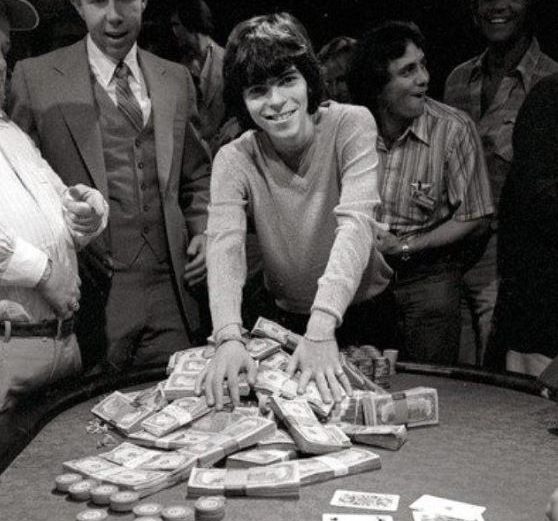
Stu Ungar in Seven Card Stud & Razz: Famous Wins, Losses, and the 1983 WSOP

Stu Ungar’s legacy in Seven Card Stud and Razz presents a fascinating paradox. The man widely considered poker’s greatest natural talent captured just one WSOP stud bracelet. He never won a Razz tournament, despite possessing perfect attributes for these memory-intensive games. His story in these variants reveals both spectacular cash game triumphs and devastating losses that defined his complex relationship with poker’s traditional games.
Key Takeaways
- 1983 Seven Card Stud Victory: Won his only stud bracelet in the $5,000 event for $110,000, defeating Dewey Tomko heads-up
- 1981 Deuce-to-Seven Win: Captured the $10,000 No Limit 2-7 Draw for $95,000, showcasing draw game mastery
- Zero Razz Bracelets: Never captured a WSOP Razz title despite his photographic memory advantage
- Cash Game Legend: Turned $3,000 into $115,000 in a single night of Seven Card Stud on multiple occasions
- Archie Karas Losses: Lost $500,000 in Razz and $700,000 in Seven Card Stud to Karas during his legendary run
- Five Total WSOP Bracelets: Three Main Events (1980, 1981, 1997) plus two non-Hold’em titles
The 1983 Seven Card Stud Championship
Stu Ungar’s sole WSOP Seven Card Stud victory came during a remarkable 1983 series. The $5,000 Seven Card Stud event attracted 44 of the era’s best players. The $220,000 prize pool represented significant money for the time.
The final table featured poker legends including future Hall of Famer Dewey Tomko and renowned theorist David Sklansky. Ungar’s victory over Tomko earned him $110,000. This proved his abilities extended beyond no-limit games (source).
That same year showcased Ungar’s consistency in stud formats. He finished second in the $1,000 Seven Card Stud event to Ken Flaton. The 124-player field generated a $124,000 prize pool. Ungar earned $24,800 for his runner-up finish while Tomko again made the final table. This back-to-back performance marked the peak of Ungar’s documented Seven Card Stud tournament success.
| Event | Buy-in | Field Size | Finish | Prize Won |
|---|---|---|---|---|
| Seven Card Stud | $5,000 | 44 | 1st | $110,000 |
| Seven Card Stud | $1,000 | 124 | 2nd | $24,800 |
Cash Game Brilliance and Devastation
Tournament records show limited success, but Ungar’s cash game performances reached legendary proportions. Poker veteran Yosh Nakano witnessed remarkable sessions. Ungar borrowed $3,000 and transformed it into $115,000 in a single night playing $75-150 Seven Card Stud.
Nakano confirmed this wasn’t isolated: “A few months later, Stu repeated the feat, again turning $3,000 into over $100,000” (source). These sessions demonstrated Ungar’s dominance when focused. His relentless pressure overwhelmed opponents.
The Mike Sexton Story
During a high-limit game, Ungar asked the nearly-broke Mike Sexton to “pick up a hand” while he used the restroom. Sexton was dealt a straight on the first five cards. He played cautiously with another man’s money. When Ungar returned and saw his money in a large pot, his enthusiasm helped Sexton win.
These triumphs were matched by spectacular defeats. Widely reported accounts describe Ungar dropping over a million dollars in single Razz sessions. During Archie Karas’s legendary 1992-1995 run, Karas defeated Ungar for $500,000 playing heads-up Razz. He then took another $700,000 in Seven Card Stud (source).
The Photographic Memory Advantage
Ungar’s photographic memory should have made him unbeatable in stud games. Tracking exposed and folded cards provides crucial information. His perfect recall gave him what professionals called a supernatural edge.
The most famous demonstration involved casino owner Bob Stupak’s bet. Accounts vary between a $10,000 single-deck last-card call (often the Ten of Diamonds) and a $100,000 three-deck count. Either way, Ungar’s memory proved genuinely photographic (source).
Mike Sexton called him “the Bobby Fischer of poker.” His chips were constantly in motion applying calculated aggression. During the 1997 WSOP, professionals described his “clairvoyant” ability to read hands.
Playing Style in Structured Betting
Ungar’s ultra-aggressive approach theoretically aligned with stud games. Position changes each street based on exposed cards. His “deadly precise” aggression combined with perfect card recall should have dominated.
However, fixed-limit betting constrained his greatest weapon. In no-limit games, Ungar could pressure opponents for their entire stack. Structured betting limited this psychological warfare in traditional Razz and stud formats.
Doyle Brunson provided crucial insight: “Stu was a genius. He had all the talents needed to achieve poker prowess, except for one thing – discipline” (source). This limitation proved costly in structured games.
What the Pros Said
Contemporary accounts paint a complex portrait of Ungar’s abilities. Mike Sexton praised his technical skills while acknowledging self-destructive tendencies. “I saw him win a million in an evening a couple of times,” Sexton recalled. Yet he concluded “in the game of life, Stu Ungar was a loser” (source).
Ungar displayed supreme confidence: “There’s no one that ever beat me playing cards, the only one that ever beat me was myself.” This proved tragically accurate. His genius-level IQ couldn’t overcome addiction issues.
Chip Reese acknowledged Ungar’s raw talent but noted consistency separated true champions. Reese’s success in H.O.R.S.E. demonstrated the discipline Ungar lacked.
The Razz Paradox
The gap between potential and results appears starkest in Razz. Ungar never captured a WSOP Razz bracelet. The game theoretically favored his memory strengths perfectly.
His willingness to play high-stakes Razz suggests confidence. Yet documented results show spectacular losses rather than victories. The widely reported million-dollar Razz losses became cautionary tales about bankroll management.
Understanding board reading in Razz requires Ungar’s exact skills. Tracking folded cards reveals which low cards remain. This theoretical advantage never translated into tournament success.
Overall Legacy in Stud Games
Stu Ungar’s poker achievements remain extraordinary. Five WSOP bracelets include three Main Events (1980, 1981, 1997). His 1981 $10,000 No Limit 2-7 Draw victory earned $95,000. He maintained a 33.3% win rate in major tournaments over $5,000.
In Razz and Seven Card Stud specifically, his legacy shows unfulfilled potential rather than dominance. His single 1983 Seven Card Stud bracelet stands alone. No Razz victories materialized despite regular WSOP events.
His 2001 Poker Hall of Fame induction recognized overall contributions. Nolan Dalla noted: “In the early ’80s, there was nobody better” (source). Yet stud games revealed his limitations.
Frequently Asked Questions
Stu Ungar’s story in Razz and Seven Card Stud challenges assumptions about poker genius. Despite perfect attributes for memory-intensive games, his success remained limited. One WSOP stud victory defined his tournament record. His reputation derived from spectacular cash sessions and equally spectacular losses. This complexity adds depth to poker’s most naturally gifted player. For those seeking mastery, understanding aggression and positional value in Seven Card Stud remains essential.
About the Author
Mixed Game Masters Editorial
Published: November 14, 2025 | Categories: Poker History, Seven Card Stud
Mixed Game Masters is the premier resource for non-Hold’em poker strategy, tournament coverage, and mixed game education. Our editorial team consists of experienced players and poker historians dedicated to preserving and sharing the rich history of poker’s most challenging variants.
We provide comprehensive coverage of stud games, lowball variants, and mixed game formats, helping players of all levels improve their skills beyond traditional No-Limit Hold’em.
Leave a Reply