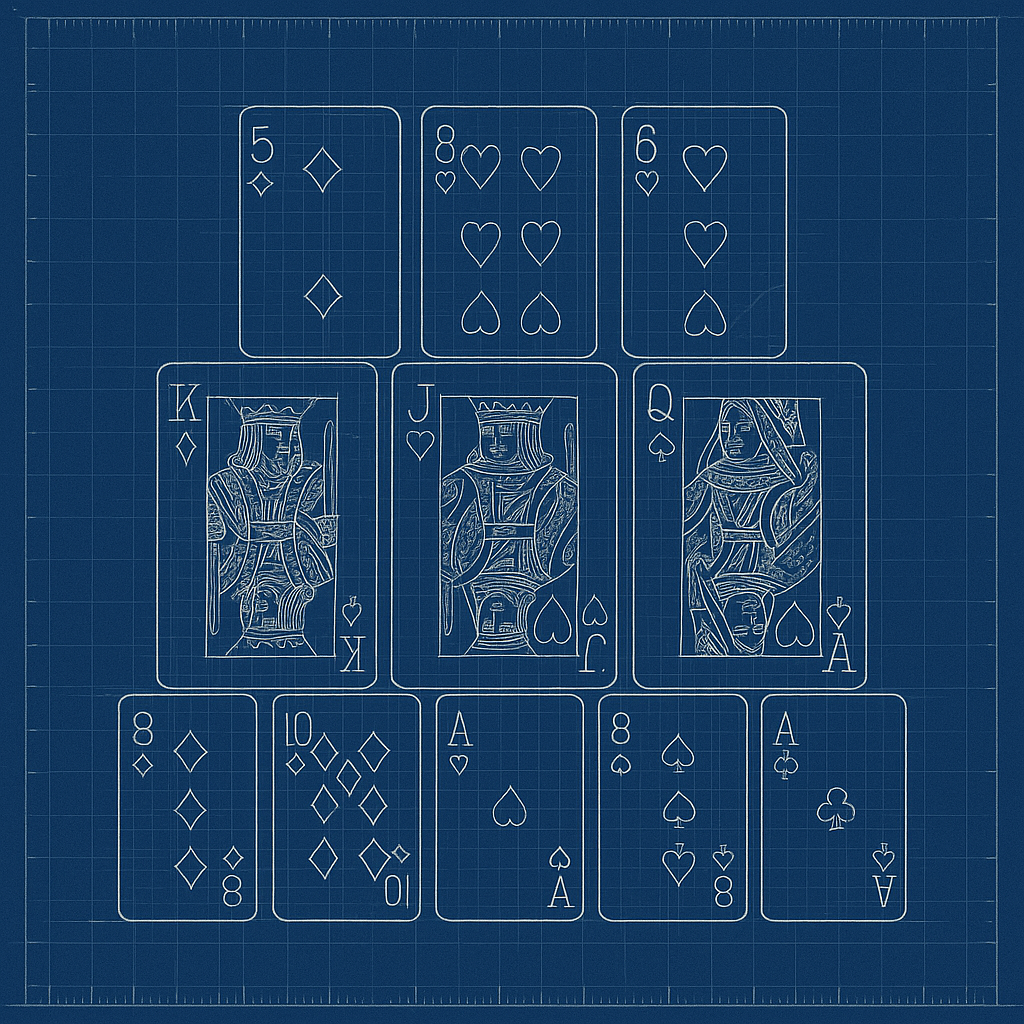
Historical Moments in Open Face Chinese Poker

When anonymous Finnish card players invented Open Face Chinese Poker in the mid-2000s, they unknowingly created what would become poker’s most successful 21st-century variant. From underground Helsinki rooms to Las Vegas penthouses where single hands could swing $300,000, OFC’s explosive growth between 2012-2015 generated millions in tournament prizes, legendary gambling sessions, and strategic innovations that transformed a simple card placement game into a mathematical battleground.
The Finnish Underground Origins
While the specific inventors remain anonymous, Open Face Chinese Poker emerged from Finland’s underground card rooms in the mid-2000s as a variation of traditional Chinese Poker. The game’s transformation from closed to open cards created an entirely new dynamic where information and progressive decision-making replaced the single placement choice of the original game.
Russian professional Alex Kravchenko became the first documented bridge between Finnish inventors and the wider poker world. After discovering OFC in Finland, he brought it to Russia’s high-stakes community where it spread “like a virus” through Moscow’s underground clubs. Kravchenko’s description of the game’s addictive nature proved prophetic as it swept through Europe’s poker elite.
The critical moment for Western poker came at Paris’s Aviation Club in 2012. This legendary poker room, which operated from 1907 until its closure in 2015, served as the incubator for OFC’s explosion into mainstream poker consciousness. The Aviation Club’s high-stakes mixed games attracted an international clientele of wealthy businessmen and professional players, creating the perfect environment for a new gambling game to flourish.
From Aviation Club to American Invasion
American professional Brandon Cantu discovered OFC at the Aviation Club in early 2012, watching a Russian player battle a Frenchman for 16 consecutive hours. After learning the rules and basic strategy, Cantu experienced what Phil Hellmuth later confirmed as one of poker’s most legendary heaters: “Brandon brought it in and won a million straight” over six months.
Cantu introduced the game to Shaun Deeb at the Aviation Club, initially winning €13,000 from him at 100 euros per point while telling him he was “investing in his future.” Deeb quickly mastered the game and became its most successful player, later recording the game’s biggest known single-day win of $2.8 million at $3,000 per point.
The Pioneer Group
The Original 15 American OFC Players (2012):
Brandon Cantu, Shaun Deeb, Jason Mercier, Barry Greenstein, Daniel Negreanu, Phil Hellmuth, Phil Ivey, Scott Seiver, Noah Schwartz, Matt Ashton, Daniel Weinman, Abe Mosseri, Jeffrey Lisandro, Michael “The Grinder” Mizrachi, and Nikolai Yakovenko.
During the 2012 World Series of Poker, this core group played for increasingly massive stakes at the Rio and Aria. Regular games ran at $200 per point, with some sessions reaching $1,000 per point. The combination of high variance and constant action proved irresistible to both professionals seeking edges and wealthy amateurs wanting gambling thrills.
The Championship Era (2013-2015)
The tournament scene exploded in 2013 with the first major European event at EPT Monte Carlo. Jason Mercier defeated 51 opponents to win €48,000 in what many consider the unofficial world championship before dedicated series emerged. Two months later at the WSOP’s Carnivale of Poker, Victor Ramdin claimed $76,707 from a $5,000 buy-in event, establishing OFC in American tournament poker.
| Date | Event | Winner | Prize | Field |
|---|---|---|---|---|
| May 2013 | EPT Monte Carlo €2K | Jason Mercier | €48,000 | 51 |
| July 2013 | WSOP Carnivale $5K | Victor Ramdin | $76,707 | 45 |
| Dec 2014 | TonyBet World Championship | Mikal Blomlie | €35,000 | 135 |
| Dec 2014 | TonyBet €10K High Roller | Jennifer Shahade | €100,000 | 40 |
| Dec 2015 | TonyBet Progressive Championship | Isabelle Mercier | €42,000 | 103 |
Jennifer Shahade’s Historic Victory
Chess grandmaster Jennifer Shahade made history in December 2014 by winning the largest OFC prize ever awarded: €100,000 at the TonyBet World Championship High Roller in Prague. Her methodical approach, honed through chess mastery, proved perfectly suited to OFC’s strategic complexities. She took maximum time in Fantasyland while opponents rushed decisions, capitalizing on their mistakes.
The 2014 TonyBet World Championship Main Event set the participation record with 135 entries that has never been exceeded. Norwegian player Mikal Blomlie claimed the €35,000 first prize, defeating a field that included most of Europe’s top mixed game specialists. This event represented OFC’s tournament peak, with subsequent years seeing declining participation as the game migrated to cash formats.
Strategic Revolution and Mathematical Mastery
The game underwent rapid strategic evolution from its original Finnish form. The breakthrough innovation of Fantasyland – a bonus round where players receive all remaining cards at once after making Queens or better in the top row – was developed by Jason Mercier and Daniel Weinman in San Remo, Italy. This addition transformed OFC from straightforward placement into complex risk-reward calculations.
Pineapple OFC emerged as the dominant variant, dealing players three cards per turn with two placed and one discarded. This increased both action and strategic depth while limiting games to three players due to deck constraints. The format proved so popular that within a year, regular OFC virtually disappeared from both live and online play.
Progressive Pineapple Fantasyland Tiers
- QQ = 14 cards
- KK = 15 cards
- AA = 16 cards
- Trips = 17 cards
Developed by TonyBet in 2015, this system created more frequent Fantasyland entries while maintaining game balance.
Mathematical analysis revolutionized play between 2014-2017. Derric “SixPeppers” Haynie created comprehensive EV calculation algorithms through his “Solving OFC” platform, while modern solvers can calculate optimal 17-card Fantasyland arrangements in under one second. This shift from intuitive play to mathematical optimization mirrors the solver revolution in No-Limit Hold’em.
Million Dollar Sessions and Legendary Stories
The cash game stakes reached extraordinary levels that dwarfed tournament prizes. Shaun Deeb’s legendary session saw him win $2.8 million in a single day playing $3,000 per point with backing. Phil Hellmuth dropped $70,000 to Deeb and Mercier in Fort Lauderdale, though he noted winning $1.2 million the previous month and remaining profitable overall.
Regular games at Paris’s Aviation Club and Las Vegas’s Aria attracted colorful characters and massive swings. One Chinese businessman missed a Queen placement that cost approximately $300,000, then “high-fived everyone” at the table. Another reportedly suggested “flipping for $200,000” just to round up change after a session.
Stakes regularly reached $200-$1,000 per point among professionals. At $1,000 per point, a single royalty bonus for a straight flush could be worth $50,000. The combination of skill edge and massive variance created perfect conditions for both professionals seeking profit and wealthy amateurs seeking action.
The Security Scandal
Barry Greenstein’s 2013 discovery of critical security flaws in popular OFC mobile apps revealed a darker side. His programmer nephew confirmed that players could see opponents’ cards and manipulate dealing through app vulnerabilities. Greenstein published warnings about online play against unknown opponents, highlighting the challenges of maintaining game integrity in the digital age.
The Modern Online Era
By 2024-2025, OFC has largely migrated from live tournaments to online cash games. KKPoker dominates the Asian market with stakes ranging from $0.01/$0.02 to $1,000/$2,000. Russian players consistently top monthly leaderboards, with some grinding over 3,000 sets per month and showing profits exceeding €12,000.
The game thrives in multiple variants across platforms:
- KKPoker: Ultimate Joker variant offering 17-card fantasy for trips on top
- TonyBet: Regular €50 per point games with documented 54-point hands
- BetOnline/Tiger Gaming: Windfall tournaments with guarantees up to $15,000
- SWC Poker: Cryptocurrency platform serving US markets
- The Festival Series: Live tournaments maintaining the tradition
High-stakes action concentrates during Asian peak hours. Ireland’s SStaunton recorded one of online poker’s most spectacular hands at TonyBet: a 54-point combination featuring straight flushes and full houses. Mobile apps have proliferated, with Corvid Apps reporting 52,000+ downloads since 2017.
Legacy and Future
Open Face Chinese Poker’s journey from Finnish invention to global phenomenon represents one of poker’s most remarkable evolutionary stories. Despite never achieving official WSOP bracelet status and seeing tournament participation plateau after 2014-2015, the game created millionaire winners, generated legendary gambling stories, and continues thriving in online cash games.
The documented achievements establish OFC as the most successful new poker variant of the 21st century:
OFC’s Historical Milestones
- Mid-2000s: Invented in Finnish underground card rooms
- 2012: Brandon Cantu introduces OFC to America, wins “a million straight”
- 2013: First major tournaments at EPT Monte Carlo and WSOP
- 2014: Jennifer Shahade wins record €100,000; 135-player championship
- 2014: Fantasyland innovation transforms strategic landscape
- 2015: Progressive Pineapple becomes dominant variant
- 2016-2025: Migration to online platforms, Asian market dominance
While its tournament glory days appear past, with no event exceeding the 2014 World Championship’s 135 entries, the game’s migration to high-stakes online cash games ensures continued relevance. As mathematical solvers advance and new variants emerge, Open Face Chinese Poker remains a testament to how innovation, strategic evolution, and the gambling spirit can transform regional card games into international phenomena generating hundreds of millions in action.
Master Open Face Chinese Strategy
Ready to learn OFC? Explore our comprehensive guides:
Frequently Asked Questions
The Game That Changed Everything
From its humble beginnings in Finnish underground rooms to generating millions in prize pools and legendary gambling sessions, Open Face Chinese Poker’s impact on modern poker cannot be overstated. The game proved that innovation in poker wasn’t dead, that new variants could still capture the imagination of professionals and amateurs alike.
The stories – from Brandon Cantu’s million-dollar heater to Jennifer Shahade’s chess-inspired championship victory – have become part of poker folklore. While the tournament scene has quieted, the game lives on in high-stakes online battles where mathematical precision meets gambling courage.
For those who experienced OFC’s golden age, the memories of 16-hour sessions at the Aviation Club, massive swings at the Aria, and the constant shuffle of cards being placed remain vivid. Open Face Chinese Poker proved that even in poker’s modern era, a simple idea from an underground Finnish game could still revolutionize the entire landscape.
About the Author
Mixed Game Masters Editorial
Published: October 21, 2025 | Categories: Tournaments & Events, Draw & Lowball
Mixed Game Masters is the premier resource for non-Hold’em poker strategy, tournament coverage, and mixed game education. Our editorial team consists of experienced players and poker historians dedicated to preserving and sharing the rich history of poker’s most challenging variants.
We provide comprehensive coverage of stud games, lowball variants, and mixed game formats, helping players of all levels improve their skills beyond traditional No-Limit Hold’em.
Leave a Reply