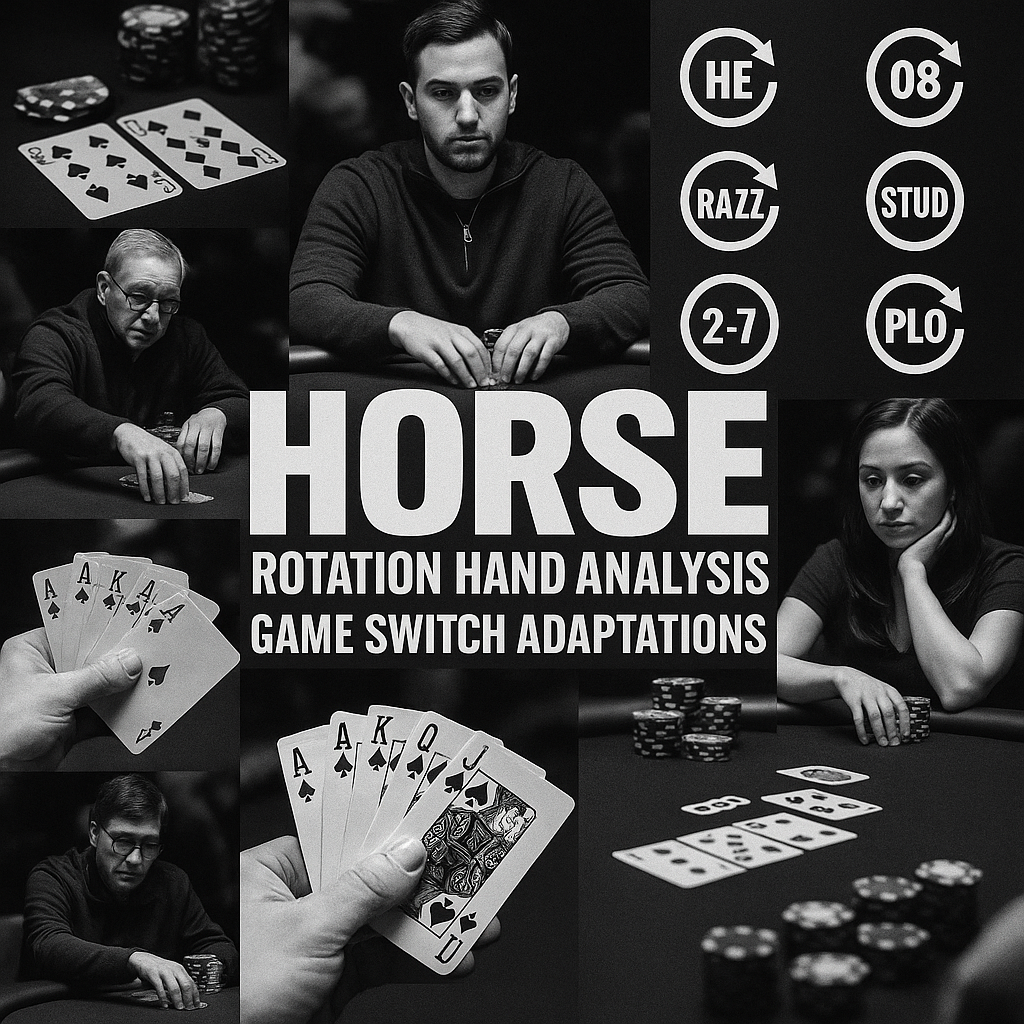
HORSE Rotation Hand Analysis: Game Switch Adaptations

HORSE poker represents the ultimate test of poker versatility, requiring players to excel across five distinct variants while managing complex mental transitions and strategic adaptations. Recent tournament results demonstrate the format’s prestige, with Michael Mizrachi winning his record fourth Poker Players Championship in 2025 for $1.33 million before capturing the WSOP Main Event weeks later – an unprecedented double that earned immediate Hall of Fame induction. The mixed game format demands not just competence in Hold’em, Omaha Hi-Lo, Razz, Seven Card Stud, and Eight-or-Better, but mastery of the transitions between them, where elite players gain their greatest edges through rapid adaptation and opponent exploitation across rotating games.
How the HORSE Rotation Creates Strategic Complexity
The HORSE tournament structure operates on a precise rotation system that fundamentally alters gameplay dynamics every level or orbit. Games rotate in exact sequence – Hold’em, Omaha Hi-Lo, Razz, Seven Card Stud, and Eight-or-Better – with changes typically occurring every tournament level when blinds increase. In cash games, rotation happens every complete orbit of eight hands. The format exclusively uses fixed-limit betting across all five variants, eliminating bet sizing as a strategic weapon while emphasizing mathematical precision and positional awareness.
The mechanical complexity extends beyond simple game changes through the “frozen button” mechanism, a crucial innovation that maintains fairness across transitions. When moving from Omaha to Razz, the dealer button moves to the next player and becomes “frozen at the rail,” remaining inactive during all three stud variants before resuming action when Hold’em returns. This system ensures equitable blind distribution while preventing positional advantages from carrying across incompatible game structures. Tournament dealers announce each game change verbally and display physical plaques indicating the current variant, though mental lapses remain common even among experienced players.
Position importance varies dramatically between variants, creating a constantly shifting strategic landscape. In Limit Hold’em and Omaha Hi-Lo, the button provides maximum information advantage with last action on all post-flop streets. Stud games completely invert this dynamic – position changes each street based on exposed cards, with the strongest showing board acting first in regular stud and the weakest board leading in Razz. This fundamental shift requires players to recalibrate their entire positional strategy multiple times per rotation, transforming what many consider poker’s most basic concept into a complex, ever-changing variable.
Famous Hands Revealing Adaptation Mastery
The 2025 WSOP showcased several pivotal hands demonstrating game-specific mastery and transition excellence. Kristopher Tong’s $10,000 HORSE Championship victory featured a crucial Stud Hi-Lo hand where his aggressive play with K♣4♥8♥7♥ forced Maximilian Schindler to fold two pairs on sixth street. Tong had struggled in earlier Hold’em rounds but demonstrated exceptional adaptation by shifting to calculated aggression in the stud variants, ultimately capturing his first bracelet and $452,689.
Zhigalov’s Perfect Razz Adjustment
Andrey Zhigalov’s dramatic comeback in the $1,500 HORSE event exemplified Razz mastery when he made a perfect wheel against Thomas Taylor’s second-best low. Zhigalov later explained his strategic thinking: “In cash game, I would’ve played it differently. I think I will raise on fifth, but here I decided to save some chips and see what’s going on on sixth.” This tournament-specific adjustment, combined with his extensive stud game experience, led to his second HORSE bracelet victory.
The 2024 Poker Players Championship produced a defining moment when Daniel Negreanu ended his 11-year bracelet drought with a decisive Pot-Limit Omaha hand against Bryce Yockey. Holding A♦Q♠J♣7♠, Negreanu flopped trip sevens and turned a full house as Yockey’s flush draw arrived too late on the river. The hand demonstrated Negreanu’s superior board reading across variants – a skill he’d honed through years of mixed game study despite previously struggling in championship events.
Historical analysis reveals consistent patterns among HORSE champions. Mike Gorodinsky’s 2023 victory featured multiple instances of exploiting opponents’ game-specific weaknesses, particularly targeting players who failed to adjust aggression levels between limit Hold’em and stud variants. His ability to identify which opponents struggled in specific games and maximize pressure during their weakest rotations exemplified the meta-game strategy that separates competent mixed game players from champions.
Strategic Metamorphosis Between Game Variants
The transition from Hold’em to Omaha Hi-Lo requires a complete philosophical shift from single-winner to split-pot thinking. Players must abandon the “any two cards can win” mentality for rigorous four-card coordination, prioritizing A-2 combinations for nut low potential while maintaining high hand possibilities. The mathematical complexity multiplies as players evaluate 16 different two-card combinations from their four hole cards, with drawing hands gaining substantially more value due to increased possibilities. Pot dynamics transform entirely – value betting requires significantly stronger holdings when pots split, and the concept of “scooping” (winning both high and low) becomes paramount.
Moving from Omaha’s split-pot complexity to Razz creates poker’s most jarring mental transition. Players must completely invert their hand evaluation system, abandoning traditional poker rankings for pure lowball thinking where aces become valuable and pairs become poison. The shift from community cards to individual exposed cards introduces memory requirements absent in flop games – tracking folded cards becomes essential for calculating accurate drawing odds. Strategic aggression patterns require recalibration as pot-building shifts to selective pressure based on visible board strength rather than hidden hand power.
The Razz-to-Seven-Card-Stud transition demands another complete value reversal, flipping from lowball back to traditional high-hand poker. Beyond simple hand ranking changes, the bring-in structure inverts – Razz’s highest door card pays while Stud’s lowest card posts the forced bet. This seemingly minor procedural difference creates significant strategic implications for starting hand selection and early street aggression. Players must shift from avoiding pairs to embracing big pocket pairs, from pursuing low draws to high flush and straight possibilities, while maintaining the card memory skills developed during Razz play.
Transitioning into Eight-or-Better adds split-pot dynamics to stud play, requiring players to evaluate both high and low possibilities across exposed and hidden cards. The 8-or-better qualification rule for low hands creates complex decision trees where players must calculate not just their equity but the probability of low qualification. Starting hand selection prioritizes “suited babies” – ace-low combinations with high suits – that can scoop entire pots. The quartering danger (winning only quarter of the pot when tied for half) demands careful pot control and selective aggression.
Professional Players’ Transition Expertise
Michael Mizrachi’s unprecedented four Poker Players Championship victories stem from his systematic approach to board reading and dead card tracking. His strategy centers on meticulous attention to exposed cards in stud games, using this information to calculate opponents’ exact drawing probabilities. “It’s about reading the boards, learning and studying all the dead cards, and in razz, all the live cards,” Mizrachi explains in his co-authored strategy guide. His ability to maintain this intense focus across game transitions while adjusting fundamental strategic principles has produced $9.5 million in mixed game tournament earnings.
Brian Rast’s evolution into a three-time PPC champion emerged through intensive study in Bobby’s Room at the Bellagio, where he learned directly from legends like Doyle Brunson and John Hennigan. His approach emphasizes theoretical understanding combined with practical application: “My favorite part is when I just play hands and sit there and think really hard about hands that I’ve played; what does this mean about how I’m supposed to play my range here.” Rast’s method of constantly analyzing range construction across different variants while maintaining aggressive meta-game pressure has proven devastatingly effective.
Phil Ivey’s HORSE excellence relies on rapid pattern recognition and psychological warfare that transcends individual game mechanics. Fellow professionals describe his “uncanny ability to dissect someone’s game” and immediately identify exploitable weaknesses across variants. Ivey’s approach centers on opponent profiling – categorizing players by their game-specific skill levels and ruthlessly targeting their weakest variants. His emotional control and stoic presence remain constant regardless of the game being played, preventing opponents from reading his comfort level with different variants.
John Hennigan represents old-school mixed game mastery with seven WSOP bracelets across multiple variants. His strategic philosophy emphasizes game selection expertise – in dealer’s choice formats, he consistently picks games where opponents show the most discomfort. Scott Seiver maintains relentless aggression while adjusting to each game’s specific dynamics, using his reputation to generate fear equity across all variants. Daniel Negreanu’s analytical approach focuses on information gathering and tell recognition, adapting his legendary reading abilities to each variant’s unique betting patterns.
Common Transition Mistakes Plague Most Players
Players consistently fail to adjust aggression levels when switching games, particularly when moving from no-limit backgrounds to HORSE’s fixed-limit structure. The inability to “push players out” with large bets frustrates aggressive players who don’t understand that calling single river bets becomes mathematically correct due to pot odds in limit formats. This fundamental misunderstanding leads to excessive bluffing in situations where opponents cannot fold, wasting bets that accumulate into significant losses over time.
The most costly errors occur in hi-lo split games where players misunderstand the 8-or-better qualification requirement for low hands. Missing scooping opportunities by playing hands that only compete for half the pot, failing to recognize counterfeit situations where low draws become worthless, and overvaluing marginal high hands in split-pot scenarios collectively destroy win rates. Professional player surveys indicate that Omaha Hi-Lo and Stud Eight-or-Better generate the highest error rates among recreational HORSE players.
Stud game transitions produce consistent tactical mistakes, primarily the failure to track folded cards. Not remembering dead cards leads to dramatically miscalculated drawing odds – players chase flushes when half their suit is already folded or fold strong draws when their outs remain live. Starting hand discipline deteriorates as players apply Hold’em hand selection to stud games, playing far too many marginal holdings that require specific development patterns. The dynamic position changes in stud variants confuse players accustomed to static button position, leading to poor timing of aggressive plays.
| Transition | Most Common Error | Win Rate Impact | Correction Focus |
|---|---|---|---|
| Hold’em → Omaha Hi-Lo | Playing non-coordinated hands | -3.5 BB/100 | A-2 requirement awareness |
| Omaha → Razz | Value inversion confusion | -4.2 BB/100 | Lowball hand reading |
| Razz → Seven Stud | Bring-in structure errors | -2.1 BB/100 | Procedural discipline |
| Stud → Eight-or-Better | Missing scoop opportunities | -5.8 BB/100 | Dual-direction evaluation |
| Eight-or-Better → Hold’em | Over-tightening ranges | -2.7 BB/100 | Range expansion |
Bankroll Management Demands Conservative Approaches
HORSE tournaments require substantially larger bankrolls than single-game formats due to increased variance across multiple variants. Professional recommendations suggest 300-500 buy-ins for sustained tournament play, compared to 100-200 for single-game specialists. The variance stems not from larger swings but from more frequent smaller fluctuations as players participate in more hands due to the fixed-limit structure. Cash game requirements mirror these elevated needs, with 300 big blinds considered absolute minimum and 500+ recommended for professional play.
The psychological challenges of managing tilt across five games multiply bankroll pressure. Players experiencing frustration in weaker variants often compound losses through emotional decision-making that carries into stronger games. Session length becomes critical – mental fatigue deteriorates play quality more rapidly in HORSE than single games due to constant strategic shifting. Professionals recommend shorter sessions initially while building multi-game stamina, treating each game transition as a mental reset opportunity.
Mixed game specialists emphasize that success requires acceptance of game-specific weaknesses. “You don’t need to be great at all five games, but you can’t be terrible at any,” represents the consensus view among elite players. This philosophy extends to bankroll allocation – maintaining reserves specifically for improving weaker games through focused study and lower-stakes practice. The investment in comprehensive game knowledge pays long-term dividends through reduced variance and increased edge identification.
Position Dynamics Shift Dramatically Across Variants
Hold’em and Omaha position operates traditionally with the button providing maximum strategic advantage through last action on all post-flop streets. Late position allows wider starting ranges, better bluffing opportunities, and superior pot control. The cutoff and hijack positions maintain significant value, while early positions require premium holdings due to poor information positioning. This familiar framework provides stability during the first two games of each rotation.
Stud games completely restructure positional concepts through dynamic action order based on exposed cards. In Seven Card Stud and Eight-or-Better, the highest showing board acts first (except for initial bring-in), while Razz reverses this with the lowest board leading action. Position changes every street as boards develop, eliminating permanent positional advantages and requiring constant recalculation of relative position strength. The absence of a dealer button means position becomes entirely merit-based – strong boards earn positional disadvantage by acting first.
The strategic implications extend beyond simple action order. In flop games, position enables multi-street planning with consistent information advantage. Stud games transform position into a fluid concept where “live” cards matter more than seat position. Having three hearts with no hearts showing provides more strategic value than acting last with dead draws. This fundamental shift rewards players who adapt their positional thinking rather than applying rigid positional concepts across all variants.
Mental Transitions Separate Professionals from Amateurs
The mental game in HORSE extends far beyond simple rule knowledge to encompass rapid strategic framework shifts, emotional regulation across variance swings in different games, and sustained focus through lengthy sessions. Professionals describe the mental demands as “poker triathlons” requiring distinct skill sets activated in rapid succession. The cognitive load of tracking exposed cards in stud games while simultaneously planning future game transitions creates decision fatigue that doesn’t exist in single-game formats.
Successful players develop specific transition routines, taking mental pauses when games switch to consciously recalibrate strategy. Visual cues like dealer announcements and table placards serve as triggers for strategic shifts. Elite players practice game transitions specifically during training, simulating the mental gymnastics required during actual play. This preparation extends to pre-session routines where players mentally rehearse each game’s strategic framework before sitting down.
The psychological challenge of maintaining confidence across skill disparities requires careful ego management. Players naturally gravitate toward their strongest games, over-playing marginal hands when comfortable while playing too tightly in weaker variants. Body language often betrays these comfort levels, providing observant opponents with valuable information. The solution requires embracing a “beginner’s mind” approach in weaker games while maintaining competitive confidence – a delicate balance few achieve.
Starting Hands Transform with Each Rotation
Hold’em starting hands follow familiar patterns with big pairs, big suited aces, and high connectors dominating the premium range. Position allows speculative hands in late position while early position demands strength. This comfortable framework provides a strategic anchor point that many players struggle to abandon when games change.
Omaha Hi-Lo revolutionizes hand selection through the A-2 requirement for nut low potential. Premium holdings like A-A-2-x with any fourth card or A-2-3-4 double-suited provide maximum scooping potential. Middle cards without ace-deuce combinations become virtually unplayable, regardless of high-hand potential. The four-card coordination requirement eliminates hands that would be premium in Hold’em – pocket kings without low backup become marginal at best.
Razz inverts everything with three cards seven or lower as minimum playability. The fundamental rule “don’t leave home without an ace” reflects the premium placed on wheel cards. Any pair significantly reduces hand value, making starting hands like A-2-3 rainbow exponentially more valuable than A-A-2. Players must completely abandon traditional hand strength concepts, viewing pocket aces as a curse rather than a blessing.
Seven Card Stud returns to traditional values with big pairs regaining premium status, but only when “live” – seeing exposed aces makes pocket aces virtually worthless. Three suited cards provide strong starting potential unless multiple cards of that suit are visible. The live card concept doesn’t exist in community card games, requiring players to integrate visible information into starting hand decisions.
Eight-or-Better demands dual-purpose holdings with high-low potential. A-A-2 or A-2-3 suited represent premium holdings that can scoop. Big pairs need low backup for maximum value, while low rundowns require high potential to avoid being quartered. The complexity of evaluating hands for both directions while considering visible cards creates the most challenging starting hand decisions in HORSE.
Starting Hand Quick Reference
- Hold’em: AA-QQ, AK suited, high suited connectors
- Omaha Hi-Lo: A-A-2-x, A-2-3-4 double suited, A-2-K-K
- Razz: A-2-3, A-2-4, A-3-4 (no pairs)
- Seven Stud: Rolled trips, big pairs (live), three suited (live)
- Eight-or-Better: A-A-2, A-2-3 suited, rolled low trips
Recent Tournament Excellence Showcases Evolution
The 2025 WSOP season produced record-breaking HORSE fields and dramatic storylines. Kristopher Tong’s $10,000 HORSE Championship victory came after years of near-misses, including a fifth-place finish in the 2023 Poker Players Championship. His patient approach through 207 competitors demonstrated the value of game-specific adjustments over forcing action. The final table featured 21 combined WSOP bracelets, highlighting the skill level required for HORSE success.
Andrey Zhigalov captured his second $1,500 HORSE bracelet by defeating a record field of 867 entries, proving that edges exist even in large-field limit tournaments. His extensive stud game experience from high-stakes cash games provided crucial advantages during the later stages when fields thinned and play shifted toward the stud variants. Chad Eveslage’s victory in the $25,000 High Roller HORSE over Brian Rast demonstrated that even against elite competition, superior game transitions create exploitable edges.
The emergence of younger players like Maksim Pisarenko winning the 2024 $10,000 HORSE Championship signals a generational shift in mixed game mastery. Online training tools and solver work for limit games have accelerated the learning curve, though veterans maintain edges through superior live reads and decades of pattern recognition. The consistent success of players like Michael Mizrachi – whose 2025 double of PPC and Main Event may never be replicated – proves that deep mixed game expertise translates across all poker formats.
Master Your HORSE Game
Ready to improve your mixed game skills? Explore our comprehensive guides:
Frequently Asked Questions
Mastering the Complete Poker Test
HORSE poker’s demanding rotation creates poker’s most complete test of skill, requiring not just competence across five variants but mastery of the transitions between them. The format rewards players who embrace complexity while maintaining strategic discipline through each game change. As tournament fields grow and strategic knowledge spreads through online resources, the edges increasingly come from superior transition management and opponent-specific exploitation rather than pure game knowledge.
The mixed game renaissance, highlighted by record-breaking fields and million-dollar first prizes, ensures HORSE will remain poker’s premier test of versatility for elite players seeking to prove their complete mastery of the game. Whether pursuing championship glory or developing well-rounded skills, understanding the nuances of game transitions and adaptation strategies separates competent players from true mixed game masters.
Key Takeaways: HORSE Rotation Mastery
- Mental Transitions: Success requires rapid strategic framework shifts and emotional regulation across five distinct variants
- Position Dynamics: Static button position in flop games versus dynamic board-based position in stud variants demands constant recalibration
- Starting Hand Transformation: Premium holdings completely change between games – pocket aces are gold in Hold’em but poison in Razz
- Common Errors: Hi-lo split games generate the highest mistake rates, particularly missing scoop opportunities and quartering situations
- Bankroll Requirements: 300-500 buy-ins needed for tournaments due to increased variance across multiple games
- Professional Edge: Elite players like Mizrachi and Rast excel through superior transition management and opponent profiling across variants
About the Author

Mixed Game Masters Editorial
Published: February 24, 2026 | Categories: Mixed Games, Tournament Strategy
Mixed Game Masters is the premier resource for non-Hold’em poker strategy, tournament coverage, and mixed game education. Our editorial team consists of experienced players and poker historians dedicated to preserving and sharing the rich history of poker’s most challenging variants.
We provide comprehensive coverage of stud games, lowball variants, and mixed game formats, helping players of all levels improve their skills beyond traditional No-Limit Hold’em.
Leave a Reply