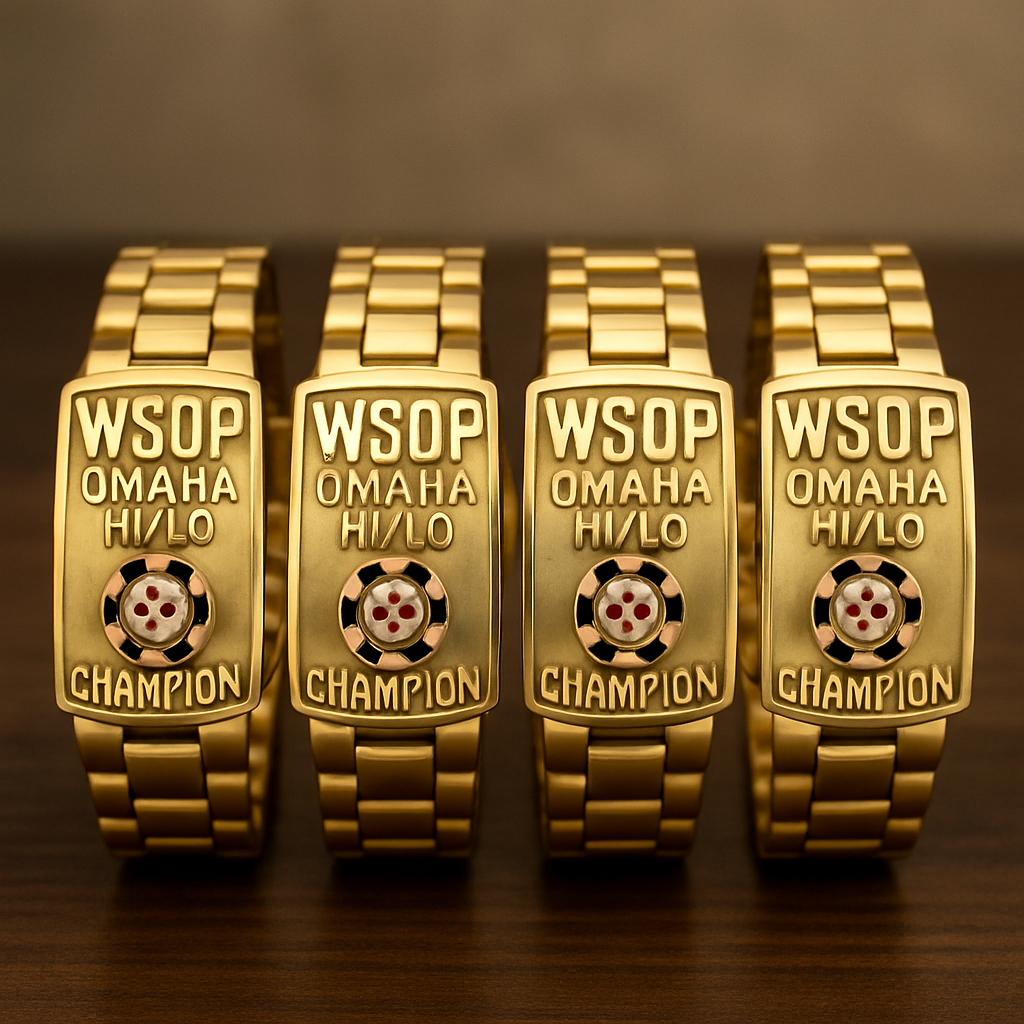
Omaha Hi/Lo: Most WSOP Bracelets Won in History

Since its introduction to the World Series of Poker in the early 1990s, Omaha Hi/Lo (Omaha 8 or Better) has evolved from a mathematical curiosity into one of poker’s most prestigious mixed-game disciplines. Mike Matusow leads all players with three Omaha Hi/Lo-related WSOP bracelets, while recent champions like Scott Seiver and Ryan Bambrick have elevated the game’s profile through dramatic victories and strategic innovation.
Key Takeaways
- Mike Matusow holds the record with 3 Omaha Hi/Lo WSOP bracelets (1998, 1999, 2002)
- Scott Seiver’s 2024 victory contributed to his Player of the Year title and 5th career bracelet
- The 2023 $1,500 event set a record with 1,143 entrants and $1.5M+ prize pool
- Benny Glaser won back-to-back Omaha Hi/Lo bracelets in 2016 for $651,297 combined
- The game generates over $7 million in prize pools across five WSOP bracelet events annually
- Ryan Bambrick defeated Daniel Negreanu in the dramatic 2025 $10,000 Championship final
The Bracelet Leaders: Matusow’s Three-Title Reign
Mike “The Mouth” Matusow stands alone atop the Omaha Hi/Lo WSOP bracelet leaderboard with three titles in the discipline. His dominance began with consecutive victories in 1998 and 1999, followed by his crowning achievement in the 2002 $5,000 Limit Omaha Hi-Lo event where he defeated Daniel Negreanu heads-up for $148,520 (source).
Following closely behind are several two-time winners who’ve demonstrated consistent excellence in split-pot formats. Benny Glaser’s remarkable 2016 campaign saw him capture both the $1,500 and $10,000 Championship events within two weeks, earning $651,297 and establishing himself as one of poker’s premier mixed game specialists.
| Player | Bracelets | Years Won | Total Earnings | Notable Victory |
|---|---|---|---|---|
| Mike Matusow | 3 | 1998, 1999, 2002 | $350,000+ | Defeated Negreanu HU in 2002 |
| Benny Glaser | 2 | 2016 (x2) | $651,297 | Back-to-back victories |
| Scott Seiver | 1* | 2024 | $426,744 | Part of POY campaign |
| Ryan Bambrick | 1 | 2025 | $447,415 | Defeated Negreanu HU |
| Phil Ivey | 1 | 2009 | $220,538 | Mixed Omaha/Stud event |
*Scott Seiver has 5 total WSOP bracelets across all disciplines
Modern Champions and Rising Stars
The 2024-2025 period has produced compelling storylines that highlight Omaha Hi/Lo’s continuing evolution. Scott Seiver’s 2024 championship victory for $426,744 came as part of an unprecedented summer where he won three bracelets in different disciplines, ultimately securing Player of the Year honors (source).
Ryan Bambrick’s 2025 triumph over Daniel Negreanu in the $10,000 Championship final provided one of the year’s most dramatic narratives. After Negreanu fought back from a 4:1 chip deficit to nearly even, Bambrick’s full house over trips sealed a victory worth $447,415, denying Negreanu his eighth bracelet (source).
International success stories include Sweden’s Magnus Edengren capturing his first bracelet in 2024’s Mixed Omaha event, while Britain’s Benny Glaser continues accumulating mixed-game titles, now holding eight total WSOP bracelets with expertise spanning PLO Hi-Lo and Limit Omaha Hi-Lo formats.
Record-Breaking Fields and Prize Pools
The explosive growth in Omaha Hi/Lo participation reflects the format’s increasing popularity among both professionals and recreational players. The 2023 $1,500 event attracted a record 1,143 entrants, generating a massive $1,525,905 prize pool that dwarfed the typical $200,000-$300,000 pools of the early 2000s.
2025 WSOP Omaha Hi/Lo By The Numbers
- 5 bracelet events featuring Omaha Hi/Lo variants
- $7.2 million in combined prize pools
- 217 entries in the $10,000 Championship (record)
- $763,087 – Largest single payout (PLO Hi-Lo Championship)
- 31 countries represented across all events
The championship events consistently draw elite fields exceeding 200 players, with buy-ins ranging from $1,500 to $10,000. Online bracelet events, introduced during the 2020 pandemic, democratized access for international players, with William Romaine winning the inaugural online Omaha Hi/Lo bracelet for $110,673.
Strategic Evolution: From Conservative to Aggressive
The strategic approach to tournament Omaha Hi/Lo has undergone dramatic transformation since the 1990s. Early champions like Steve Badger advocated ultra-conservative “nut-low only” strategies, with players folding anything without A-2 or A-3 combinations.
Modern champions employ sophisticated approaches incorporating:
- Pre-flop aggression with premium holdings to build pots for scooping
- Cooperative betting patterns between high and low hands
- Mathematical precision understanding that scooping is 2.67x more valuable than splitting in 5-way pots
- Position-based ranges expanding beyond traditional A-2 requirements
- Blocker awareness for both high and low possibilities
Scott Seiver’s observation that modern structures allow him “to survive on a short stack for a long time” reflects how deeper starting stacks and sophisticated pot control strategies have replaced the push-fold dynamics of earlier tournaments.
Mixed Game Specialists vs Pure Omaha Players
The Omaha Hi/Lo bracelet winner’s circle reveals two distinct paths to success. Pure specialists like David Shmuel, who called Omaha Hi/Lo his “favorite game” after winning the 2025 $1,500 event, demonstrate deep understanding of split-pot dynamics through focused study. These players often achieve higher ROI in their specialized events but have fewer opportunities throughout the WSOP schedule.
Mixed-game masters like Benny Glaser and John Monnette leverage cross-game skills from formats like H.O.R.S.E. and 10-Game. Their varied experience makes them less predictable and better equipped to adapt when Omaha Hi/Lo appears in mixed formats. Phil Ivey’s 11 non-Hold’em bracelets exemplify this approach, with his 2009 Mixed Omaha/Stud victory demonstrating versatility across split-pot variants.
Most Dramatic Moments and Bad Beats
Omaha Hi/Lo’s split-pot nature creates unique dramatic possibilities. The 2025 Championship bubble burst saw Nadya Magnus Stone eliminated in what witnesses called “one of the worst beats I’ve ever seen,” while Zachary Zaret’s transformation of five big blinds into a bracelet in the PLO Hi-Lo event exemplified the format’s volatility.
Family connections have produced compelling storylines, with Annie Duke becoming the first woman to win an Omaha Hi/Lo bracelet in 2004 while eliminating her brother Howard Lederer from multiple events. The fastest final table in history occurred in Magnus Edengren’s 2024 Mixed Event victory, lasting just 35 minutes.
Historical anomalies include Joe Ford reaching the final table of the same event 12 years apart (2013 and 2025) and the dramatic growth in first-place prizes from typical $100,000 payouts in the 1990s to Philip Sternheimer’s $763,087 score in the 2025 PLO Hi-Lo Championship.
The Future of Omaha Hi/Lo at the WSOP
As field sizes continue growing and prize pools reach record levels, Omaha Hi/Lo’s position as a cornerstone of the WSOP schedule appears secure. The format’s inclusion in prestigious mixed events like the $50,000 Poker Players Championship validates its status among poker’s elite disciplines.
The emergence of solver technology and training sites dedicated to board texture evaluation suggests strategic understanding will continue evolving. Young players studying split-pot theory from the beginning of their careers may develop advantages previous generations couldn’t imagine.
Master Omaha Hi/Lo Strategy
Ready to compete for WSOP bracelets? Start with our comprehensive guides:
- 📚 Complete PLO Hi-Lo Rules
- 🎯 Premium Starting Hands Guide
- 💡 Avoiding Getting Quartered
- 🏆 Tournament vs Cash Strategy
For online practice, check out SwC Poker’s mixed game offerings.
Frequently Asked Questions
The Legacy Continues
From Mike Matusow’s three-bracelet dominance to Ryan Bambrick’s dramatic 2025 victory over Daniel Negreanu, Omaha Hi/Lo has established itself as one of poker’s most prestigious and strategically complex tournament formats. The game’s evolution from conservative nut-peddling to sophisticated aggressive play mirrors poker’s broader transformation into a game of mathematical precision.
As prize pools exceed $7 million annually and field sizes continue breaking records, the opportunity to join poker’s elite through mastery of Omaha Hi/Lo remains tantalizingly open. Whether following the specialist path like David Shmuel or the mixed-game route of Benny Glaser, the next generation of champions will build upon a rich legacy of strategic innovation and dramatic competition at poker’s highest level.
About the Author
Mixed Game Masters Editorial
Published: February 18, 2026 | Categories: Tournaments & Events, Omaha Variants
Mixed Game Masters is the premier resource for non-Hold’em poker strategy, tournament coverage, and mixed game education. Our editorial team consists of experienced players and poker historians dedicated to preserving and sharing the rich history of poker’s most challenging variants.
We provide comprehensive coverage of Omaha games, stud variants, and mixed game formats, helping players of all levels improve their skills beyond traditional No-Limit Hold’em.
Leave a Reply