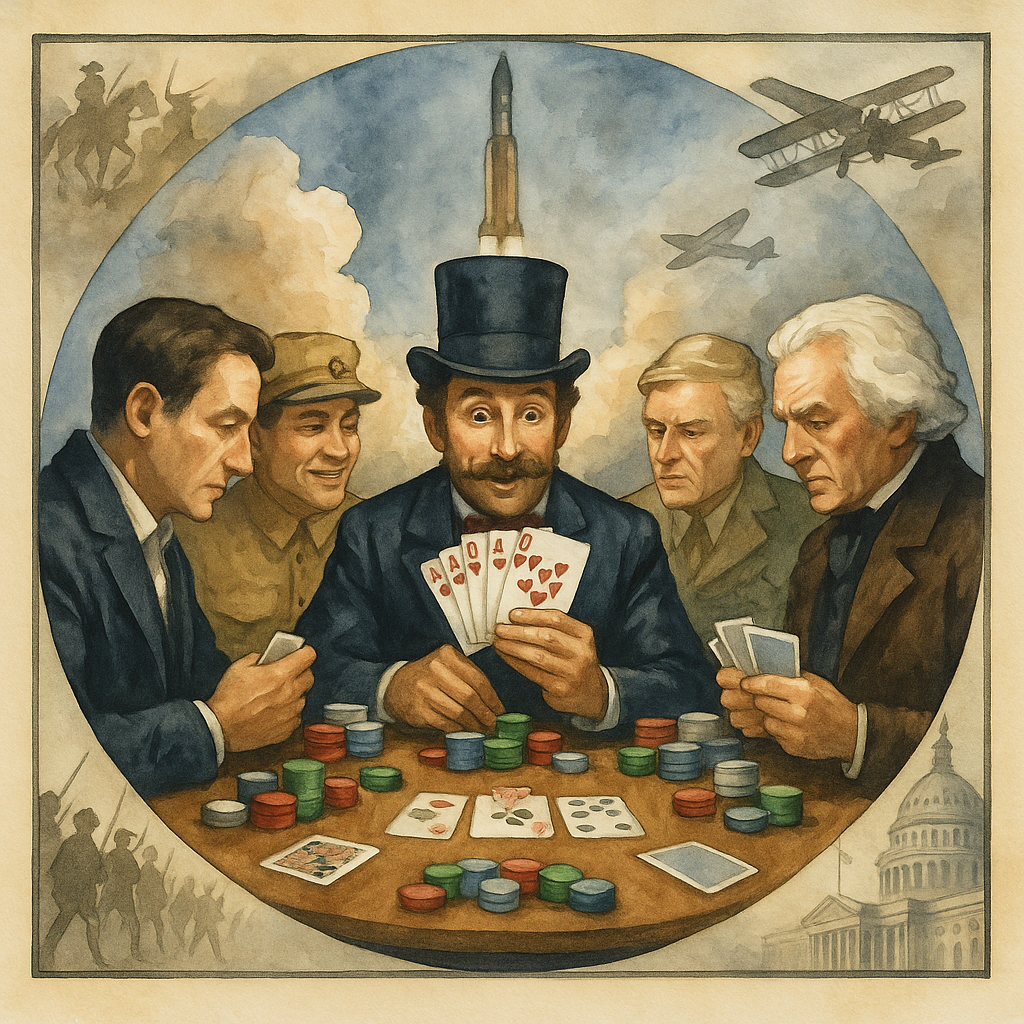
Poker’s Luckiest Streaks in Historic Events

Poker’s greatest winning streaks represent statistical impossibilities made real through a combination of extraordinary skill, perfect timing, and remarkable variance. From Archie Karas turning $50 into $40 million to Adam Friedman winning the same WSOP event three consecutive times—a feat never before accomplished in the tournament’s 52-year history—these achievements define the boundaries of what’s possible at the felt. The mathematical probability of these streaks ranges from improbable to nearly impossible, with modern back-to-back WSOP Main Event victories carrying odds of approximately 1 in 64 million, yet history has recorded multiple such occurrences.
The Legendary Run That Rewrote Gambling History
Archie Karas’s “The Run” from December 1992 to early 1995 stands as the longest and most lucrative winning streak in gambling history, verified by Guinness World Records. Starting with just $50 in his pocket and a $10,000 loan, Karas transformed this stake into $40 million through an unprecedented combination of pool hustling, high-stakes poker, and dice games at Binion’s Horseshoe.
His poker victories alone included defeating legends Stu Ungar for $1.2 million, Chip Reese for over $2 million, and Johnny Chan, Puggy Pearson, and Johnny Moss for millions more. At his peak, Karas held every $5,000 chip at Binion’s Horseshoe and was betting up to $300,000 per craps roll. The Las Vegas Review-Journal extensively documented his exploits, with numerous professional players witnessing his dominance firsthand. The tragic epilogue—losing $30 million in three weeks—serves as poker’s ultimate cautionary tale about variance and bankroll management.
Modern Era’s Million-Dollar Heaters
Fedor Holz’s six-week miracle from May 29 to July 8, 2016, generated $16,484,153 in tournament winnings, effectively doubling his lifetime earnings at age 22. His streak included:
- $111,111 High Roller for One Drop: $4,981,775
- $300,000 Super High Roller Bowl (2nd): $3,500,000
- Multiple seven-figure scores across three continents
Similarly remarkable was Dan Colman’s 2014 dominance, capturing $22,389,481 including the then-largest single tournament score of $15,306,668 in the Big One for One Drop. These modern streaks occurred in an era of unprecedented prize pools and field sizes, making their statistical improbability even more pronounced.
Tournament Domination That Defied Mathematical Probability
The most statistically improbable tournament achievement belongs to Adam Friedman, who won the WSOP $10,000 Dealer’s Choice Championship three consecutive times (2018, 2019, 2021), becoming the first player in WSOP history to three-peat any event. Mathematical analysis reveals the odds of this achievement, given field sizes of approximately 100-120 elite players, at roughly 1 in 1.4 million. For context, no other player has won the same WSOP event even twice consecutively in the modern era.
Andrew Ostapchenko recently broke Ronnie Bardah’s record by cashing in seven consecutive WSOP Main Events (2016-2023), a feat with odds of approximately 1 in 100,000 given average field sizes exceeding 6,800 players. The consistency required to navigate through thousands of opponents year after year represents perhaps poker’s ultimate test of sustained excellence.
| Player | Years | Field Size | Prize Money | Notable Achievement |
|---|---|---|---|---|
| Johnny Moss | 1970-1971 | 6, 7 | $60,000 | First back-to-back winner |
| Doyle Brunson | 1976-1977 | 22, 34 | $560,000 | Won with 10-2 both times |
| Stu Ungar | 1980-1981 | 73, 75 | $745,000 | Youngest champion at 26 |
| Johnny Chan | 1987-1988 | 152, 167 | $825,000 | Last to achieve the feat |
The holy grail of poker achievements—consecutive WSOP Main Event victories—has been accomplished only four times in history. Johnny Chan’s back-to-back wins in 1987 and 1988 made him the last player to achieve this feat, and his near-miss at a three-peat in 1989 (losing heads-up to 24-year-old Phil Hellmuth) remains one of poker’s great what-if moments. Lakers owner Jerry Buss had promised Chan an NBA championship ring if he completed the three-peat, but Hellmuth’s pocket nines held against Chan’s ace-seven to deny history.
The Statistical Reality Behind Poker’s Greatest Heaters
Academic research analyzing 456 million poker hands reveals that while luck dominates individual sessions, skill emerges as the primary factor after approximately 1,500 hands. Top-decile players achieve 30% or higher return on investment compared to negative 15% for average players, according to analysis by economists Levitt and Miles. This skill edge translates to improved winning probabilities—a professional with a 3x skill advantage sees their tournament winning odds improve from 1 in 1,000 to approximately 1 in 333.
The mathematics of consecutive victories become astronomical quickly. In modern WSOP Main Events with 8,000-plus entrants, the probability of back-to-back victories for an average player is 1 in 64 million. Even with an elite skill edge reducing this by a factor of five, the odds remain at 1 in 2.56 million.
Stu Ungar’s Impossible Comeback
Stu Ungar’s achievement of winning three WSOP Main Events (1980, 1981, 1997) becomes even more remarkable considering the 16-year gap between his second and third victories. His 1997 comeback, backed at the last minute by Billy Baxter while wearing blue-tinted sunglasses to hide collapsed nostrils from cocaine abuse, represents poker’s ultimate redemption story—though his death one year later with only $800 to his name underscores the game’s brutal variance.
Mathematical models demonstrate that tournament variance creates massive confidence intervals even for skilled players. A professional with a 20% return on investment can experience 95% confidence intervals spanning 200-500% of expected results, meaning both extreme winning and losing streaks fall within normal statistical expectations. This explains how players like Viktor Blom could win $6 million online in two months during 2009-2010, then lose $4.2 million to Brian Hastings in five hours—the largest documented online poker loss at the time.
When Amateurs Caught Lightning in a Bottle
Chris Moneymaker’s 2003 WSOP Main Event victory sparked poker’s modern boom and remains the sport’s most transformative amateur success story. After qualifying through an $86 PokerStars satellite (not $40 as initially reported), the Tennessee accountant navigated through 839 players to win $2.5 million. His journey to victory exemplified the perfect storm of skill, luck, and timing that defines poker’s greatest amateur triumphs.
Key hands included eliminating childhood hero Johnny Chan with aces and eights, surviving a bad beat against Phil Ivey when his ace-queen rivered an ace against Ivey’s pocket nines, and executing what ESPN’s Norman Chad called “the bluff of the century” against Sam Farha in heads-up play, moving all-in with king-high and forcing Farha to fold top pair. The combined probability of satellite qualification to Main Event victory was approximately 1 in 855,000.
Jerry Yang’s 2007 victory provides another remarkable amateur narrative. A Laotian refugee and psychotherapist who had been playing poker for only two years, Yang qualified through a $225 satellite and entered the final table as the second-shortest stack before eliminating seven of eight opponents. His religious displays and pledge to donate 10% to charity became defining elements of his run.
Jamie Gold’s 2006 victory for a record $12 million came amid controversy when Bruce Crispin Leyser sued for half the winnings, claiming a pre-tournament deal. The legal proceedings, which froze $6 million during litigation, inadvertently provided extensive documentation verifying the win’s legitimacy.
Historical records show that Hal Fowler became the first true amateur to win the WSOP Main Event in 1979, defeating 54 players for $270,000 and proving non-professionals could compete at poker’s highest level. The satellite system itself, created in 1982 by WSOP tournament director Eric Drache to boost Main Event entries, democratized poker by providing a pathway for dreamers—a system that fed amateur hopes for 40 years until its discontinuation in 2023.
High-Stakes Cash Game Miracles and Records
The cash game arena has produced its own legendary streaks, though documentation becomes less precise outside tournament settings. Phil Ivey’s 2006 heads-up battle against billionaire Andy Beal saw Ivey win $16.6 million over three days playing $50,000/$100,000 limit hold’em, recovering money Beal had previously won from other members of “The Corporation”—a group of elite professionals who pooled bankrolls to play Beal.
Online poker’s golden age produced staggering swings concentrated in brief periods. Tom Dwan’s biggest televised pot reached $3.1 million in May 2023 at Hustler Casino Live, while his earlier battles with Viktor Blom saw millions change hands across multiple tables simultaneously. Patrik Antonius won what was then online poker’s largest pot—$1.35 million—against Blom, who himself experienced perhaps the most volatile swings in poker history, winning $6 million in his first two months on Full Tilt Poker before losing $4.2 million to Brian Hastings in a single five-hour session.
Doyle Brunson’s most remarkable cash game achievement came in the mid-1960s after surviving a cancer diagnosis. Playing with newfound aggression—feeling he was living on borrowed time—Brunson won 54 consecutive sessions, using the winnings to pay off all medical debts. “It was so uncanny it got to be a joke,” Brunson later wrote in his memoir, though this streak predates modern verification methods.
WSOP Bracelet Dominance Across Single Seasons
Seven players share the record for most WSOP bracelets won in a single year with three each, but Jeff Lisandro’s 2009 achievement stands unique—he became the only player to win all three seven-card stud disciplines (Stud High, Stud Hi-Lo, and Razz) in the same series. Phil Ivey’s 2002 campaign, winning three bracelets and earning the nickname “The Year of Ivey,” established him as a mixed-game specialist at age 26.
Phil Hellmuth’s overall WSOP dominance spans five decades with 17 bracelets and 162 cashes—both all-time records. His consistency across 40-plus years of play, winning bracelets in the 1980s through 2020s, represents perhaps poker’s greatest sustained excellence. Ivey’s 11 bracelets all came in non-hold’em events, a specialized record unlikely to be matched as mixed games decline in popularity.
| Player | Year | Events Won | Total Prize Money |
|---|---|---|---|
| Puggy Pearson | 1973 | Main Event, Limit Hold’em, NL Hold’em | $190,000 |
| Ted Forrest | 1993 | Razz, Omaha Hi-Lo, Seven Card Stud | $324,000 |
| Phil Hellmuth | 1993 | Limit Hold’em (2), NL Hold’em | $313,000 |
| Phil Ivey | 2002 | Seven Card Stud, S.H.O.E., Limit Hold’em | $391,860 |
| Jeff Lisandro | 2009 | Stud, Stud Hi-Lo, Razz | $432,500 |
| George Danzer | 2014 | Razz, Seven Card Stud Hi-Lo (2) | $520,538 |
| Benny Glaser | 2025 | Mixed Triple Draw, Omaha Hi-Lo, PLO | $856,321 |
Modern single-year earnings records belong to players like Justin Bonomo, who won over $25 million in 2018 high roller events, while Bryn Kenney leads all-time tournament earnings with $73-plus million. The largest single tournament score remains Antonio Esfandiari’s $18,346,673 victory in the 2012 Big One for One Drop, though Kenney’s $20.5 million second-place finish in the 2019 Triton Million (due to a deal) represents the largest payout in poker history.
The Legacy of Legendary Streaks
The documented history of poker’s greatest winning streaks reveals a consistent pattern: exceptional skill provides opportunities for these streaks to begin, but variance determines their magnitude and duration. The most successful players who experienced legendary heaters—Daniel Negreanu, Phil Ivey, Johnny Chan—demonstrated remarkable longevity beyond their peak periods through disciplined bankroll management and consistent skill refinement. Others like Archie Karas and Stu Ungar became cautionary tales, their astronomical wins followed by complete financial ruin.
Modern poker’s comprehensive documentation through video coverage, online hand histories, and centralized databases like Hendon Mob has transformed streak verification from folklore to fact. While the romantic tales of Wild West poker largely dissolve under historical scrutiny, today’s achievements are meticulously recorded and mathematically analyzed.
The evolution from 20-card decks in New Orleans saloons to multi-million dollar televised tournaments reflects not just poker’s growth but the parallel development of systems to verify and celebrate its most improbable achievements. These streaks, whether lasting days or years, represent the outer boundaries of possibility in a game where skill and luck dance an eternal, precisely documented tango.
Key Takeaways: Poker’s Most Improbable Winning Streaks
- Archie Karas (1992-1995): Turned $50 into $40 million in history’s longest verified winning streak
- Adam Friedman (2018-2021): First player to win the same WSOP event three consecutive times
- Back-to-Back Main Events: Only achieved 4 times in history, last by Johnny Chan (1987-1988)
- Modern Probability: Back-to-back Main Event wins now carry 1 in 64 million odds
- Skill vs. Luck: Research shows skill dominates after ~1,500 hands of play
- Amateur Dreams: Chris Moneymaker’s $86 satellite to $2.5 million Main Event victory (2003)
- Cash Game Records: Phil Ivey won $16.6 million from Andy Beal in three days (2006)
- Single Year Dominance: Seven players have won three WSOP bracelets in one year
Master Your Game Beyond Hold’em
Want to improve your chances in mixed games and tournaments? Explore our comprehensive strategy guides:
Frequently Asked Questions
Looking Forward: The Future of Poker Streaks
As poker evolves with solver technology, GTO strategies, and increasingly sophisticated training tools, the nature of winning streaks continues to transform. Modern professionals armed with computational analysis and perfect mathematical models should theoretically reduce variance through optimal play. Yet the documented evidence suggests otherwise—streaks remain as unpredictable and spectacular as ever.
The rise of high-roller tournaments with buy-ins reaching $1 million creates opportunities for single-session wins that dwarf entire careers from previous generations. Meanwhile, online poker’s return to prominence through sites featured in our cryptocurrency poker platforms enables volume and variance that live play cannot match.
Whether measured in dollars, bracelets, or consecutive victories, poker’s luckiest streaks remind us that in a game of incomplete information and calculated risks, the impossible remains tantalizingly possible. The next legendary run could begin with any hand, at any table, transforming an unknown player into poker immortality—or adding another chapter to an established legend’s story.
About the Author

Mixed Game Masters Editorial
Published: October 21, 2025 | Categories: Tournaments & Events, Draw & Lowball
Mixed Game Masters is the premier resource for non-Hold’em poker strategy, tournament coverage, and mixed game education. Our editorial team consists of experienced players and poker historians dedicated to preserving and sharing the rich history of poker’s most challenging variants.
We provide comprehensive coverage of stud games, lowball variants, and mixed game formats, helping players of all levels improve their skills beyond traditional No-Limit Hold’em.
Leave a Reply