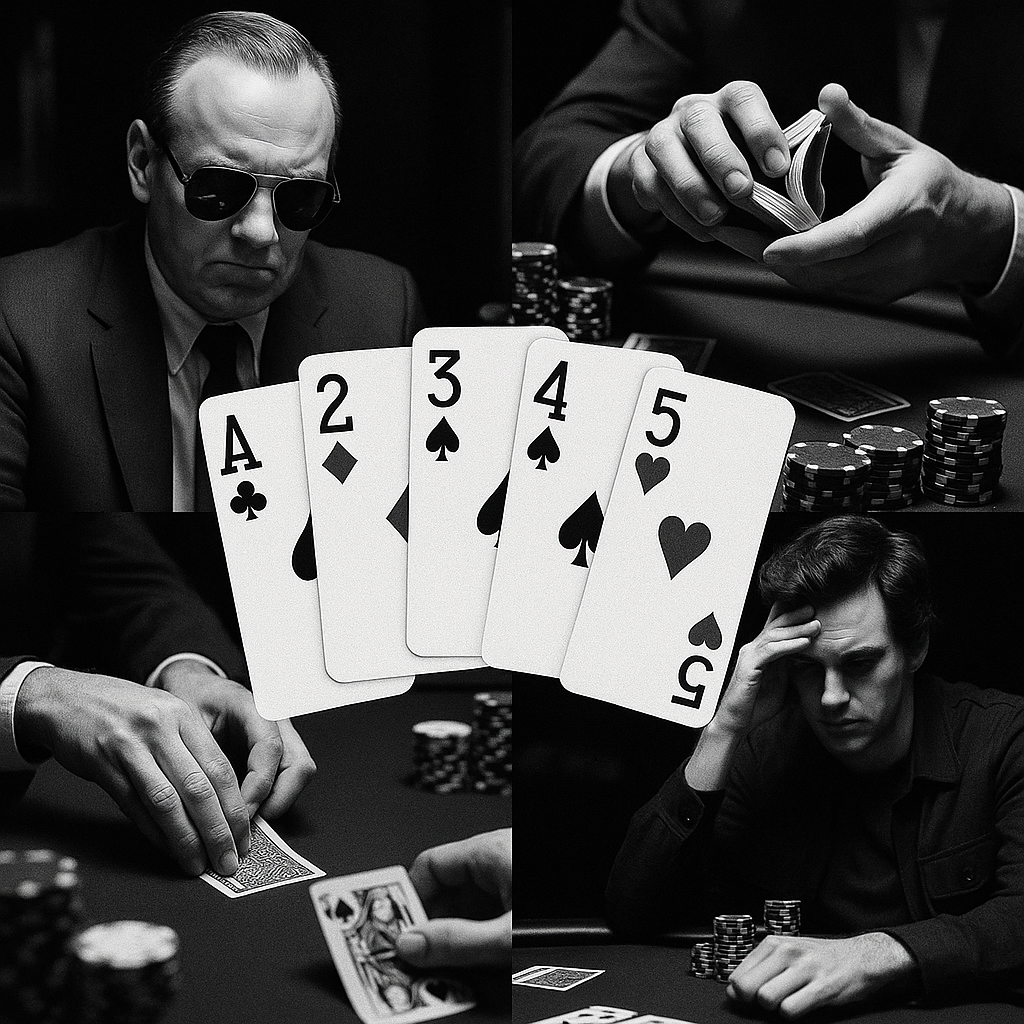
Razz Strategy Fads That Didn’t Last

The graveyard of failed Razz strategies tells a cautionary tale of poker evolution, where intuitive approaches that dominated smoky cardrooms for decades crumbled under mathematical scrutiny. From the 1970s to today, Razz strategy has undergone revolutionary changes, exposing fundamental flaws in methods once promoted by legendary players and respected authors.
Key Takeaways
- 1971-1983: “Feel-based” era dominated by intuition over mathematics, epitomized by Stu Ungar’s failed hyperaggression
- 1983: David Sklansky’s mathematical approach revolutionizes Razz, though 70% later proves outdated
- 2004-2011: Online poker boom exposes myths through millions of tracked hands
- 2008: Mitchell Cogert’s flawed strategies include checking with the best hand
- Post-2015: Solver concepts complete the transition from exploitation to balanced play
The Feel-Based Era’s Expensive Mistakes
Jimmy Casella’s victory in the inaugural 1971 WSOP Razz event for $10,000 established the game’s tournament legitimacy, but his conservative approach would prove exploitable by modern standards. The early era prioritized reading opponents and aggressive representation over mathematical calculation, creating strategic myths that persisted for decades.
Stu Ungar’s “raise-it-to-the-roof” philosophy epitomized this era’s fundamental flaw. Despite his legendary memory, Ungar lost $500,000 to Archie Karas in heads-up Razz, then another $700,000 in seven-card stud (source). Even Chip Reese, considered the greatest cash game player of his generation, lost over $2 million to Karas, demonstrating that pure feel couldn’t overcome mathematical reality.
Pre-1980s strategies included catastrophic misconceptions that cost fortunes. Players defended bring-ins with any high card in heads-up situations, believing “good pot odds” compensated for poor winning probability. The “bet when you look good” philosophy ignored equity calculations entirely, while the belief that “a made hand always beats a draw” led to countless mistakes when rough nine-lows faced smooth four-card wheels.
Sklansky’s Revolution and Eventual Obsolescence
David Sklansky’s 1983 “Sklansky on Razz” marked the first systematic mathematical approach to the game. His work, later incorporated into “Sklansky on Poker” (1994), became the definitive old-school text. Yet modern analysis reveals that 70% of Sklansky’s material is now “fairly basic or outdated,” despite remaining the most comprehensive early guide available (source).
Sklansky’s rigid starting requirements—playing only “three cards to a 6” or better—made players too predictable. His famous “never open limp” rule was later contradicted by Ted Forrest and Huck Seed, who identified valid reasons for limping including trapping aggressive players. The insufficient emphasis on positional awareness and conservative betting patterns became exploitable as opponents evolved.
Mitchell Cogert’s 2008 “Play Razz Poker to Win,” despite PokerStars selecting it for worldwide player training, contained egregious errors. Cogert advocated not betting when holding the best hand, specifically recommending checking with 7-9-J-5 against opponents showing Q-6-Q on fourth street. Critics demolished this advice: “You have the best hand! Personally I would not want to let them draw for free.”
| Year | Author/Book | Key Strategy | Fatal Flaw |
|---|---|---|---|
| 1983 | Sklansky on Razz | Mathematical approach | Rigid, exploitable patterns |
| 2008 | Cogert – Play Razz to Win | Conservative checking | Checking with best hand |
| 2009 | Full Tilt Strategy Guide | Variance avoidance | Folding profitable spots |
| 2015+ | Modern GTO Approach | Balanced frequencies | Still evolving |
How Online Poker Exposed Fundamental Flaws
The 2004 launch of Razz on Full Tilt Poker triggered a strategic revolution. Online players could suddenly play hundreds of hands daily versus dozens live, creating statistical samples that revealed which strategies actually worked versus poker room folklore. PokerStars added Razz in 2006, accelerating the game’s evolution from months to years.
The volume exposed numerous myths with mathematical certainty. The “always play three to a wheel” rule crumbled when data showed dead card analysis mattered more than rigid requirements. The belief that stealing against any high card was profitable ignored position and board texture nuances. Even the sacred cow that “pairs are always bad” fell when analysis proved some paired hands could be profitable with proper dead card consideration.
Online play revealed the “16 big bet” bankroll rule as dangerously inadequate. Razz’s multiple betting rounds and potential for strong starts to become disasters required bankrolls many times larger. Players following traditional bankroll management went broke repeatedly, learning expensive lessons about true variance.
Tournament Strategy Myths That Crumbled
Tournament Razz revealed distinct failed strategies from cash games. David Baker’s 2015 analysis identified the “ABC strategy is sufficient” myth, showing simple tight play left players “at the mercy of the cards” without accumulating chips through skill (source).
The Ted Forrest versus Huck Seed debate from the Full Tilt Strategy Guide exposed fundamental disagreements. Seed argued for folding live A-2-3 facing a raise and reraise to avoid variance, prompting Forrest’s memorable response: “I think I could make money playing Huck’s discards.” This highlighted the misconception that avoiding profitable spots for variance reduction was correct tournament strategy.
Stack size considerations were consistently misunderstood. The belief that 30 big bets provided sufficient tournament chips proved false when analysis showed players could go broke after just two volatile hands. Proper structure required 75+ big bets, a revelation that changed tournament design.
The Catalog of Failed Specific Tactics
Most Expensive Failed Strategies
- “Low door card always bets” – Created predictable, exploitable patterns
- “Never bluff in Razz” – Missed profitable semi-bluffing opportunities
- “Always draw to your low” – Ignored crucial card removal effects
- “Point of no return on fifth” – Failed to account for doubled bet sizes
- “16 big bet bankroll” – Led to countless unnecessary bankruptcies
Door card stealing became overemphasized, with 1980s advice suggesting stealing with any ace through five showing, regardless of position or hole cards. This led to expensive bluffs against calling stations and ignored table dynamics entirely. The opposite extreme, the “never bluff in Razz” school, proved equally flawed.
Fourth street became a particular minefield. Players continued bluffing after catching bad, reasoning opponents couldn’t see hole cards, but observant players deduced from betting patterns when aggressors had likely paired. The myth that “a four-card hand is much, much better than a three-card hand” led to overly aggressive play that online data proved was often negative expected value.
Drawing strategies contained multiple fatal flaws. The “always draw to your low” mistake ignored card removal—when needed cards appeared in opponents’ hands or the muck, drawing became mathematically incorrect regardless of pot size. Understanding board reading and upcard information became crucial for avoiding these expensive errors.
Mixed Games Reveal Razz Incompetence
The rise of H.O.R.S.E. and 8-Game tournaments after 2000 exposed widespread Razz incompetence. Ashley Adams noted players often played “much more tightly and timidly” during Razz rounds, creating opportunities for aggressive accumulation (source).
Andy Bloch observed that players frequently forgot which Stud variant they were playing: “invariably going to be a couple of hands where somebody forgets,” revealing how superficial many players’ Razz knowledge remained. Mixed game exposure forced strategic evolution as players could no longer avoid Razz entirely, accelerating the abandonment of exploitative approaches in favor of balanced play.
Modern Technology’s Final Verdict
The post-2015 solver era brought a mathematical mindset that transformed Razz thinking. Randy Ohel, high-stakes mixed game regular and WSOP bracelet winner, advocates balanced play: “I love playing against people who two-bet their wheel draws and call their 7 and 8 draws… They are gaining a little bit of value on third street, but they are giving me so much information.” (source)
The transition from exploitative to balanced play marked the final rejection of old-school wisdom. Pre-online Razz was purely exploitative—identify weak players and attack specific leaks. Online evolution demanded more balanced approaches as player pools sophisticated. The modern synthesis combines GTO baselines with exploitative adjustments.
Training sites now teach mathematical approaches that would seem alien to 1970s players. The emphasis shifted from memorizing starting hand charts to understanding range construction, from pure aggression to frequency-based play, from feel to calculation. While dedicated Razz solvers remain limited, the mathematical framework from Hold’em solver work revolutionized approach.
Master Modern Razz Strategy
Ready to learn what actually works? Explore our comprehensive guides:
Why These Strategies Failed
The fundamental failure stemmed from limited sample sizes and absence of computational analysis. Strategies developed in smoke-filled poker rooms against specific player pools proved disastrous when exposed to millions of online hands and diverse opponent types. The poker boom’s influx of educated players armed with the same books made previously effective exploitative strategies self-defeating.
Mathematical inadequacy pervaded every aspect. Early approaches lacked proper pot odds calculations, ignored implied odds across multiple streets, and failed to account for card removal effects. Emotional decision-making replaced calculation, with feel-based approaches leading to tilt and catastrophic bankroll management.
The replacement strategies emphasize mathematical precision over intuition. Modern players calculate equity considering dead cards, understand position’s impact on starting requirements, and balance ranges to prevent exploitation. For those wanting to practice these concepts, SwC Poker offers mixed games including Razz with lower stakes for learning.
Frequently Asked Questions
The Continuing Evolution
Razz strategy continues evolving, though at a slower pace than during the online boom. The game Jimmy Casella won in 1971 with straightforward conservative play has transformed into a sophisticated battle of ranges, frequencies, and calculated aggression. Modern champions like Brian Rast demonstrate advanced tournament play that would mystify early practitioners.
The graveyard of failed Razz strategies serves as a cautionary tale about accepting wisdom without mathematical verification. From Stu Ungar’s hyperaggression to Mitchell Cogert’s passive checking with the best hand, from the “never play an 8” rule to the “16 big bet” bankroll disaster, each abandoned strategy represents expensive lessons learned through countless lost pots and busted bankrolls. Today’s accepted strategies may themselves become tomorrow’s cautionary tales as the game continues its relentless evolution.
About the Author
Mixed Game Masters Editorial
Published: February 15, 2026 | Categories: Strategy & Analysis, Stud & Razz
Mixed Game Masters is the premier resource for non-Hold’em poker strategy, tournament coverage, and mixed game education. Our editorial team consists of experienced players and poker historians dedicated to preserving and sharing the rich history of poker’s most challenging variants.
We provide comprehensive coverage of stud games, lowball variants, and mixed game formats, helping players of all levels improve their skills beyond traditional No-Limit Hold’em.
Leave a Reply