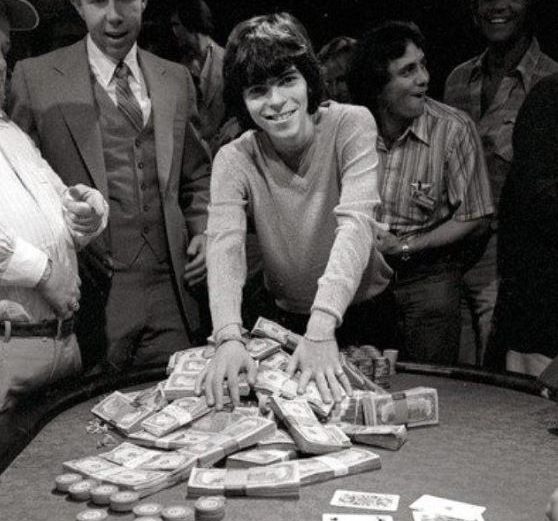
Stu Ungar History: Genius of Limit Texas Hold’em and Beyond

Stuart Errol “The Kid” Ungar (1953-1998) stands as poker’s most gifted and tragic figure – a player who won the World Series of Poker Main Event three times, dominated every card game he touched with supernatural ability, yet died alone in a cheap Las Vegas motel with $800 to his name. His 33.3% win rate in major tournaments remains unmatched, his photographic memory and card-reading abilities became legendary, and poker luminaries from Doyle Brunson to Mike Sexton unanimously declared him the greatest natural card player who ever lived. This comprehensive examination reveals both the extraordinary achievements and heartbreaking downfall of a genius whose story continues to captivate the poker world decades after his death.
From Lower East Side Prodigy to Gin Rummy Destroyer
Born September 8, 1953, in Manhattan’s Lower East Side to Jewish immigrants of Hungarian descent, Stu Ungar displayed genius-level intelligence from childhood, with an IQ estimated over 140 and what many described as authentic photographic memory. His father Isidore “Ido” Ungar operated Foxes Corner, a bar that doubled as an illegal gambling den at 118 Second Street, where young Stu absorbed the rhythms of card games despite his father’s attempts to shield him from gambling’s darker side.
By age 7, he was calculating odds and paying out winnings for his father’s customers, and at age 10, he won his first gin rummy tournament – a harbinger of the dominance to come. Tragedy struck early when Ido died of a heart attack on July 25, 1967, leaving 13-year-old Stu as the family’s primary breadwinner after his mother Faye suffered a debilitating stroke around the same time.
Dropping out of Seward Park High School in the 10th grade, Ungar turned to gin rummy full-time, quickly establishing himself in New York’s underground gambling scene. Under the mentorship of Victor Romano, a reputed organized crime figure who protected the arrogant young prodigy from offended opponents, Ungar’s reputation grew to legendary proportions.
The Gin Rummy Match That Ended a Career
Around 1970, Ungar faced Harry “Yonkie” Stein, widely considered America’s best gin player, at the Pennsylvania Hotel on 7th Avenue. In what became gin rummy’s most famous match, the diminutive Ungar – so small he needed a Coca-Cola crate on his chair to reach the table properly – destroyed Stein 86 games to 0 in Hollywood Gin. Stein immediately retired from professional play, reportedly “never the same again.”
By the mid-1970s, Ungar’s dominance was so complete that casinos requested he not participate in tournaments because other players refused to enter, and he offered increasingly desperate handicaps – letting opponents see the bottom card, giving positional advantages – just to find action. His gin mastery reached almost supernatural levels; he could predict opponents’ entire 10-card hands after just two or three discards, never sorted his own cards to avoid giving information, and once won a $100,000 bet from Bob Stupak by correctly identifying all 156 remaining cards in a six-deck shoe.
Three WSOP Main Events and Tournament Dominance Beyond Belief
When gin rummy action completely dried up, Ungar moved to Las Vegas in 1977 and reluctantly turned to poker. His transition was nothing short of miraculous. The 1980 WSOP Main Event was the first Texas Hold’em tournament he ever entered – he had read Doyle Brunson’s “Super System” the night before.
In the heads-up final against Brunson himself, Ungar held 5♠4♠ against Brunson’s A♥7♠ on a board of A♦7♦2♣-3♥, making his straight on the turn. When Brunson moved all-in on the river, Ungar called with the nuts, becoming the youngest WSOP champion in history at age 26. Brunson later remarked it was “the first time I had seen a player improve as the tournament went on.”
Ungar successfully defended his title in 1981, defeating Perry Green heads-up with A♠Q♥ against Green’s 10♣9♦, becoming one of only four players to win consecutive Main Events. He nearly wasn’t allowed to play after spitting at a dealer, but Jack Binion convinced his father Benny to permit his entry. Between these victories, Ungar added a $95,000 Deuce-to-Seven Draw bracelet in 1981 and a $110,000 Seven-Card Stud bracelet in 1983, demonstrating mastery across multiple variants including Seven-Card Stud strategy and 2-7 Triple Draw fundamentals.
| Year | Event | Prize | Field Size |
|---|---|---|---|
| 1980 | Main Event – No Limit Hold’em | $385,000 | 73 |
| 1981 | Main Event – No Limit Hold’em | $375,000 | 75 |
| 1981 | $1,000 Deuce to Seven Draw | $95,000 | 95 |
| 1983 | $5,000 Seven Card Stud | $110,000 | 31 |
| 1997 | Main Event – No Limit Hold’em | $1,000,000 | 312 |
The most remarkable victory came in 1997 after a 16-year absence plagued by drug addiction. Staked by Billy Baxter with the $10,000 buy-in just minutes before registration closed, Ungar wore cobalt blue-tinted sunglasses to hide his cocaine-collapsed nostrils. Despite appearing gaunt and exhausted, falling asleep at the table on Day 1, he summoned his genius one final time. In the heads-up final against John Strzemp, Ungar’s A♦4♦ made a wheel straight against Strzemp’s A♠8♠, securing the $1 million prize and completing an unprecedented comeback. He carried his daughter Stefanie’s photo throughout, dedicating the victory to her in the ESPN interview.
Beyond the Main Events, Ungar’s tournament record defies belief. He won 10 out of 30 major no-limit Hold’em tournaments with buy-ins of $5,000 or more – a 33.3% win rate that remains unmatched and likely untouchable. He captured Amarillo Slim’s Super Bowl of Poker Main Event three times (1984, 1988, 1989), the only player to achieve this feat. Slim himself said “Stu musta won a million dollars in my tournaments.” His verified tournament earnings exceeded $3.6 million, though his total career winnings including cash games approached an estimated $30 million – virtually all lost to sports betting, drug addiction, and compulsive gambling on anything from ping-pong matches at $50,000 per game to coin flips for thousands.
Playing Style That Revolutionized Poker Psychology
Ungar’s approach to poker was decades ahead of its time, combining ultra-aggressive play with almost supernatural reading ability that tournament directors at the 1997 WSOP described as “clairvoyant.” Mike Sexton observed that “Ungar’s chips were constantly in motion,” applying relentless pressure that forced opponents into uncomfortable decisions. Unlike random aggression, his bluffs were surgically timed, and he deliberately used psychological warfare – talking constantly, insulting inferior players, and projecting supreme confidence that intimidated even seasoned professionals.
The Most Famous Call in Poker History
In a $50,000 heads-up freezeout against 1990 WSOP champion Mansour Matloubi, with the board showing 3-3-7-K-Q and Matloubi moving all-in for approximately $32,000 on the river, Ungar tanked before declaring: “You’ve either got 4-5 or 5-6, I call” – and called with just ten-high. Matloubi indeed held 5♦4♦, and Ungar’s read was exactly correct. This hand has become poker folklore, demonstrating abilities that seemed to transcend normal human pattern recognition.
His strategic approach combined genius-level mathematical calculation with devastating psychological insight. Victor Romano, his early mentor who could recite dictionary definitions and shared Ungar’s passion for calculating gambling odds, helped shape this mathematical precision. But Ungar went beyond pure calculation – he viewed poker as psychological combat, famously saying he wanted to “destroy people” at the table rather than just beat them. This fearless, confrontational style influenced a generation of tournament professionals who learned that aggression and psychological dominance could overcome mathematical disadvantages, principles still relevant in modern No-Limit Texas Hold’em strategy.
The Demons That Destroyed a Genius
Despite his extraordinary success, Ungar’s life was defined equally by devastating personal struggles. His cocaine addiction began around 1979 following his mother’s death, initially used to stay alert during marathon sessions but quickly escalating into serious dependency. By the late 1980s, the drug had severely damaged his nasal passages, requiring surgery – though he reportedly used cocaine just hours after leaving the hospital. The addiction deepened dramatically after his adopted stepson Richie’s suicide in 1989, shortly after the boy’s high school prom, a loss that shattered Ungar emotionally.
His relationships reflected both his capacity for love and his self-destructive patterns. He married Madeline Wheeler in 1982, having a daughter Stefanie who became the emotional anchor of his life, and legally adopting Madeline’s son Richie. The marriage collapsed in 1986 due to his drug use and gambling lifestyle, with Madeline later saying “the drugs destroyed our marriage.” His bond with Stefanie remained powerful – she told him before the 1997 WSOP “Daddy, I’m going to disown you if you don’t win the tournament,” motivating his final triumph. Tragically, they weren’t speaking when he died, as she had attempted “tough love” to force him into sobriety.
The poker community repeatedly tried to save him. Billy Baxter, who first met Ungar when the young player beat him for $40,000 and needed a Coca-Cola crate to reach the table, became his most loyal supporter, staking him for multiple tournaments including the 1997 victory. Mike Sexton, Chip Reese, and Doyle Brunson offered to pay for rehab anywhere in the world, but Ungar refused, claiming drugs were “easier to obtain in rehab than on the street.” Todd Brunson once desperately suggested to Sexton that they should kidnap Ungar and forcibly detain him in Canada for three months – a plan Sexton later regretted not pursuing.
The End at the Oasis Motel
On November 20, 1998, Ungar checked into Room 6 at the Oasis Motel, a seedy establishment at the end of the Las Vegas Strip that the manager described as an “adult-movie motel.” He paid $48 per night for two nights, leaving only The Mirage’s phone number as contact information. Bob Stupak had given him a $25,000 advance just days earlier, planning to stake him in a December tournament at Trump’s Taj Mahal. When asked about travel arrangements, Ungar had smiled and said “Let’s fly business class.”
Two days later, on November 22, 1998, motel employees found him dead on the floor, fully clothed with the television off, just after checkout time. He had $800 in his pocket – all that remained from Stupak’s advance. The autopsy revealed traces of cocaine, methadone, and Percodan in his system, but not enough to cause death directly. The official cause was heart failure brought on by years of drug abuse – his body had simply given out at age 45. Despite speculation, the coroner definitively ruled it was not an overdose but rather the cumulative damage of his lifestyle.
His funeral on Thanksgiving eve drew over 100 gamblers and poker players to Palm Mortuary, with Bob Stupak organizing a collection to pay for services since Ungar died with no assets. He was interred at Palm Valley View Memorial Park in East Las Vegas, his headstone reading “A great person, but a greater loss.”
Legacy of the Greatest Card Player Who Ever Lived
Stu Ungar’s reputation as possibly the greatest card player in history rests on a foundation of unprecedented achievement and universal acclaim from those who witnessed his abilities. Doyle Brunson, despite calling Ungar the most arrogant player he’d ever met at the table, “adored him” away from it, recognizing his genius immediately. Mike Sexton declared “I believe he was the most talented player who’s ever walked on the planet earth,” while simultaneously acknowledging that “in the game of life, Stu Ungar was a loser.”
His impact on poker extends far beyond statistics. He pioneered the ultra-aggressive tournament style that became standard, demonstrated that natural talent could overcome experience, and showed that psychological warfare was as important as mathematical calculation. Modern players still study his approach, though debate continues about whether his lack of formal training would handicap him against today’s theoretically sound professionals utilizing GTO vs exploitative strategies. Most agree, however, that his pure card sense and fearlessness were unmatched and likely unmatchable.
The fascination with Ungar’s story has produced extensive documentation: the Emmy-winning ESPN documentary “One of a Kind” (2006), the biographical film “High Roller” (2003) starring Michael Imperioli, and the definitive biography by Nolan Dalla and Peter Alson (2005). In 2024, father-son writing duo Eric and Geoff Roth secured exclusive rights for a television series, ensuring his story reaches new generations.
Key Facts About Stu Ungar’s Career
- Three-time WSOP Main Event Champion: 1980, 1981, 1997 (only player with Johnny Moss)
- 33.3% Tournament Win Rate: Won 10 of 30 major no-limit events ($5,000+ buy-ins)
- Five WSOP Bracelets: Including Deuce-to-Seven Draw and Seven-Card Stud
- Youngest Main Event Champion: Age 26 in 1980
- Gin Rummy Legend: Beat Harry Stein 86-0, ending Stein’s career
- Estimated $30 Million Won: Nearly all lost to gambling and drugs
- IQ Over 140: Photographic memory verified by multiple sources
- Died at Age 45: November 22, 1998, with just $800 to his name
Conclusion
Stu Ungar embodied both the highest potential of human talent and the devastating cost of personal demons. His story serves as inspiration for what pure genius can achieve – three WSOP Main Events, dominance across multiple games, recognition as history’s greatest card player – while warning of addiction’s power to destroy even the most gifted. In poker terms, he held pocket aces against life but went all-in on a seven-deuce bluff against his demons.
The fact that professionals still debate whether anyone could match his natural abilities, that his tournament records remain unbroken, and that his story continues to captivate audiences decades later proves that Stuart Errol Ungar achieved a form of immortality. He remains, now and perhaps forever, “The Kid” – the greatest natural card player who ever lived, whose genius burned too bright and too briefly, leaving behind a legacy of extraordinary achievement shadowed by profound tragedy.
Frequently Asked Questions
About the Author
Mixed Game Masters Editorial
Published: February 3, 2026 | Categories: Poker History, Legends & Champions
Mixed Game Masters is the premier resource for non-Hold’em poker strategy, tournament coverage, and mixed game education. Our editorial team consists of experienced players and poker historians dedicated to preserving and sharing the rich history of poker’s most challenging variants.
We provide comprehensive coverage of stud games, lowball variants, and mixed game formats, helping players of all levels improve their skills beyond traditional No-Limit Hold’em.
Leave a Reply