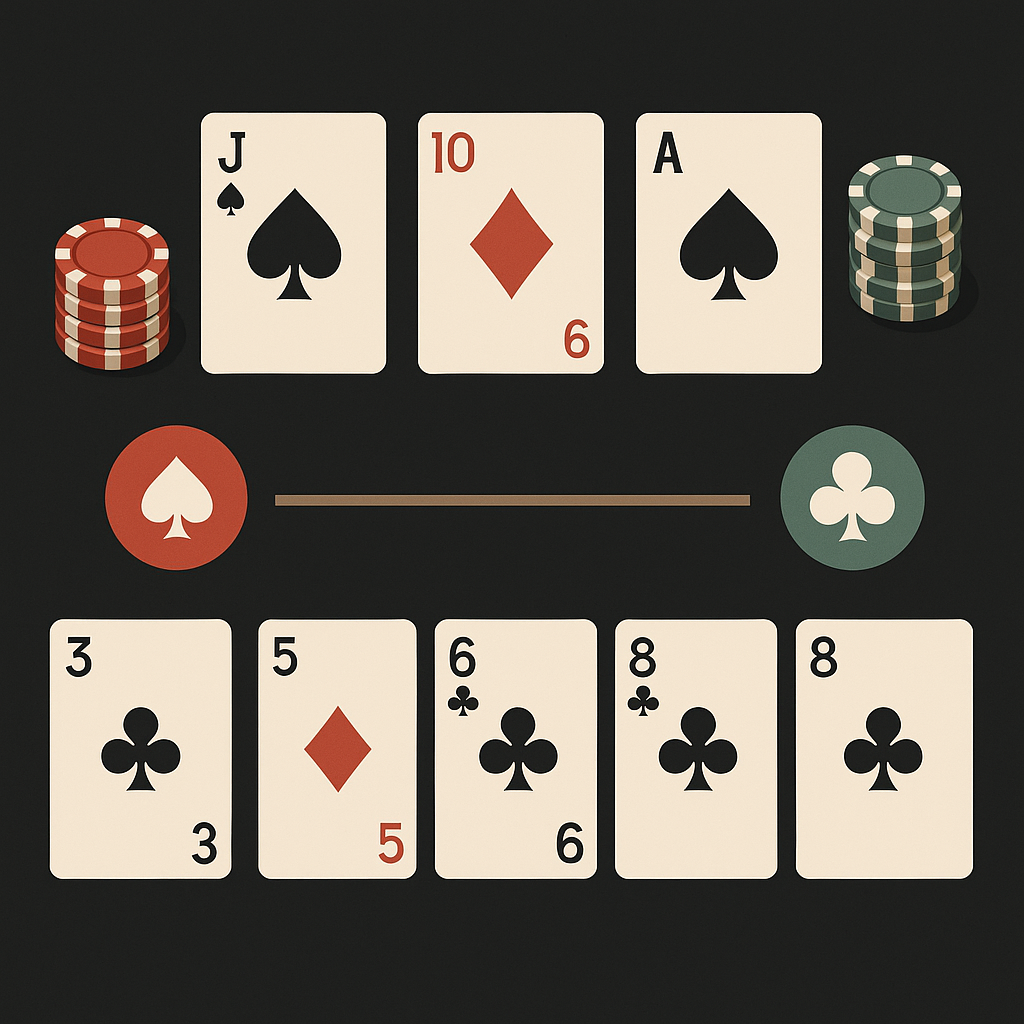
Stud Hi/Lo No Qualifier Hand Analysis: Unrestricted Low Chases

Seven Card Stud Hi/Lo No Qualifier fundamentally transforms split-pot poker by eliminating the 8-or-better requirement for low hands, creating a mathematically lopsided game where any five unpaired cards can win half the pot. This seemingly minor rule change produces a strategic earthquake: high pairs become virtually unplayable, medium pairs gain viability, and catching a single high card can destroy your entire hand equity. The variant, featured in Doyle Brunson’s original SuperSystem and still available in WSOP Dealer’s Choice events, disappeared from regular rotation precisely because players learned its optimal strategy eliminates the profitable mistakes that once made it lucrative.
The No-Qualifier Revolution Changes Everything
Stud Hi/Lo No Qualifier operates identically to regular Seven Card Stud Hi/Lo except for one critical distinction: there is no 8-or-better requirement for the low hand. Players receive seven cards through five betting rounds, making their best five-card high hand and best five-card low hand from the same seven cards. The high hand follows standard poker rankings while the low hand uses ace-to-five lowball rankings where straights and flushes don’t count against you.
The elimination of the qualifier requirement means that even K-Q-J-10-9 can win the low half if it’s the lowest hand at showdown. This creates an environment where low hands possess an immense mathematical advantage, often freerolling against high-only holdings. The dealing procedure follows standard Stud protocols with the highest door card bringing in on third street, but crucially, action begins with the best low board showing on all subsequent streets, adding a positional advantage to low-oriented hands.
The betting structure typically uses fixed limits with small bets on third and fourth streets, then big bets from fifth street through the river. When the pot splits, the high hand and low hand each receive half, with any odd chip going to the high hand. The same player can win both halves by scooping, which becomes the primary strategic goal given its 4-to-1 profit advantage over splitting.
Strategic Foundations Flip Traditional Stud Wisdom
The absence of an 8-qualifier completely inverts traditional Stud starting hand values. Premium starting hands now consist exclusively of low-oriented holdings: three suited low cards dominate the hierarchy, followed by three lows with straight potential like A-2-3 or 2-3-4, and pocket aces with a low kicker preferably 8 or lower. The mathematical reality that any low hand can win half the pot while potentially competing for the high makes these hands vastly superior to traditional high holdings.
High pairs become essentially unplayable – even rolled-up kings should typically be folded unless specific multiway situations arise. This dramatic shift occurs because high-only hands rarely scoop and face constant pressure from low draws that can develop high potential. Conversely, medium pairs gain unexpected viability: hands like (6♠A♥)6♦ or (7♥7♠)2♣ become playable since they face minimal competition from premium high hands that dominate regular Stud games.
The Critical Concept: Not All Bricks Are Equal
In regular Stud 8 or Better, if both players chasing lows catch high cards – say you catch a King while your opponent catches a 9 – neither player qualifies for low, but your King might help win the high.
In No Qualifier, this same scenario becomes catastrophic: your best possible low is now King-high, severely limiting scooping potential while your opponent with 9-high maintains reasonable two-way equity. Catching any face card or ten essentially caps your low at that rank, fundamentally altering drawing decisions throughout the hand.
Street-by-street play requires constant reassessment of scooping potential. On fourth street, marginal low hands that catch bad while opponents improve should often fold immediately – the pot odds rarely justify continuing with compromised scooping chances. Fifth street becomes the critical decision point where premium draws with flush or straight potential can continue despite catching bricks, while one-dimensional hands must evaluate whether they’re drawing live to only half the pot.
Mathematical Edge Heavily Favors Low-Oriented Play
The mathematics of Stud Hi/Lo No Qualifier create an environment where scooping provides a 200% return on investment versus 50% for splitting. Consider a three-player pot with $1 bets: scooping the $3 pot yields $2 profit (200% ROI), while splitting returns just $1.50 for $0.50 profit (50% ROI). This 4-to-1 advantage in profit margins explains why hands with two-way potential vastly outperform one-dimensional holdings.
| Outcome | Investment | Return | Profit | ROI |
|---|---|---|---|---|
| Scoop | $1.00 | $3.00 | $2.00 | 200% |
| Split High | $1.00 | $1.50 | $0.50 | 50% |
| Split Low | $1.00 | $1.50 | $0.50 | 50% |
| Quarter (tied low) | $1.00 | $0.75 | -$0.25 | -25% |
Equity calculations demonstrate that catching high cards in No Qualifier produces dramatically worse outcomes than in regular Stud 8. Available tools like the Stud Game Equity Calculator and TwoDimes poker calculator can run simulations specifically for the no-qualifier variant, consistently showing that low-oriented hands maintain 60-70% equity against high-only holdings in typical scenarios.
Quartering risks increase exponentially in multiway pots where multiple players chase lows. When two players tie for low while another wins high, each low hand receives just 25% of the pot – reducing expected value by half. This danger peaks in pots with four or more players where counterfeiting becomes common and multiple players may make identical low hands. The formula for split-pot calling decisions requires roughly twice the equity compared to regular pot odds: a $10 bet into a $50 pot normally needs 16.7% equity, but when expecting to split, you need 33.3% equity to break even.
Advanced Concepts Separate Experts from Intermediates
David Sklansky’s analysis in SuperSystem identified the freerolling concept as the game’s fundamental strategic principle. Low hands often freeroll high hands by competing for both halves while high holdings can only win their half. This creates situations where competent low-hand players essentially couldn’t lose against opponents playing high hands incorrectly – explaining why the game thrived when information was scarce but died when strategy became widely available.
Aggressive value betting with marginal scooping hands becomes crucial when opponents play reasonably well. The edges in properly played No Qualifier games are thin, making these value bets and raises essential for long-term profitability. Players must push seemingly small advantages, particularly in position with decent lows against opponents showing high boards.
The concept of hand protection takes on unique dimensions in No Qualifier. Raising to thin the field protects marginal low draws from quartering while building pots when you maintain equity advantages. However, this must be balanced against the reality that you’re often playing for half the pot, affecting the risk-reward calculation for aggressive plays.
Understanding board texture dynamics becomes critical for expert play. When multiple low cards appear on fourth street, the likelihood of quartering increases dramatically. Conversely, when the board shows predominantly high cards, even marginal low draws gain value as fewer opponents can compete for the low half. Expert players constantly adjust their continuation decisions based on how the collective board texture affects splitting probabilities.
Tournament Excellence Requires Specific Adjustments
The WSOP Dealer’s Choice Championships represent the primary tournament venue for Stud Hi/Lo No Qualifier, with events ranging from $1,500 buy-ins to the prestigious $25,000 championship. Recent champions like John Hennigan (7-time bracelet winner), Robert Mizrachi (5-time bracelet winner), and Chad Eveslage (who won both Dealer’s Choice events in 2023) demonstrate that mixed-game expertise translates into No Qualifier success.
Tournament play requires adjusting for shorter stacks and survival pressure. The mathematical advantage of low hands becomes even more pronounced when players can’t afford to gamble with marginal high holdings. This creates opportunities to exploit opponents who tighten up incorrectly, folding playable medium pairs while continuing with weak high-only hands.
In Dealer’s Choice formats, selecting Stud Hi/Lo No Qualifier becomes a tactical weapon against opponents unfamiliar with the variant. The game appears deceptively similar to regular Stud Hi/Lo, leading to costly mistakes from players who don’t adjust their starting standards sufficiently. Observing which opponents struggle with the format provides valuable information for game selection in later orbits.
Notable historical performances include the game’s prominence in early high-stakes cash games at the Horseshoe and Binion’s during poker’s golden era. Players like Doyle Brunson and David Sklansky built their reputations partly on exploiting the massive edges available when opponents didn’t understand split-pot dynamics. While modern players rarely make such fundamental errors, studying these historical approaches reveals timeless principles about exploiting information asymmetry.
Common Transition Mistakes Cost Players Money
Players moving from regular Stud Hi/Lo consistently make five critical errors that hemorrhage chips:
The Five Costliest Mistakes
- Overvaluing high hands – Even players who intellectually understand that high pairs are weak still struggle to fold pocket kings or aces without low potential. The emotional attachment to traditionally strong holdings proves costly when they rarely scoop.
- Misjudging brick impact – In regular Stud 8, catching a Queen when going low is bad but not catastrophic since you might not qualify anyway. In No Qualifier, that Queen caps your low at Queen-high, essentially ending your scooping chances.
- Failing to adjust multiway dynamics – High hands that might be playable multiway in Stud 8 become death traps in No Qualifier where every additional opponent likely competes for low.
- Inadequate value betting – Players accustomed to Stud 8’s more balanced high-low dynamics don’t push thin edges aggressively enough with marginal scooping hands.
- Positional misunderstanding – The shift from high card bringing in to low board acting first on subsequent streets changes information dynamics that many players fail to exploit.
Comparison with Regular Stud Hi/Lo Strategy
The strategic divergence between No Qualifier and regular Stud Hi/Lo centers on three fundamental axes:
Starting hand standards shift dramatically: while both variants prize three suited low cards, regular Stud 8 makes high pairs playable in position, whereas No Qualifier renders them virtually worthless. Medium pairs like sixes and sevens gain viability in No Qualifier specifically because high pairs exit the ecosystem.
Drawing decisions follow completely different frameworks. In Stud 8, the 8-qualifier creates a binary outcome – you either qualify or you don’t. This makes drawing to marginal lows (those needing perfect cards to qualify) generally unprofitable. No Qualifier eliminates this binary nature: every low draw has value, though catching high cards progressively destroys scooping equity rather than just qualification chances.
Betting patterns diverge based on pot-splitting frequency. Regular Stud 8 sees frequent scoops when no low qualifies, creating larger average pots won and more aggressive betting dynamics. No Qualifier’s guarantee that pots split (barring scoops) produces tighter, more value-oriented betting patterns where players must carefully calculate whether they’re getting correct odds to draw for half the pot.
Historical Context Explains the Variant’s Decline
Stud Hi/Lo No Qualifier enjoyed a golden era from the 1970s through the early 1990s when information asymmetry created massive edges. Recreational players routinely played high hands with no realistic winning chances, essentially donating money to knowledgeable low-hand players. The game thrived in Las Vegas’s biggest games where a small cadre of experts exploited widespread strategic misunderstanding.
The publication of SuperSystem in 1979 began the game’s decline by revealing optimal strategy to the masses. As David Sklansky’s chapter spread through the poker community, the egregious errors that made the game profitable gradually disappeared. By the late 1990s, the game had largely vanished from regular rotation as players learned that proper play eliminated most profitable opportunities.
A brief revival occurred in the 2010s when mixed games gained popularity and a new generation discovered the variant. However, as expert analysis notes, “everyone seemed to play it reasonably well and there wasn’t much action so it seemed to die a second death.” The game’s fundamental mathematical imbalance – where low hands possess such overwhelming advantages – creates a solved game where optimal play produces minimal action and few edges.
Today, Stud Hi/Lo No Qualifier survives primarily in WSOP Dealer’s Choice events where its inclusion among 20 approved games ensures occasional play. High-stakes mixed-game cash games during the WSOP sometimes feature the variant when players seek variety or when someone believes they’ve identified an opponent unfamiliar with optimal strategy. The game serves as a historical curiosity and educational tool, demonstrating how rule variations can fundamentally alter strategic landscapes.
Key Takeaways: Mastering Stud Hi/Lo No Qualifier
- Any low wins: The elimination of the 8-qualifier means K-Q-J-10-9 can win the low half
- High pairs are death: Even rolled-up kings should usually be folded – they can only win half the pot
- Medium pairs rise: Hands like pocket 6s or 7s become playable due to absence of competing high pairs
- Bricks matter differently: Catching a Queen caps your low at Queen-high, destroying scooping equity
- Scooping dominates: 200% ROI for scooping versus 50% for splitting creates a 4-to-1 profit advantage
- Low hands freeroll: Low-oriented holdings compete for both halves while high hands only win one
- The game is solved: Optimal strategy eliminates edges, explaining why it disappeared from regular play
Master Split-Pot Strategy
Ready to improve your mixed game skills? Explore our comprehensive guides:
Frequently Asked Questions
Looking Ahead: Lessons from a Solved Game
Stud Hi/Lo No Qualifier stands as poker’s ultimate lesson in how minor rule changes create major strategic revolutions. The removal of the 8-qualifier transforms a balanced split-pot game into a mathematically lopsided contest where low hands dominate through freerolling potential and guaranteed pot splits. Understanding this variant provides invaluable insights into split-pot theory, scooping mathematics, and the importance of two-way hand development that apply across all hi-lo formats.
While the game’s solved nature limits its commercial viability, its strategic principles remain essential education for serious mixed-game players. The variant’s historical arc from profitable chaos to solved equilibrium mirrors poker’s broader evolution from gambling to game theory, reminding us that information edges are temporary but fundamental understanding endures.
For players seeking to master modern Stud Hi/Lo or excel in Dealer’s Choice formats, studying No Qualifier provides crucial context for understanding why the 8-qualifier exists and how its presence creates the balanced, action-generating game we play today. The lessons learned from this “dead” variant continue to inform optimal play across all split-pot formats.
About the Author

Mixed Game Masters Editorial
Published: February 27, 2026 | Categories: Strategy & Analysis, Stud Games
Mixed Game Masters is the premier resource for non-Hold’em poker strategy, tournament coverage, and mixed game education. Our editorial team consists of experienced players and poker historians dedicated to preserving and sharing the rich history of poker’s most challenging variants.
We provide comprehensive coverage of stud games, lowball variants, and mixed game formats, helping players of all levels improve their skills beyond traditional No-Limit Hold’em.
Leave a Reply