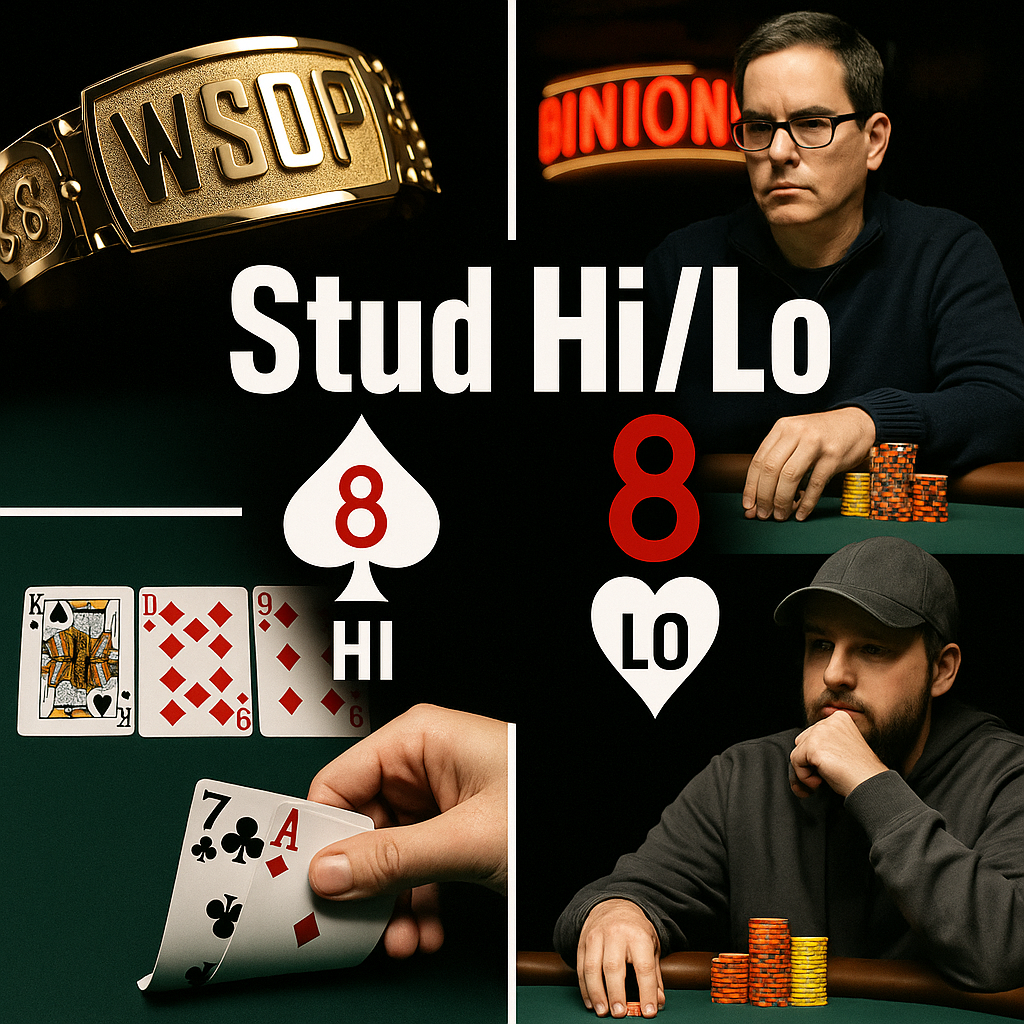
Stud Hi/Lo: Strategic Hand Reviews from the WSOP

Seven Card Stud Hi/Lo has produced some of the WSOP’s most strategically complex moments since its introduction in 1970, challenging players to master split-pot dynamics that reward both mathematical precision and psychological warfare. From Jeff Lisandro’s unprecedented 2009 sweep to Qinghai Pan’s 2025 championship victory worth $411,051 (PokerNews), this demanding variant continues attracting poker’s elite mixed-game specialists who understand that scooping both halves represents the ultimate strategic achievement in split-pot poker.
What is Stud Hi/Lo?
Seven Card Stud Hi/Lo (also called Stud 8 or Better) is a split-pot poker variant where the pot is divided between the highest and lowest qualifying hands. Players receive seven cards total (three down, four up) and must make their best five-card hand. To qualify for the low half, a hand must contain five unpaired cards ranked eight or lower. The ace plays both high and low, making A-2-3-4-5 the best possible low hand.
Key Takeaways
- Premium Starting Hands: Rolled-up trips, A-2-3 suited, and suited wheel cards offer maximum scoop potential
- Modern Discipline: Today’s winning players employ tighter starting-hand selection and more aggressive third-street play
- Quartering Risk: Tying for low while losing high yields only 25% of pot, often resulting in net losses
- 2025 Championship: Qinghai Pan won $411,051 from 186-player field in $10,000 Championship
- Strategic Evolution: Modern fields are tougher with more pressure applied when live low cards are dead
Championship-Defining Hands That Shaped History
The 2023 WSOP Event #55 final table produced one of the most psychologically intense moments in recent Stud Hi/Lo history. Mike Matusow faced an agonizing decision holding 7♦7♥8♠/4♥J♠9♥Q♥ against Marcin Horecki’s A♥8♥4♠/5♣3♦J♦3♠. After a prolonged tank, Matusow folded what would have been a chopped pot, allowing Horecki to show his bluff with just a pair of threes and an eight-low (PokerNews).
This momentum shift proved decisive as Horecki captured his first bracelet and Poland’s first-ever WSOP gold, denying Matusow his fifth bracelet. The tournament’s final hand crystallized the variance inherent in split-pot games when Matusow’s kings lost to Horecki’s running jacks on fifth and sixth streets.
Strategic analysis reveals consistent patterns among champions. Winners maximize fold equity through aggressive betting with two-way hands, while losers often chase half the pot with marginal holdings. As Daniel Negreanu emphasizes in his third street strategy guide, the ability to fold strong one-way hands in multiway pots separates champions from also-rans.
The Legends Who Mastered Split-Pot Excellence
Jeff Lisandro’s unprecedented 2009 achievement stands as the pinnacle of Stud mastery – winning all three Stud variant bracelets in a single WSOP series. His $431,656 victory in the $10,000 Seven Card Stud Hi/Lo Championship anchored this historic sweep (PokerNews). His methodical approach emphasized supreme card memory and disciplined starting hand selection, folding even strong high hands when low possibilities dominated.
George Danzer emerged as the decade’s dominant specialist, capturing the $10,000 Championship in both 2014 ($352,696) and 2016 ($338,646) (PokerNews). His 2014 campaign saw him win three bracelets total, earning WSOP Player of the Year honors. Danzer’s strategic philosophy centers on aggressive third street play with premium hands while maintaining exceptional discipline with marginal holdings.
| Year | Champion | Prize | Entries | Notes |
|---|---|---|---|---|
| 2025 | Qinghai Pan | $411,051 | 186 | Hellmuth 13th; Viktor Blom 10th |
| 2024 | Arash Ghaneian | $376,476 | 167 | Defeated Richard Sklar heads-up |
| 2019 | Robert Campbell | $385,763 | 151 | Second bracelet of summer |
| 2016 | George Danzer | $338,646 | 144 | Second title in this Championship (also 2014) |
| 2014 | George Danzer | $352,696 | 134 | WSOP POY year |
Sources: PokerNews WSOP Coverage (2014-2025), WSOP.com Official Results
Eli Elezra’s five bracelets include multiple Stud victories, notably his 2007 triumph for his first gold. His philosophy captures the specialist’s advantage perfectly: “When you love a game, the game loves you back” (Wikipedia). This deep understanding of split-pot concepts creates substantial edges against Hold’em specialists attempting mixed games.
Critical Strategic Concepts in Practice
The scooping imperative drives every decision in Stud Hi/Lo. Premium starting hands include rolled-up trips (especially trip fives that block low straight draws), three wheel cards with an ace like A-2-3, and suited babies like 5♣4♣3♣ offering maximum scoop potential. Ray Zee’s foundational framework from “High-Low Split Poker for Advanced Players” established categories still used today: zero-gappers (A-2-3, 2-3-4), one-gappers (2-3-5, 3-4-6), and marginal holdings (Ray Zee, “High-Low Split Poker for Advanced Players”).
Card removal effects dominate expert decision-making far more than amateur players realize. Tracking all exposed cards, especially aces through fives, determines drawing viability. Elite players maintain perfect recall of folded cards throughout entire sessions, adjusting opponent hand ranges based on visible information. This skill becomes crucial when navigating low hand equity situations.
The quartering problem represents Stud Hi/Lo’s most punishing dynamic. When two players tie for the low half while a third wins the high, each low hand receives only 25% of the total pot. For example, in a $1,000 pot where Player A wins high with a flush, while Players B and C both make 7-6-4-3-A for low, Players B and C each receive just $250 (minus rake) despite their strong low hands. After accounting for their betting investments throughout all streets, they often show a net loss despite “winning” half the pot. Daniel Negreanu calls this “a game of inches,” where superior decision-making in marginal spots separates winners from losers (Card Player).
Common Mistakes That Destroy Bankrolls
The most expensive error plaguing losing players is the “two games at once” fallacy – believing Stud Hi/Lo combines regular Stud and Razz starting requirements. Playing K♠6♣6♦ because it’s playable in regular Stud or 2♥4♣8♠ because it works in Razz guarantees long-term losses. Focus exclusively on hands with scoop potential, as outlined in our comprehensive starting hand guide.
Broadway straight draws tempt intermediate players into devastating mistakes. Hands like 9♠T♠J♠ or K♣Q♦J♠ appear attractive but rarely scoop against competent opposition. These holdings typically win small pots when successful while losing large ones when dominated. The combination of poor low potential and reverse implied odds makes them automatic folds.
Chasing weak eights in multiway pots against obvious better lows exemplifies poor pot odds calculation. Drawing to 8-7-6-x-x when opponents show A-2-x-x and 3-4-x-x means competing for one-quarter of the pot at best. Understanding quartering avoidance prevents these costly mistakes.
The Modern Game and Future Evolution
The 2025 $10,000 Championship showcased the game’s continuing ability to attract elite mixed-game specialists. Qinghai Pan conquered a 186-player field to claim $411,051, with Phil Hellmuth finishing 13th and Viktor “Isildur1” Blom finishing 10th (PokerNews). The $1,729,800 prize pool demonstrated that despite smaller fields than Hold’em events, Stud Hi/Lo championships generate substantial prizes.
Strategic evolution continues accelerating through solver technology and database analysis. Modern fields are tougher and more aggressive on third street than in the 1990s, with tighter starting-hand discipline and more pressure applied when live low cards are dead. The ability to quickly calculate pot odds for split scenarios has become mandatory rather than advanced, similar to skills required in 8-Game mixed formats.
Field sizes for $1,500 events have grown to approximately 460-615 players since 2019 (2019: 460, 2022: 471, 2024: 611, 2025: 615) (PokerNews, Hendon Mob), while $10,000 Championships consistently attract 140-190 entrants. These numbers indicate a dedicated community of serious players rather than casual participants. The skill level has never been higher – modern fields consist primarily of mixed-game specialists who view Stud Hi/Lo mastery as essential to their HORSE tournament success.
Frequently Asked Questions
Seven Card Stud Hi/Lo at the WSOP continues challenging players with its unique blend of mathematical precision and psychological warfare. From Lisandro’s historic 2009 sweep to Pan’s 2025 championship (PokerNews), the game rewards those who master split-pot dynamics and understand that scooping represents the ultimate achievement. While Hold’em dominates modern poker, Stud Hi/Lo’s survival as a championship event ensures this intellectual challenge remains available for players seeking poker’s deepest strategic waters.
Leave a Reply