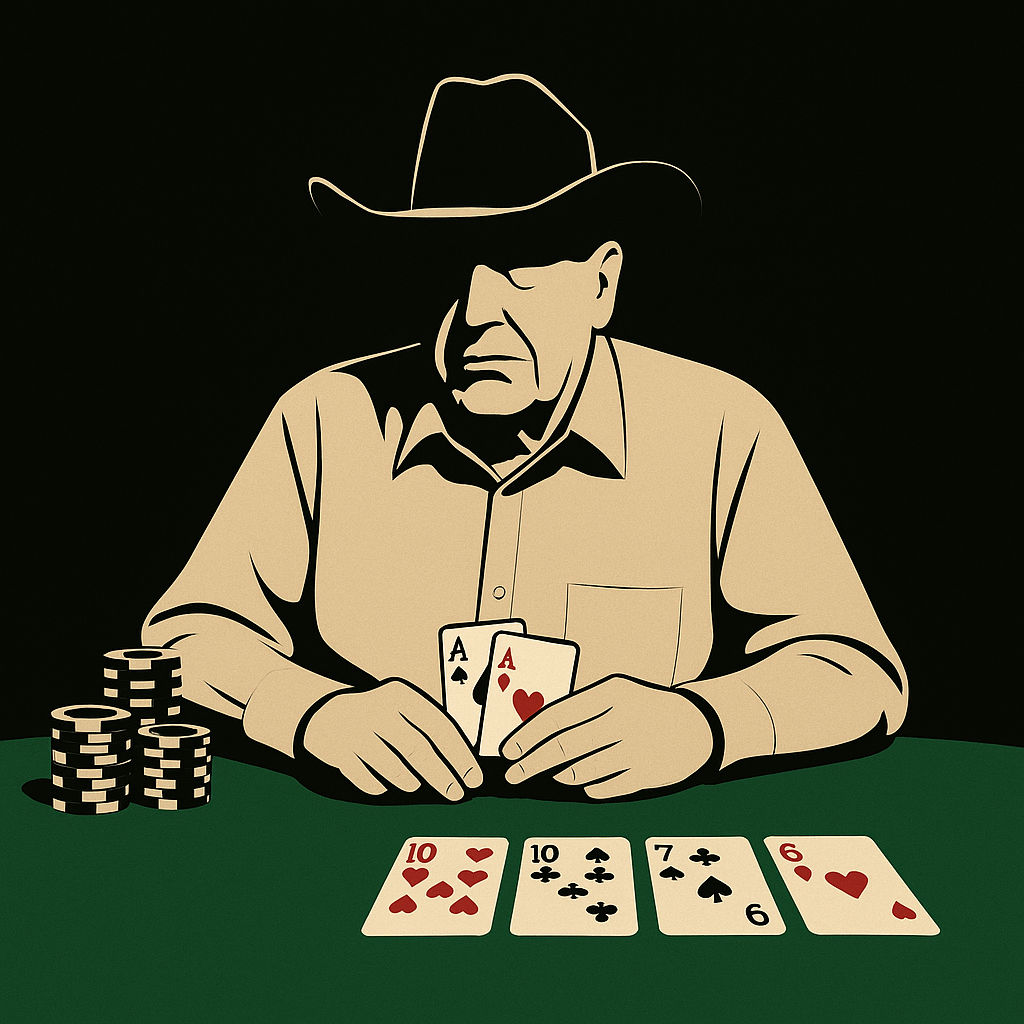
Top Hands Featuring Doyle Brunson in Hold’em

Doyle “Texas Dolly” Brunson won an astonishing 10 WSOP bracelets over his legendary career, including back-to-back Main Event championships in 1976 and 1977—both won with the same unlikely hand, 10-2, which became permanently known as the “Doyle Brunson hand.” His documented career earnings exceed $6.1 million in tournaments alone, with his greatest wealth accumulated through high-stakes cash games where he won individual pots exceeding $800,000. From witnessing murders in Texas road gambling games to bluffing Phil Hellmuth at age 89, Brunson’s winning hands span seven decades and define poker’s evolution from illegal backrooms to televised spectacle.
The Legendary 10-2 Championship Hands Created Poker History
The most famous hands in poker history occurred during Brunson’s consecutive WSOP Main Event victories, both won with 10-2 making the identical full house. In 1976, facing Jesse Alto’s A♣J♥ with his 10♠2♠, Brunson watched the flop deliver A♥J♠10♥, leaving him severely behind Alto’s two pair. Despite being a 10-to-1 underdog, Brunson pushed all-in with the chip lead as an intimidation play. The turn brought the 2♣ and the river the 10♦, completing his miracle full house—tens over deuces—for the $220,000 championship.
The following year proved even more improbable. In the 1977 final against Gary “Bones” Berland, Brunson held 10♣2♥ (offsuit this time) against Berland’s 8♥5♣. The flop came 10♦8♠5♥, again putting Brunson behind with just top pair against Berland’s two pair. Both players slow-played the flop before the 2♣ on the turn gave Brunson the lead with two pair. When Berland check-raised all-in on the turn, Brunson instantly called. The river delivered another 10♣, creating the exact same winning hand—tens full of deuces—for $340,000.
Mathematical Miracle
The odds of winning two consecutive Main Events with the same weak starting hand, making identical full houses both times, remain virtually incalculable. Professional mathematicians estimate the probability at less than 1 in 100 million when accounting for all variables.
These victories transformed 10-2 from one of poker’s worst starting hands (winning only 35% against random cards) into its most legendary. Following Brunson’s death in May 2023, the poker community established October 2nd as “Doyle Brunson Day,” with card rooms worldwide encouraging players to play the hand in tribute. Brunson himself acknowledged the hand’s weakness, admitting during the 2003 WSOP when he played it: “I just couldn’t help myself.”
Eight Additional WSOP Bracelets Showcase Unmatched Versatility
Beyond his Main Event triumphs, Brunson demonstrated remarkable versatility by winning eight more bracelets across multiple poker variants between 1976 and 2005. His 1976 Deuce-to-Seven Draw victory for $80,250 actually preceded his first Main Event title that same year, establishing his dominance from the start. The 1977 season proved extraordinary as Brunson captured three total bracelets, including a memorable heads-up victory over future poker theorist David Sklansky in Limit Seven-Card Stud Hi-Lo for $52,500.
| Year | Event | Prize Money | Field Size |
|---|---|---|---|
| 1976 | Deuce-to-Seven Draw | $80,250 | 16 |
| 1976 | Main Event | $220,000 | 22 |
| 1977 | Main Event | $340,000 | 34 |
| 1977 | Seven-Card Stud Split | $62,500 | 13 |
| 1978 | Seven-Card Stud | $68,000 | 17 |
| 1979 | Mixed Doubles | $4,500 | 9 teams |
| 1991 | $2,500 No Limit Hold’em | $208,000 | 207 |
| 1998 | Seven-Card Razz | $93,000 | 155 |
| 2003 | H.O.R.S.E. | $84,080 | 81 |
| 2005 | $5,000 6-Handed NLHE | $367,800 | 301 |
During his peak years from 1976-1979, Brunson accumulated six bracelets in four years, showcasing mastery across Stud, Hold’em, and Draw variants. His wins included the unusual 1979 Mixed Doubles Seven Card Stud with partner Starla Brodie, one of the few mixed doubles events in WSOP history.
His final bracelet came in 2005 at age 71, winning the $5,000 No Limit Hold’em 6-Handed event for $367,800 against a field of 301 players—his largest tournament field victory. The final hand proved poetic: holding 10♠3♦, which he mistakenly thought was 10-2, Brunson pushed all-in against Minh Ly’s K♥Q♦. When a three appeared on the flop, his pair held for the victory. “I thought it was the 10-2,” Brunson admitted at the table, demonstrating how deeply the legendary hand remained embedded in his consciousness even decades later.
High-Stakes Cash Games Produced Million-Dollar Swings
Brunson’s greatest financial success came through high-stakes cash games, particularly in Bobby’s Room at the Bellagio, where he regularly played $4,000/$8,000 limit mixed games against the world’s elite. His largest televised pot occurred on High Stakes Poker Season 4, winning $818,100 from Cirque du Soleil founder Guy Laliberte.
Holding A♦10♦ against Laliberte’s A♥5♥, Brunson navigated the A♣J♠4♦ flop expertly, firing $40,000 into the $57,100 pot. When the 2♦ turn brought Brunson the nut flush draw, Laliberte attempted a massive check-raise from $110,000 to $310,000, but Brunson jammed for $340,500 total. They ran it twice, with Brunson winning both runouts for the entire pot.
High Stakes Poker Dominance
Throughout seven seasons of High Stakes Poker, Brunson accumulated $538,150 in profits, ranking fourth all-time behind only Tom Dwan, Johnny Chan, and David Benyamine. His appearances showcased strategic mastery even into his 80s.
A memorable $352,700 pot against Daniel Negreanu showcased Brunson’s fearless style, where his pocket aces miraculously held against Negreanu’s flopped set of eights. The hand became legendary when Negreanu later analyzed it on YouTube, discussing the board texture that led to Brunson’s surprising all-in with just an overpair.
Texas Road Gambling Shaped a Legendary Career
Brunson’s poker journey began in the dangerous illegal games of 1950s Texas, where violence and death were commonplace. During his first year as a professional, he witnessed a player shot point-blank in a Fort Worth pool hall: “His brains seemed to splatter all over the wall,” Brunson recalled. The game resumed within hours.
His most famous early session occurred on Jacksboro Highway (“Bloodthirsty Highway”), Fort Worth’s notorious red-light district, where he played a five-day marathon of No Limit Ace-to-Five against a slaughterhouse worker named Virgil. After Brunson won a crucial pot, Virgil suffered a fatal heart attack reaching for his winnings. “After the paramedics took him away, the game resumed and we played another 24 hours,” Brunson noted, describing the cold-blooded nature of that era’s players.
Partnering with Thomas “Amarillo Slim” Preston and Bryan “Sailor” Roberts, Brunson formed the legendary Texas Rounders, traveling throughout Texas, Oklahoma, and Louisiana seeking wealthy “fish”—oil men and businessmen. They accumulated a six-figure bankroll over six years before attempting Las Vegas.
The 10-2 Hand Transcends Mathematics to Become Poker Legend
The cultural impact of Brunson’s signature hand extends far beyond his championship victories, transforming 10-2 from mathematical weakness into poker’s most famous symbol of improbable triumph. Professional players regularly show their 10-2 hands as tribute when playing near Brunson’s legacy, while recreational players deliberately play it “out of sentiment” despite knowing its statistical inferiority.
Phil Galfond once lost a significant pot trying to impress Brunson by playing 10-2 aggressively against Daniel Negreanu, sheepishly explaining afterward: “I was trying to impress Doyle…”
Statistical analysis confirms 10-2’s weakness—it cannot make a straight using both cards, creates only a 10-high flush when suited, and wins merely 35% of hands against random holdings. Yet this mathematical poverty makes Brunson’s achievements more remarkable. Modern poker educators use these victories to teach about “results-oriented thinking,” demonstrating how good outcomes don’t always stem from good decisions.
Memorable Bluffs and Strategic Masterclasses
Brunson’s final televised appearance came at the December 2022 WPT World Championships at age 89, where he executed a masterful king-high bluff against Phil Hellmuth. Holding K♣J♣ on an A♣8♥10♠2♥5♥ board, Brunson jammed $25,600 into a $20,600 pot. Hellmuth tanked for several minutes with A♦Q♥ (top pair, good kicker) before folding, later joking about being “bluffed by Doyle across four decades.”
This hand perfectly encapsulated Brunson’s fearless aggression that defined his seven-decade career. Even approaching 90, he maintained the strategic acumen and psychological warfare that made him legendary.
The Enduring Legacy of Texas Dolly
Doyle Brunson’s documented winning hands span from witnessing murders in 1950s Texas road games to executing sophisticated bluffs on television at age 89, encompassing poker’s entire modern evolution. His 10 WSOP bracelets, including the miraculous back-to-back Main Event victories with 10-2, established records that define championship poker.
The $818,100 pot against Guy Laliberte remains among television poker’s largest, while his consistent success in Bobby’s Room’s $4,000/$8,000 games generated his greatest wealth. Beyond statistics and prize money, Brunson’s legacy lives through the 10-2 hand—poker’s permanent reminder that in a game demanding mathematical precision, human courage and improbable luck can still create legends.
Key Takeaways: Doyle Brunson’s Greatest Hands
- 1976-1977: Won consecutive WSOP Main Events with 10-2, making identical full houses both times
- 10 WSOP Bracelets: Spanning multiple variants from 1976 to 2005, demonstrating unmatched versatility
- $818,100 Pot: Largest televised win against Guy Laliberte on High Stakes Poker
- October 2nd: “Doyle Brunson Day” celebrates his legacy with the 10-2 hand
- Seven Decades: Career spanned from 1950s Texas road games to televised poker at age 89
- $6.1 Million: Tournament earnings, with far greater wealth from cash games
Master Texas Hold’em Strategy
Ready to improve your Hold’em game? Explore our comprehensive guides:
Frequently Asked Questions
About the Author

Mixed Game Masters Editorial
Published: April 13, 2026 | Categories: Poker History, Texas Hold’em
Mixed Game Masters is the premier resource for non-Hold’em poker strategy, tournament coverage, and mixed game education. Our editorial team consists of experienced players and poker historians dedicated to preserving and sharing the rich history of poker’s most challenging variants.
We provide comprehensive coverage of stud games, lowball variants, and mixed game formats, helping players of all levels improve their skills beyond traditional No-Limit Hold’em.
Leave a Reply