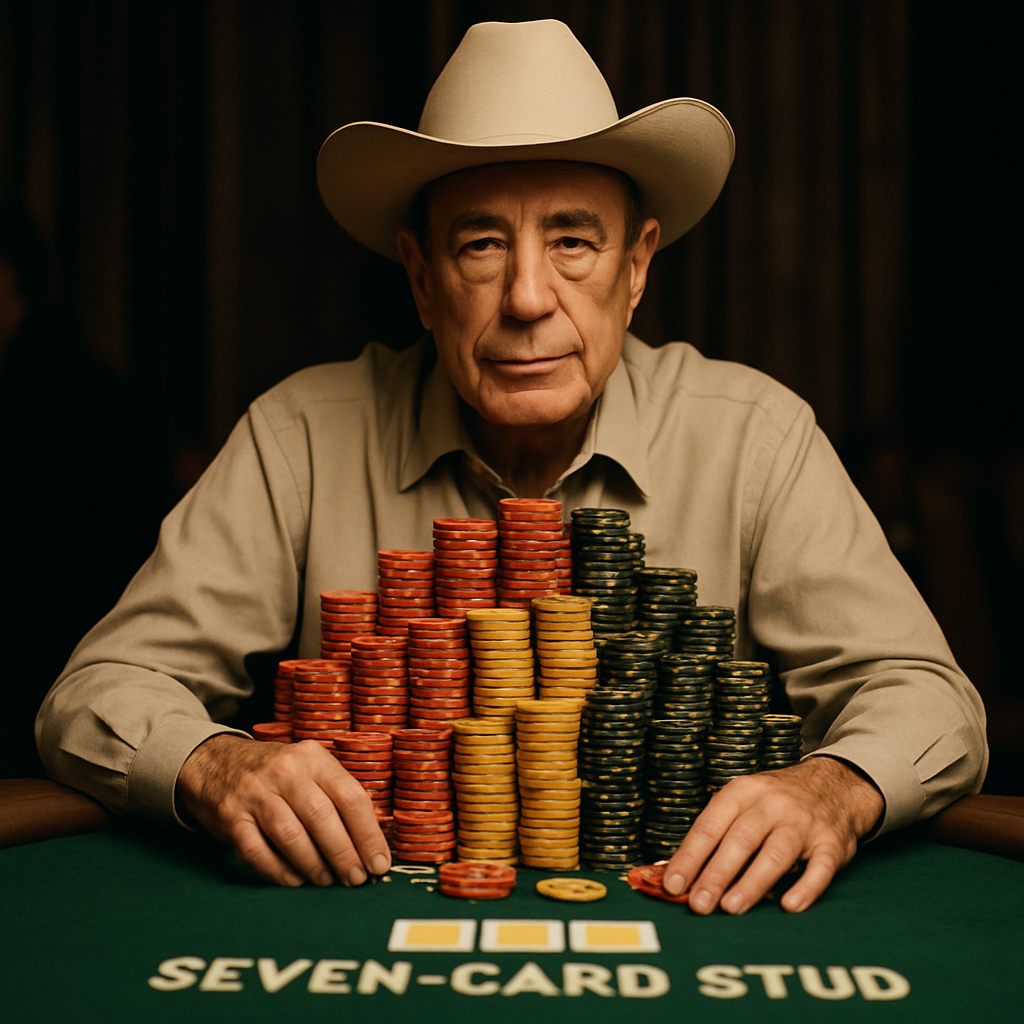
Chip Reese History: Dominance in Seven Card Stud High

David “Chip” Reese stands alone as the greatest Seven Card Stud player who ever lived, building a fortune that began with a $60,000 Vegas detour on his way to Stanford Law School. His 2006 victory in the inaugural $50,000 H.O.R.S.E. Championship at age 55 cemented a legacy spanning three decades of dominance in the highest-stakes cash games ever played, earning him posthumous immortalization through the trophy that bears his name. Today, every champion who lifts the David “Chip” Reese Memorial Trophy connects with the gold standard of what it means to master Seven Card Stud strategy and mixed games.
Key Takeaways
- 1974 Vegas Detour: Won $60,000 at the Sahara Casino, accumulated $100,000 by September, never attended Stanford Law
- WSOP Success: Three bracelets (1978, 1982, 2006) with $3,999,090 in tournament earnings
- Cash Game Legend: Co-founder of “The Corporation” that battled Andy Beal at $100,000/$200,000 stakes
- 2006 H.O.R.S.E. Victory: Won $1,784,640 after 7-hour heads-up battle lasting 286 hands
- Hall of Fame Pioneer: Youngest living inductee at age 40 in 1991
- December 4, 2007: Died at age 56; WSOP named championship trophy in his honor
From Ivy League to Vegas: The $60,000 Detour
Born March 28, 1951, in Centerville, Ohio, Reese’s path to poker greatness began with an unlikely childhood setback. At age five, rheumatic fever confined him to bed for nearly a year, during which his mother and great-grandmother taught him card games. By age six, he was beating fifth-graders at poker for their baseball cards. This early immersion in strategic thinking would shape a career that redefined poker excellence through mathematical precision and psychological mastery.
Reese’s academic credentials were impeccable. At Dartmouth College, where he majored in economics and graduated in 1973, he earned roughly $4,000 playing poker during his freshman year alone—equivalent to his annual tuition. The Beta Theta Pi fraternity permanently honored him by naming their card room the “David E. Reese Memorial Poker Room,” complete with a plaque listing 15 names of people who had lost money to him.
The summer of 1974 changed everything. Driving to Stanford Law School with $400 in his pocket, the 23-year-old stopped in Las Vegas to visit a friend. After losing his stake at blackjack, he rebuilt through low-limit Seven Card Stud games, eventually entering a $500 tournament at the Sahara Casino. His victory netted between $40,000 and $60,000 (source). By September, he had accumulated over $100,000. Within two years, his bankroll exceeded $1 million.
Seven Card Stud Supremacy Through Mathematical Mastery
Reese’s dominance in Seven Card Stud was absolute. His two earliest WSOP bracelets came in Stud variants—the 1978 Seven Card Stud Split for $19,200 and the 1982 $5,000 Limit Seven Card Stud for $92,500. Doyle Brunson, who once lost $6 million to Reese, called him “the best seven-card stud player I’ve ever played with” and specifically recruited him to write the Seven Card Stud chapter for Super/System, poker’s best-selling instructional book.
What separated Reese from other elite players was his fusion of mathematical precision with psychological warfare. His economics background from Dartmouth enabled him to calculate pot odds and probabilities in real-time while maintaining what Mike Sexton described as extraordinary consistency: “When they are on their A game they are all fantastic players, some probably better than my A game. The thing is, my D game isn’t much different than my A game” (source). Reese never tilted, never steamed, never let emotion cloud his judgment.
His strategic innovations in Seven Card Stud third street play included superior card-tracking abilities, pattern recognition that allowed him to read opponents’ tendencies with uncanny accuracy, and an understanding that respecting losing opponents ensured they’d return to play again. In one famous instance, after a tourist beat him for $30,000 in 30 minutes, Reese graciously let the man leave, telling Sexton: “That’s why I’ve got all the money. That guy was treated with respect and he’ll be back.”
The Corporation, Bobby’s Room, and Battles with Billionaires
Reese was a cornerstone of “The Big Game” at Bellagio’s Bobby’s Room (later renamed Legends Room), where stakes regularly reached $4,000/$8,000 limit and higher. Phil Ivey and Reese are considered among the biggest lifetime winners in these legendary games. The regular lineup read like a Hall of Fame roster: Doyle Brunson, Barry Greenstein, Johnny Chan, Jennifer Harman, Daniel Negreanu, and other elite professionals featured in our mixed games legacy profiles.
Perhaps most famously, Reese was a founding member of “The Corporation,” an elite group that pooled bankrolls to take on billionaire Andy Beal in what became poker’s most legendary heads-up matches. These games reached astronomical stakes of $100,000/$200,000, representing some of the highest-stakes poker ever played (source). The original Corporation included Brunson, Reese, Harman, Howard Lederer, John Hennigan, Chau Giang, and David Grey—a dream team assembled specifically to combat Beal’s enormous bankroll advantage.
| Year | Achievement | Prize/Significance |
|---|---|---|
| 1974 | Sahara Casino Tournament Victory | $40,000-$60,000 (never attended Stanford Law) |
| 1978 | First WSOP Bracelet (7-Card Stud Split) | $19,200 |
| 1982 | Second WSOP Bracelet ($5K Limit Stud) | $92,500 |
| 1991 | Poker Hall of Fame Induction | Youngest living inductee at age 40 |
| 2006 | $50,000 H.O.R.S.E. Championship | $1,784,640 (inaugural event) |
| 2008 | Trophy Named in His Honor | David “Chip” Reese Memorial Trophy |
The Rivalry That Defined an Era: Reese versus Ungar
While Stu Ungar possessed arguably the most natural talent in poker history, Reese represented the philosophical opposite. When Mike Sexton asked if Ungar was the best No Limit Hold’em player ever, Reese’s response revealed his fundamental approach to the game: “Maybe. But it doesn’t matter. He never understood the object of the game… To me, the object of the game was to continually grow your wealth, continually improve your lifestyle, and take care of your family.”
This contrast between disciplined excellence and self-destructive genius defined their era. While both men possessed extraordinary abilities, Reese’s approach led to sustained success, family stability, and universal respect, while Ungar’s path ended tragically. Their rivalry showcased two divergent philosophies of what poker mastery meant, much like the contrasts explored in our poker legends history series.
The $50,000 H.O.R.S.E. Triumph That Crowned a Legend
Reese had largely retired from tournament poker to focus on lucrative cash games, but returned in 2004 at his children’s request so they could watch him on television. His comeback culminated in the 2006 inaugural $50,000 H.O.R.S.E. World Championship, the first WSOP event with a buy-in exceeding $10,000.
The final table represented three generations of poker excellence: Doyle Brunson, Chip Reese, and Phil Ivey. The heads-up battle against MIT graduate Andy Bloch lasted a record-setting seven hours and 286 hands (source), with Reese ultimately prevailing when his A♣Q♠ held against Bloch’s 9♠8♠ on a J♦7♥7♠4♦4♠ board. The $1,784,640 first prize represented his largest tournament score, but more importantly, it validated his status as poker’s greatest all-around player in the H.O.R.S.E. mixed game format.
Tournament Excellence Beyond the Felt
Despite being primarily a cash game specialist, Reese’s tournament record was exceptional:
- 3 WSOP bracelets spanning three decades (1978, 1982, 2006)
- $3,999,090 in total tournament earnings
- 64 career cashes over 30 years
- 20+ WSOP cashes (WSOP DB lists 25) with 4 runner-up finishes (WSOP profile)
These statistics barely scratch the surface of his poker earnings. Conservative estimates suggest he won several million dollars annually during his prime years in cash games. His other notable victories included the 1982 Amarillo Slim’s Super Bowl of Poker Deuce-to-Seven Lowball for $84,000.
What the Legends Said About the Legend
The poker community’s assessment of Reese’s abilities was virtually unanimous. Doyle Brunson called him “unquestionably the greatest game player of all time” at his funeral. Mike Sexton declared him “the greatest all-around poker player that ever lived, especially when it came to playing multiple games.” Daniel Negreanu dubbed him “The True King of Poker” after his 2006 H.O.R.S.E. victory.
Barry Greenstein provided perhaps the most telling insight: “He was a family man like no one else in poker. No matter what the situation was, if his kids had something going on—a baseball game, a recital, whatever—he would quit to go to it” (source). The most famous example: Reese once left a game while down $700,000 to attend his son’s Little League game.
Hall of Fame Pioneer and the Rule That Bears His Name
In 1991, at age 40, Reese became the youngest living player inducted into the Poker Hall of Fame, a record that stood until Phil Hellmuth’s induction in 2006. His induction at precisely 40 later inspired the “Chip Reese Rule,” implemented in 2011, requiring Hall of Fame nominees to be at least 40 years old.
The WSOP permanently honored his legacy by naming the $50,000 Poker Players Championship trophy the “David ‘Chip’ Reese Memorial Trophy” beginning in 2008. The trophy features his winning hand from the 2006 H.O.R.S.E. victory, ensuring every future champion receives a reminder of the standard Reese set for all-around poker excellence.
The Sudden Farewell That Shocked Poker
On December 4, 2007—coincidentally his father’s birthday—Chip Reese died in his sleep at his Las Vegas home at age 56. He had complained of flu-like symptoms and been diagnosed with pneumonia the night before. His son Casey discovered him the next morning. Las Vegas Mayor Oscar Goodman declared December 7, 2007, as “David ‘Chip’ Reese Day.”
Frequently Asked Questions
Chip Reese represented poker perfection through a unique combination of mathematical brilliance, emotional control, and respect for both the game and its players. His dominance in Seven Card Stud remains unmatched, his cash game success legendary, and his influence on poker strategy enduring. The David “Chip” Reese Memorial Trophy stands as more than a prize; it represents an ideal of what a poker champion should be—proof that the greatest gamble of all was the one he took in 1974 when he chose poker over law school, a decision that earned him immortality in the game he mastered like no one before or since.
Leave a Reply